Children and adults pedalling to school, work and play — this was a common sight on Pune’s streets not so long ago. Once known for its vibrant cycling culture, the city still has many groups and communities that promote non-motorised transport. However, with the rise of motorised vehicles, cycling has not only taken a back seat, but has also become unsafe and inconvenient due to poor infrastructure. This is despite Pune having dedicated cycle tracks and lanes.
The decline in cycling infrastructure is reiterated by a recent audit, which found that only 11% of cycle tracks in Pune fell in the ‘good’ category.
Parisar, an NGO working in the field of sustainable urban transport, has released a report of an audit of bicycle tracks in Pune. The audit took place from April 2024 to March 2025 and assessed 83 kilometres across the city. Trained surveyors participated in the auditing process, documenting their observations and interacting with local cyclists.
The last such audit was carried out by Parisar in 2011. Unfortunately, the results of the latest audit show that not a lot has changed since then. This is significant as Pune is promoting cycling by hosting the Grand Tour, an international cycling competition, in 2026.
With the metro, Punekars have another mode of transport. However, last-mile connectivity is still a challenge: a gap that can be filled by cycling, provided there are good cycle tracks and lanes. So, what are the results of the audit?
Read more: No city for cyclists: Enthusiasts decry lack of road safety
Findings of the audit
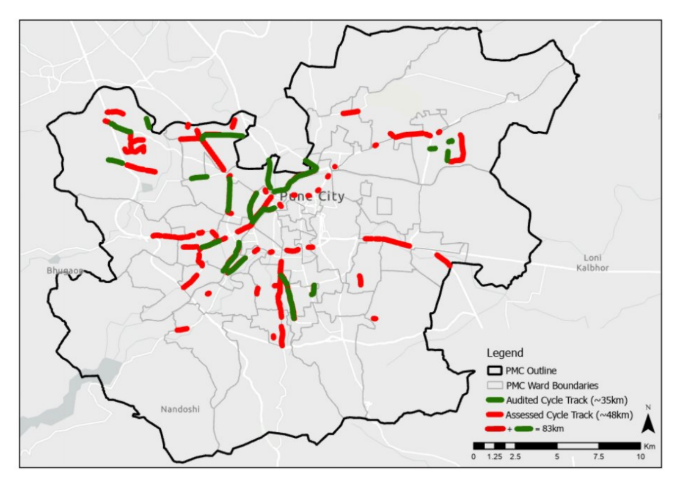
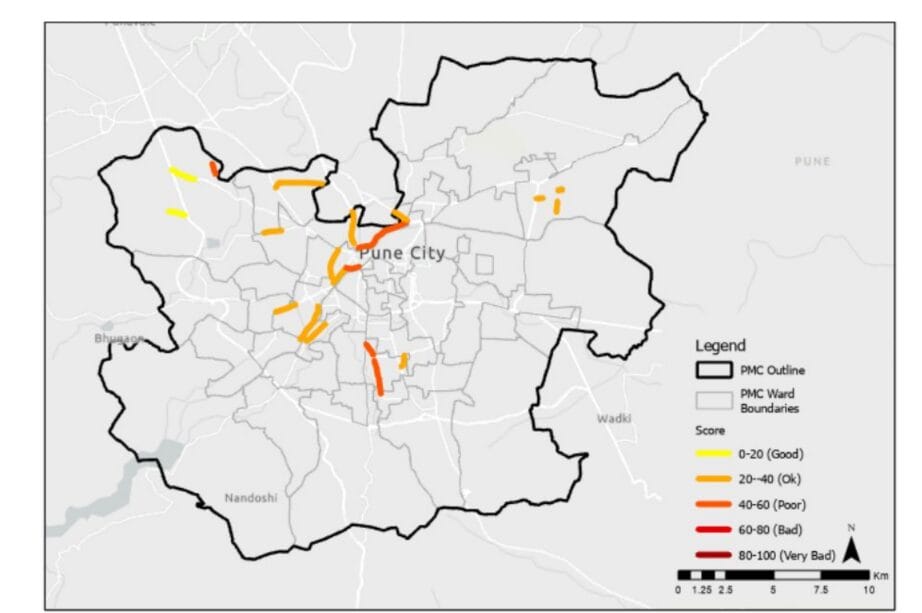
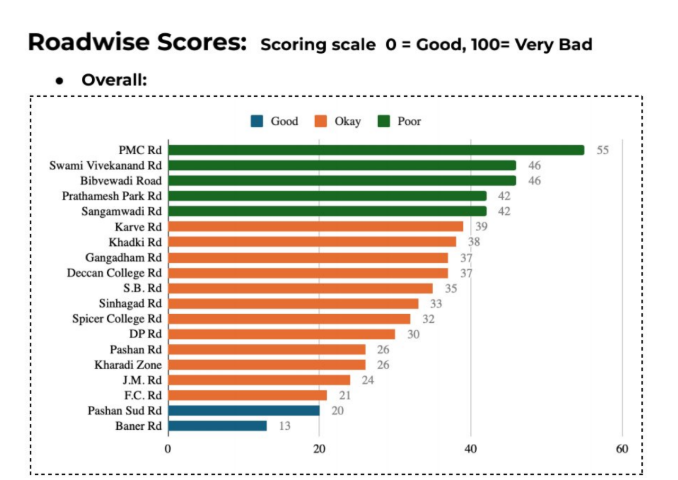
A total of 35 kilometres of functional cycle tracks were audited by dividing them into segments of 500 metres. The process covered 77 such segments across 19 roads. The audit was designed to check three parameters: safety, comfort, and continuity. Safety entailed criteria like a buffer zone, light after dark, and traffic calming devices. Continuity was checked for factors like missing ramps and signage, and the number of obstructions. And finally, comfort covered points such as shade and the quality of the track surface.
The scores given to roads under these three parameters have been combined to arrive at a final score. Based on this score, only 11% of cycle tracks are in the ‘good’ category. 61% are classified as ‘okay’, which means that though tracks are there, they do not meet high standards. Further, 28% are ‘poor’, indicating grave infrastructural gaps.
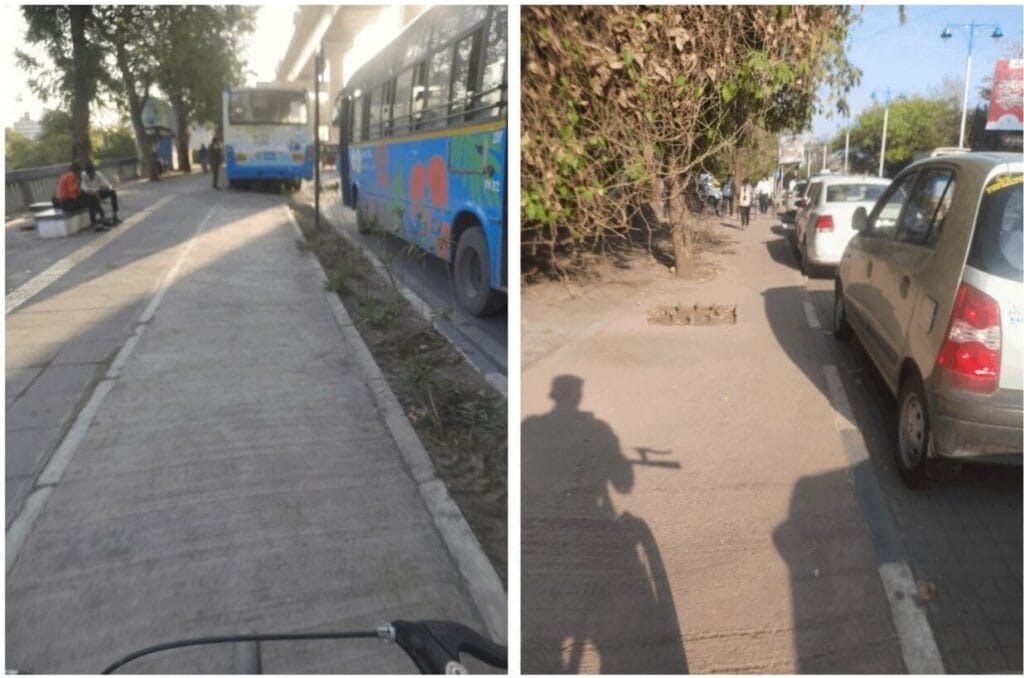
In the individual category scores, continuity fared better than comfort and safety, with 11 out of 77 segments scoring ‘good’, and eight scoring ‘okay’. This implies that tracks exist, but the safety of riders is uncertain. Moreover, their comfort is also brought into question.
The audit found that Baner Road was the safest for cyclists, followed by Deccan College Road. Baner Road is also more comfortable compared to other tracks; it has the potential to be a model cycling corridor. Whereas, Fergusson College Road and Jangli Maharaj Road got a high continuity score, because they were mostly free of obstructions.
Read more: Better mobility design can encourage the use of public transport, cycling and walking
Comprehensive Bicycle Plan: Only on paper?
Parisar’s earlier audit paved the way for the creation and adoption of the Comprehensive Bicycle Plan (CBT). Pune became the first city in India to adopt a plan of this nature in 2017. The CBT acknowledges that Pune lacks a robust cycling infrastructure and the need for it to promote non-motorised transport (NMT). It also accepts that cycling as a mode of transport has dropped from 27% in the 1980s to 3%.
Although the number is small at 3%, it is half the number of car trips at 5.5% and a little less than autorickshaw use at 4%. This is a clear indication that people want to use cycling as a mode of transport. Most significantly, according to the plan, 90% of people are willing to shift to cycling, provided there is good infrastructure which ensures the safety of riders. In fact, the CBT notes that the number of accidents has increased due to a rise in motorised transport and a lack of segregated cycle lanes.
On paper, the CBT seems like a well-thought-out, albeit ambitious plan. But practical implementation has failed. Tanzeel Allapur, Project Associate at Parisar, says, “When the Pune Comprehensive Bicycle Plan was released, immediately after that, a Bicycle Department was made in the Pune Municipal Corporation. But that was also discontinued. The NMT committee was an active member in that bicycle department as well.” She explains that though the NMT committee is very eager to work, their interactions with the PMC have decreased significantly.
The CBT also refers to the Smart City Mission, which highlights the use of NMT as one of its goals, aiming to increase it to 8% from the current 1%. “There is definitely some work done under the smart city works, for example, there is an ITI road which is on the Aundh Road, which is supposed to be a very model road. There’s a wide footpath, there is space for walking, there’s space for cycling, there’s space for people to sit around and also engage with any activities that they would want to,” says Tanzeel.
However, she points out that even on this road, the cycle track is level with the footpath, with no significant segregation between the footpath and the track. Moreover, it has not been painted in a different colour. This can lead to a conflict between the pedestrians and the cyclists. Moreover, there are utilities on the footpath.
Read more: “Need a mindset change in how people see commute in cities” – Shilpi Sahu, Cyclist
Cycling to school: Making it safe for students
The Roads Department of the PMC has initiated a School Travel Implementation Plan (STIP). The programme aims to ensure that school-going children of all ages and abilities have access to safe travel by demarcating school zones. Moreover, its goal is to implement sensitively planned design interventions to achieve this. One of the key action points in this plan is to promote cycling in schools by declaring a ‘Cycle Day’ and providing dedicated parking for cyclists.
The STIP also has guidelines on having good pedestrian pathways or cycle tracks around schools, explains Tanzeel. She adds, “If the STIP and Pune Cycle Plan or the city plan for the cycling tracks is integrated, then the school improvement zone does not remain only a school improvement zone. The students can travel far and wide and have independent mobility in the city, and not just around the school areas.”
According to Tanzeel the work of identifying where cycle tracks or lanes can be built, and how to turn them into an interconnected network has already been done in the city. All that remains is for the local administration to implement it with the seriousness it deserves. At one time Pune was known as a city of cyclists. For it to win back that sobriquet, the PMC has to diligently implement the CBT.
You can find the Parisar audit report here.
| Recommendations made in the audit report: 1. Build a continuous, citywide cycling network. 2. Design upgrades and clear markings. 3. Bring about behavioural change through design. 4. Strengthen governance and enforcement. 5. Have user engagement and citizen feedback systems. 6. Establish safe school zones. 7. Integrate the cycling network with Pune Metro. 8. Establish the Pune Cycle Partnership (PCP). 9. Leverage credit notes and PPP models. 10. Focus on high-priority growth areas. |