This is the second in our series of Cycle2Work interviews from men and women employed in diverse sectors. The series will bring to you stories of these green commuters who cycle to work. We hope that these stories will inspire and encourage more Bengalureans to cycle, and not drive, to work’
Karthik Ranganathan is an engineer with Texas Instruments in Bengaluru and has been cycling to work for over 10 years. “I started cycling in 2011 and found no reason why I should not cycle to work”.
Karthik finds cycling saved lot of commute time and events like annual cycle to work day, free cycle repair workshops and one-day rental events at his workplace encouraged more colleagues to cycle to work.
Excerpts from the interview:
How did you start cycling to work, what was your motivation
Around 2011 when I came back from Dallas, I was introduced to a colleague who used to cycle to work. I brought my cycle along when I moved, and I found no reason not to cycle to work in Bengaluru.
The cycle is the first vehicle to freedom. I always loved to cycle during my childhood.
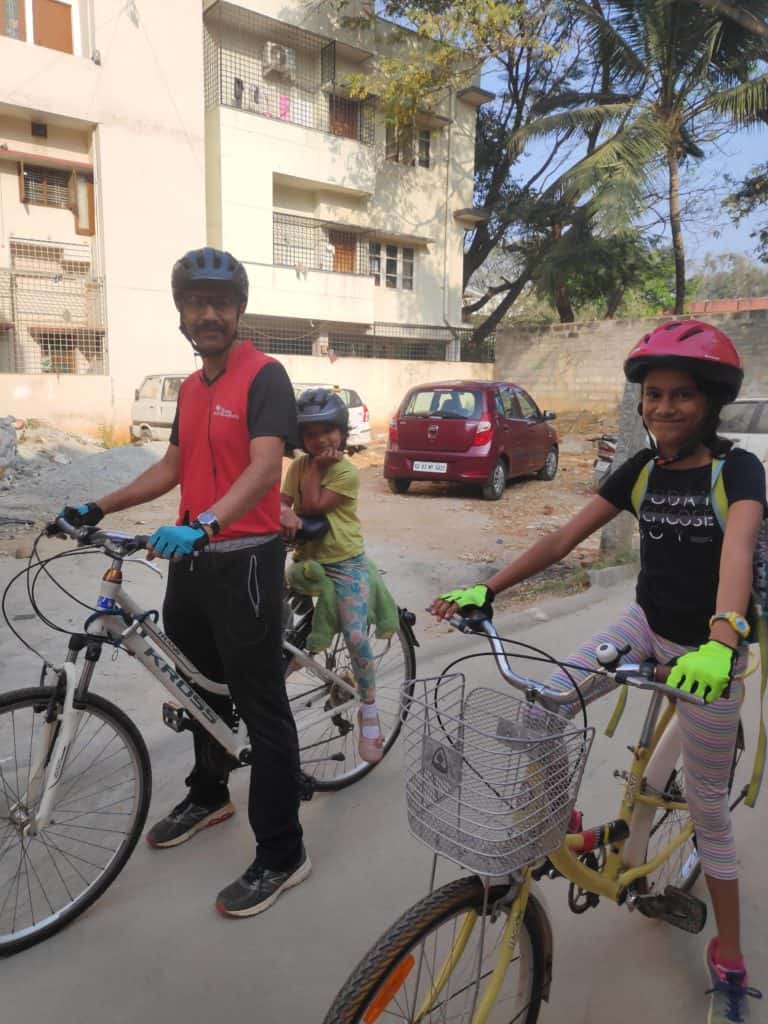
How did you make cycling for commute part of your lifestyle?
First, I successfullychallenged myself to avoid commuting via motorcycle for one month. I used to cycle 3-4 days a week before the challenge but used to find one reason or another to take the motorcycle for work commute.
This challenge pretty much convinced me that riding around on a cycle is actually a lot less painful than riding a motorcycle, especially during peak traffic hours.
Cycling to work doesn’t lose you time in a city like Bengaluru, and during a traffic jam, you can always carry your cycle onto the pavement.
I also moved closer to my workplace—initially, I lived 6km away, but now I live just 2-3km from the office.
Read more: “Need a mindset change in how people see commute in cities” – Shilpi Sahu, Cyclist
Your thoughts on the new cycling lanes in the city
I live near Indiranagar and my office is near CV Raman Nagar. I have not used cycling lanes since they are not present in my area. There are more cycling lanes in Outer Ring Road.
I see them as a big plus. I hear from many cycling friends who share stories that motorcyclists don’t respect cyclists on the road. We need to have more cycling lanes in the city. It would be great if they are publicised more by advertising on hoardings, talking on media and the radio. The city should make more noise about cycling lanes.
How does your company support cycle to work
We have a strong cycling community in our company. We have dedicated lockers, showers, and a covered parking lot for cycles.
We have an annual bike to work day in the May to encourage as many people as possible to cycle to work. We used to give T-shirts and free breakfast on that day.
We arrange free cycle check-up workshops regularly and used to invite notable cycling celebrities in the city to come and do sessions every year at our office.
We also organise one-day rentals at our workplace with local vendors so that our employees can try models which fit them.
What other events did you find successful at the workplace to encourage more colleagues to commute by cycle
I found one event very successful. We as a cycling group at our workplace used to make our cycles available for a couple of hours to our colleagues as an open house event.
A lot of colleagues including women employees used to attend these events, test ride our bicycles, and clear their doubts about cycling to work. There are many colleagues who bought bicycles after such events.
Read more: ORR Cycle Lane: Do cyclists benefit at all?
Your suggestions for people who are looking to cycle to work
I suggest prioritising safety. Personally, any time I step out to cycle, whatever the time of the day, I don’t step out without riding glasses, gloves, and helmet. These three are non-negotiable accessories.
- Whenever someone buys a cycle, they should buy a helmet and gloves.
- Be aware of yourself on the road and know the road you use well.
- Use a carrier attached to the cycle to make your commute easy.
- Most of us change phones every two years and spend at least Rs 15000 on it. I advise new buyers to set aside a similar amount for a cycle. Cycling gives you good health and reduces the cost of commuting.
[This article is part of the series of Cycle2Work interview series, a project of Global Shapers Bangalore Hub, which is part of the Global Shapers Community, an initiative of the World Economic Forum]
Some parts of Bangalore are too dangerous to ride on cycle because of the pollution.