They paved paradise and put up a parking lot/ With a pink hotel, a boutique, and a swinging hot spot.
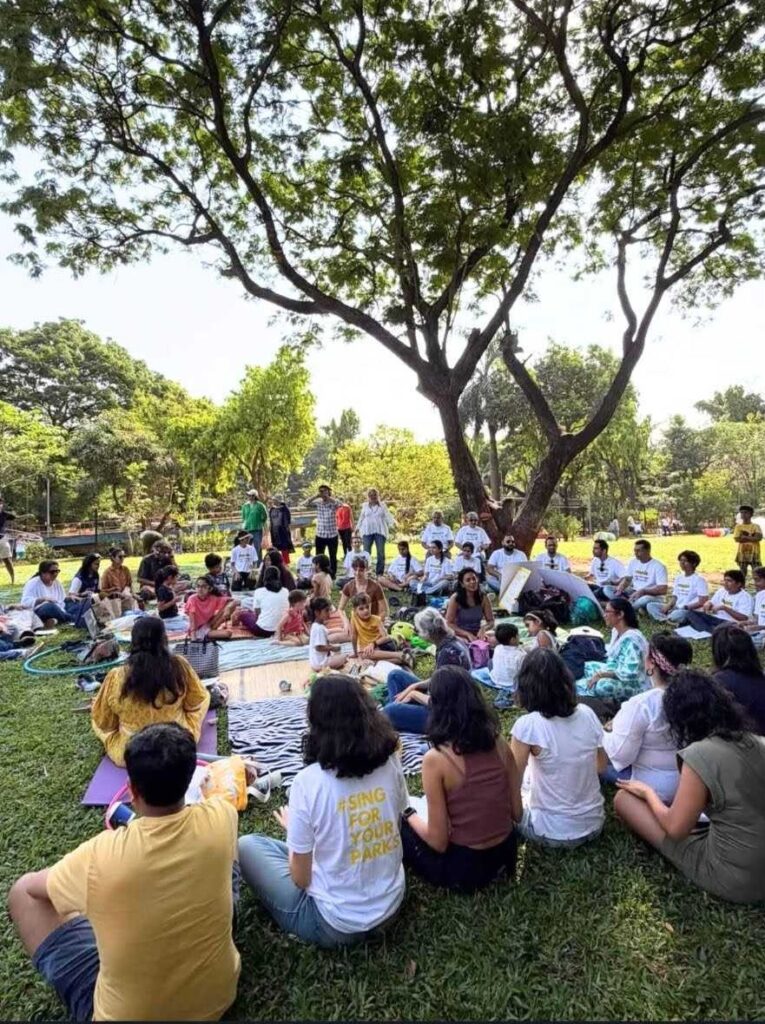
These words of the Joni Mitchell classic Big Yellow Taxi filled a corner of Pushpa Narsee Park in Juhu on a bright Sunday morning in March. Though the song was released in 1970, the words resonate in 2026, especially for this park. There have been several attempts to convert Pushpa Narsee Park into a parking lot, only foiled by the vigilance of the locals, says Anca Florescu Abraham, co-founder of Love Your Parks Mumbai (LYPMumbai). This initiative advocates for the better use of open spaces, particularly parks, in Mumbai.
At this community gathering put together by LYPMumbai, members of a local choir, Rising Voices, performed for an audience spanning diverse age groups. As the morning proceeded, people joined the choir in singing, there were children playing board games, using the hula hoop, climbing trees, munching on snacks, and listening to stories being read for them. Petra Misquita, the director of Rising Voices, appreciates the way parks become democratic, vibrant, active community spaces when used this way.
The roots of LYPMumbai
In Mumbai, as built areas are increasing, open spaces are shrinking. NAGAR, in collaboration with UDRI, carried out a study of the demarcated open spaces according to the Development Plan in two of the densest wards in Mumbai, P-North (Malad) and K-West (Andheri West). It showed that only 30% of the public open spaces are accessible. This is particularly concerning as Mumbai is experiencing heat waves each summer in the past couple of years. Shaded areas, green spaces can offer some respite from the rising mercury, particularly for people who work outdoors.
According to the BMC’s Environment Status Report 2024-25, Mumbai has 325 gardens, 480 recreation grounds, and 369 playgrounds. But access still remains limited as Anca found out in 2018 when her children were toddlers.
Her experiences in parks left her frustrated and puzzled by the restrictions on how citizens are allowed to use public spaces. Incidents such as park watchmen preventing her children from walking or playing on the grass, climbing trees, or even eating a snack prompted her to start LYPMumbai. “The idea behind it is that people should connect with their local parks,” says Anca.
The first event they did in 2018 was another ‘Sing for Your Parks’: after a two-month rehearsal, they performed at two parks.
Read more: Pockets of greenery and recreation: How Mumbai is claiming its open spaces
Branching out and blooming
The movement has grown organically with more and more citizens joining in. Since the first event LYPMumbai has organised hundreds of events.
Organising events with multiple variables requires thoughtful planning. Anca says there are three parts to it. The first is to get the requisite permission from the Gardens Department of the Brihanmumbai Municipal Corporation and the local corporator. The second is to organise good-quality programmes. This involves reaching out to art or fitness practitioners who would be willing to contribute their time and energy. And the third is to spread the word, so as many people as possible can enjoy the event. Keeping the security personnel at the park informed makes the experience much smoother.
Shagun Luthra, who organised an event at Pramod Mahajan Park in Andheri in collaboration with LYPMumbai, points out that the role of the local corporator is important. A supportive corporator makes it easy to organise a park event.
She appreciates her ward corporator, Sayali Kulkarni, for helping arrange the community gathering. Sayali says, “The BMC is the caretaker of certain parks, gardens and public grounds in Mumbai.” She adds that as elected representatives, they, too, are caretakers of the area. The organiser of the event must obtain an NOC from both the BMC and the local corporator, along with a letter explicitly stating that they will not take over any BMC property. She adds that, as long as the activities are non-commercial, organisers usually receive permission from the BMC.
Read more: Why Mumbai needs parks more than parking lots for its 32 lakh cars
Growing the canopy
People who want to organise an event at their local park often reach out to LYPMumbai. Shagun, who has done events at local parks in collaboration with LYPMumbai, says, “I strongly believe that we need to use our spaces, and if we don’t use them, then there’s no excuse for the condition that they stay in.” She adds that the more we frequent parks and use them, the more we draw the attention of people to them. Arranging an event is a way to let people know that such parks exist.
She first reached out to Anca when she wanted to put together an event at Pramod Mahajan Park in Andheri. With LYPMumbai’s support, she set up a community gathering with activities such as yoga, flow exercises, painting, crochet and knitting.
Shagun adds that thanks to the attention the event received, they even managed to get maintenance work done at the park. For instance, they were able to change the gate, clean the grass and repair the washroom. The community was successful in getting the authortiries y were also able to get the road outside the park paved smoothly so that prams and wheelchairs can enter.
She stresses that parks are excellent third spaces which allow people to spend time outdoors on a weekend instead of cocooned in the house or in a coffee shop. Her advice to anyone who wishes to do a park event is to find a good park, publicise the event in your networks, and seek the support of the local authorities.
Read more: Mumbai: City planning leaves few open spaces for citizens to breathe free
Nurturing the initiative
The initiative needs consistent effort to succeed. For example, despite the advocacy about the use of public parks, recently some park visitors at Pushpa Narsee park were hauled to the police station for sitting on the grass. LYPMumbai stepped in, campaigned for people to use the grassy areas, and met the local MLA. Their effort bore fruit.
One of the biggest challenges they face, says Anca, is the arbitrary nature of rules at BMC parks across the city. She says, “There’s so much bureaucratic complexity from permission and coordination with the multiple authorities and then you have the inconsistent maintenance standards across parks.” Recently, LYPMumbai started a petition to make uniform rules for parks across Mumbai and to improve access to them.
People want to use parks and contribute to community building, but unfortunately, they lack the time to seek the requisite permissions. Ultimately, they give up, says Anca. Sometimes people are not even aware of the parks in their area. LYPMumbai is also working towards becoming self-sustainable, exploring diverse and meaningful ways to build long-term support and resilience.
Petra, who conducted the choir for an event, appreciates the diverse age of the audience. But she also wishes such programmes would reach people from different socio-economic strata rather than only the English-speaking, upper-middle class, and that it would benefit the people who have very limited access or almost no access to third spaces.
A movement like LYPMumbai is vital in a city which offers approximately 1.2 square metres of open space per person. Joni Mitchell’s words are worth remembering: Don’t it always seem to go/That you don’t know what you’ve got, ‘til it’s gone?
What can you do to be involved in the community?
- Become a part of your RWA
- Join your ALM
- Participate in community events
- Take initiative and organise events involving community members
Do you want to get information on local events in Bengaluru, Mumbai and Chennai, news updates, links to explainers, data and more? Join our WhatsApp broadcast channel, Citizen Matters – Civic updates for the Active Citizen.
Also read:
- Beyond the parks and gardens, Bengaluru’s ‘wasteland’ ecosystems call for protection
- CIDCO’s new flamingo study raises questions on Navi Mumbai airport safety, wetland future
- The trees we forget: What a city loses when the canopy disappears