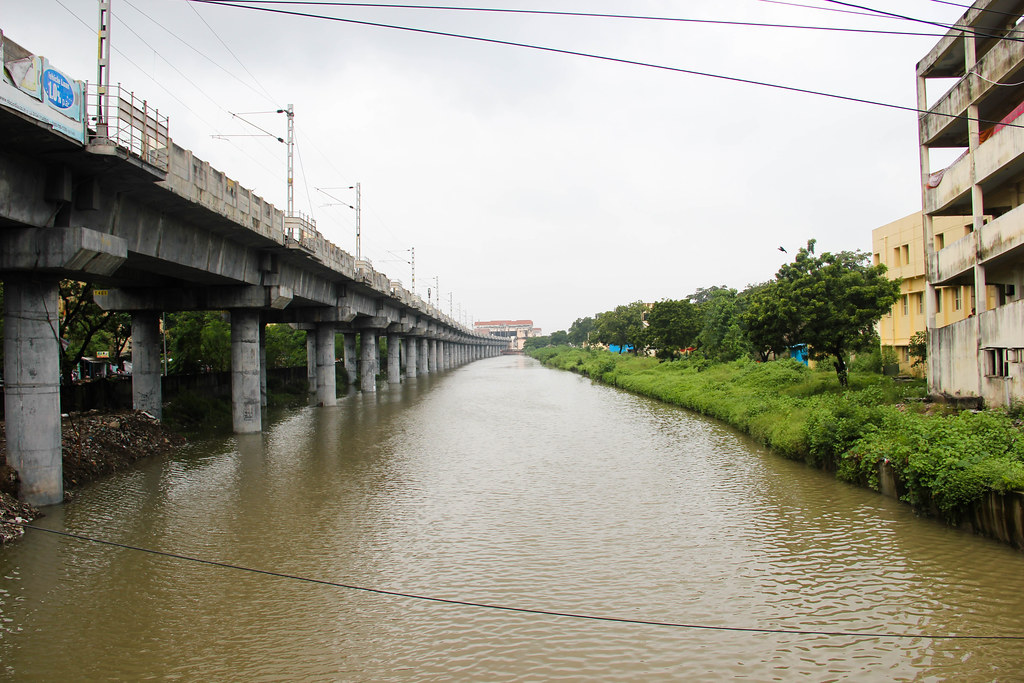
The Straight-cut Flood Escape Channel project at Uthandi in the southern part of Chennai along East Coast Road was conceived by the Water Resources Department (WRD) as a flood mitigation measure, with a budget of ₹91 crores. The plan proposes a cut-and-cover drain through the VGP Layout in Uthandi, to connect the Buckingham Canal to the Bay of Bengal. The drain is supposedly meant to divert excess floodwater in Buckingham Canal during heavy rains, when areas around the Pallikaranai marsh and Okkiyam Madavu face flooding.
Work on the project started immediately after its inauguration in August 2025. However, residents of Uthandi and the nearby fishing hamlet of Nainarkuppam raised objections to the project. Their protests (page 6) gained ground when it was established that the project was kicked off without the required clearances and the mandatory studies and reports.
The project has been suspended since October 2025, and the matter remains before the National Green Tribunal (NGT), which took suo motu cognisance of the issue in September 2025 based on media reports. The major concerns that are yet unaddressed cover CRZ violations, groundwater contamination, local flooding, ecological damage and hindrances to the livelihoods of fishing communities. The residents hope that the new administration will consider these issues and discard the project, especially since more viable solutions can be implemented without the huge environmental and monetary cost of the present plan.
Sewage-mixed discharge
Residents point out that the discharge carried by the proposed channel will be heavily polluted. It is common knowledge that the Buckingham Canal has hundreds of sewage outfalls. Many settlements on its banks use the Canal for waste disposal. It has to be noted that there are separate ongoing cases in the NGT in which such sewage outfalls into the Buckingham Canal and the Muttukadu Estuary have been raised as a matter of grave environmental concern. A report submitted by the Chennai Metro Water Supply and Sewerage Board (CMWSSB) to the NGT in January 2026 admitted to the presence of these sewage discharges. Further, after authorities carried out inspections at the site, they noted that sewage tanker lorries were dumping waste into the Muttukadu Estuary.
While the WRD insists that Buckingham Canal water is not polluted, the independent water testing initiated by the residents finds otherwise. The test was conducted by CUBE Lab – a joint startup by IIT Madras and the State government. The findings revealed faecal coliform levels at 1,600 MPN/100 ml, around 16 times the permissible limit, and biochemical oxygen demand at 26.5 mg/l, nearly nine times the standard.
Violations of CRZ norms and protected aquifer zone
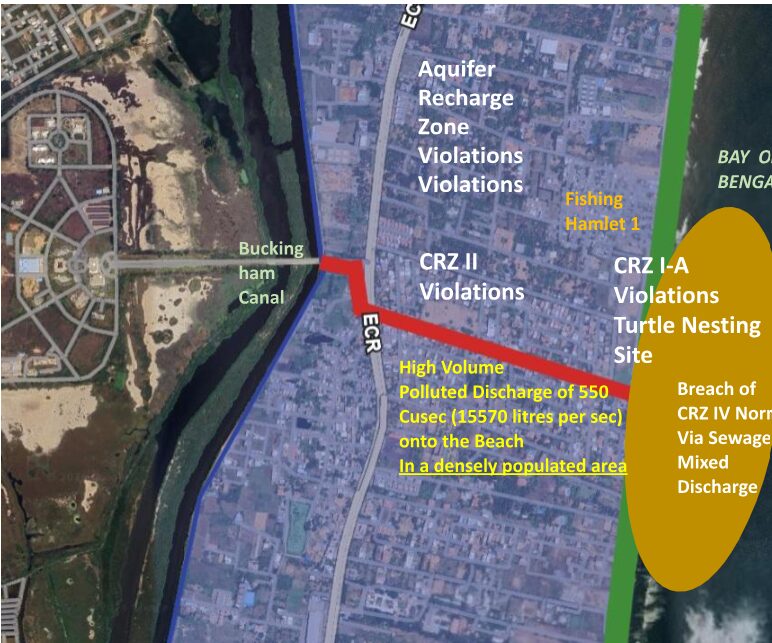
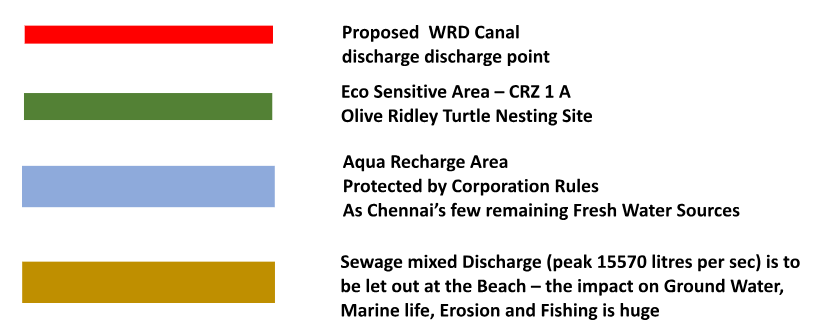
The proposed channel will run more than a kilometre through a layout that is close to the Uthandi beach. This area is a CRZ II Zone. The discharge point of the channel on the Uthandi beach is classified as an eco-sensitive CRZ 1-A Zone by the Tamil Nadu Forest Dept due to Olive Ridley turtle nesting sites. The project will also violate CRZ IV norms, which state that “No untreated sewage, effluents… can be dumped” into the sea.
With so many CRZ Zones being affected by the project, it was surprising that it was started without any CRZ clearances. WRD later applied for CRZ clearance and their application is now under the consideration of the District and State level Coastal Management Authorities (DCZMA and TNSCZMA) who have raised several queries.
Read More: Living near the coast? What you must know about Coastal Regulation Zone guidelines
Residents are also concerned about the groundwater contamination that will be caused by the discharge. Uthandi is on the Aquifer Recharge Zone and is as such protected by Corporation rules. This is especially significant because Chennai already struggles with water stress. If an aquifer recharge zone is polluted, the damage may be difficult to reverse.
Ecological damage
The proposed channel will have a peak discharge capacity of 550 cusecs – equivalent to the capacity of 78 water tanker lorries per minute. This huge outflow to the sea will be through the Uthandi beach. WRD has not yet conducted studies on how such a discharge will affect erosion and marine life. While the Chennai Corporation is concerned about rising sea levels and receding shorelines, the impact of a huge outflow by this channel onto an already sensitive beach is ignored. Also missing are studies on how this discharge will affect Olive Ridley turtles and marine life in general.
Impact on fishing communities
The two fishing hamlets of Nainarkuppam and Kanathur are on either side of the discharge point of the proposed channel. The communities in these hamlets are solely dependent on fishing for their livelihood. A polluted sewage-mixed discharge into the sea will impact marine life in a major way and make shore seine fishing impossible. The fishing communities have handed over petitions against the project to the Collector and the Director of Environment and Climate Change, who is also the Member Secretary of the TNSCZMA. They have expressed their fear of losing a livelihood that has sustained them for generations. For these fishing communities, the sea is not an empty outlet for excess urban water. It is their workplace and source of livelihood. Any decline in water quality can directly affect their fish catch, income and food security.
Read More: Left behind in the heat: Chennai’s fisherfolk face climate crisis without policy support
One’s gain, another’s loss
The root cause of flooding in the low lying areas around Pallikarani has been the steady increase in grey cover over the years. These encroachments, along with silt buildup in Buckingham Canal and the Muttukadu Estaury, have reduced the discharge capacity of Buckingham Canal resulting in flooding. These problems have been the focal points in all flood mitigation studies.
The project however overlooks these issues and looks to trade the benefits of one for that of another. Encroachments continue to suffocate natural drain areas and inadequate waste management policies result in silt and debris that block natural pathways for flood water to escape. The new solution proposed is now putting Uthandi in the line of danger.
Alternatives to the proposed project
While residents understand the need for flood mitigation measures, they want it to be done in an equitable and sustainable manner.
The options suggested are:
- Desilt Buckingham Canal and dredge the Muttukadu Estuary to increase the Canal’s discharge capacity
- Remove encroachments to reduce grey cover and restore Buckingham Canal to its original width and depth
- Implement a strong waste management plan that will prevent future dumping of waste and silt buildup in the Buckingham Canal or the Estuary. Defaulters should be heavily penalized to discourage misuse of all waterways
- Clear existing water bodies in the city along with their network of micro/macro drains. These water bodies were acting as natural reservoirs during rains before encroachments and debris made them non-functional
- Collaborate with the Inland Waterways Authority of India (IWAI) to ensure that Buckingham Canal is maintained and sustained as a National Waterway
The larger question for Chennai
The Uthandi dispute reflects a larger question about Chennai’s flood planning. The city urgently needs better drainage, especially as extreme rainfall events become more frequent. But flood infrastructure cannot be planned as a purely engineering exercise. Any solution should ensure that it does not impact people, marine life and the environment to the extent that the solution becomes an even bigger problem.