They form the backbone of the country’s seafood export industry, worth over ₹60,000 crore. However, Chennai’s coastal communities, especially fisherwomen, remain mostly invisible in policy and pay. Enduring punishing 15-hour days under sweltering heat, they clean, dry, and sell fish for just ₹200 to ₹300 a day. They work on blistering concrete without shade, toilets, or access to safe drinking water. Prolonged exposure to these conditions puts them at risk of sunburn, dehydration, dizziness, eye damage, and kidney issues. These health problems remain largely unaddressed.
At sea, rising water temperatures and pollution continue to push fish further offshore. This forces fishers to travel longer distances, increasing fuel costs and reducing daily catches. Their struggle spans land and sea, with no adequate safety net in place.
From the accounts shared by fisherfolk in our earlier article, extreme heat and climate change have emerged as the most pressing challenges. These require targeted and robust policy responses.
Existing plans fail to recognise fishers as a vulnerable group
The first step in addressing heat-related challenges must be the formal recognition of fishers as a vulnerable group. However, the government does not specifically classify them as vulnerable to heat stress based on their occupation. Instead, they are broadly grouped under categories such as outdoor workers, street vendors, or those living below the poverty line.
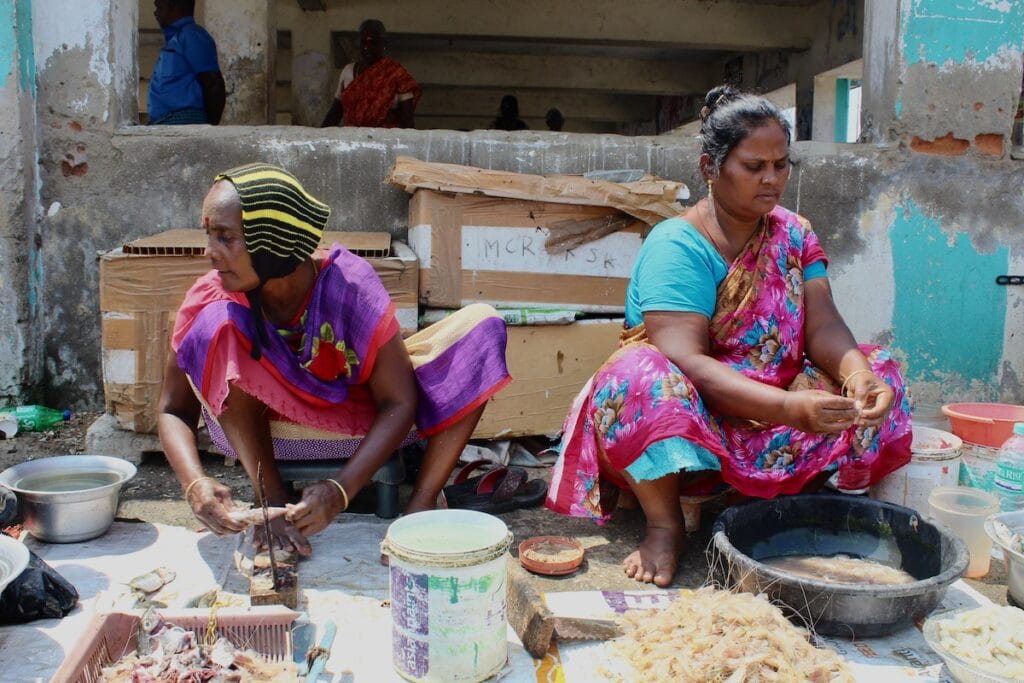
General recommendations, like increasing the supply of Oral Rehydration Solution (ORS) in primary health centres, may offer some relief. However, they fail to address the unique and occupation-specific issues that fishers face on a daily basis.
One of the most overlooked aspects is gender. “Gender is often applied as an afterthought at the policy level, but we should proactively look at it through an inclusive lens. Gender-specific planning, analysis, resource allocation, and training must be carried out separately for fishermen and fisherwomen,” says Vivek Venkataramani, a public finance and climate resilience expert. As noted in our earlier reporting, fisherwomen bear a disproportionate share of the burden. Empowering them and designing inclusive interventions is essential to reduce long-term harm.
Interestingly, the Chennai Climate Action Plan (CCAP) does acknowledge fishers as highly vulnerable to sea-level rise. Yet, it does not include the Fisheries and Fishermen Welfare Department among the implementing agencies. Similarly, the Tamil Nadu State Action Plan on Climate Change and Human Health (2022–2027) omits this department from the list of responsible sectors. These exclusions create a significant gap in accountability and hinder effective implementation.
Read more: Heat stories: The daily grind of outdoor workers under the scorching sun
What the Heat Mitigation Strategy says about fishers
Among existing plans and state-led studies, the State Planning Commission’s Heat Mitigation Strategy is the only one that considers the fishing industry in the context of rising temperatures. Although it focuses more on the industry than on the communities themselves, it includes two key recommendations for the Fisheries and Fishermen Welfare Department:
- Introduce early warning systems to alert fishers about changes in fish migration or environmental risks caused by heat
- Improve access to microfinance and insurance schemes to support incomes during the summer months
Vivek stresses the importance of affordable insurance policies for the fishing community. He argues that the market must offer affordable premiums. He also insists that financial support should go beyond one-time compensation. “Fishers need a steady flow of liquid cash to continue venturing out to sea, except during official fishing ban periods,” he notes.
The strategy also promotes the development of the mKRISHI Fisheries mobile app. This tool is designed to provide fishers with sea temperature data, identify potential fishing zones using satellite imagery, and offer updates on wind speed, wave height, and unsafe regions.
However, accessibility remains a concern. Most fishers continue to rely on traditional knowledge passed through generations. According to the CCAP, only 4,993 fishing families in Chennai own mobile phones, and just 117 have access to GPS technology. Without digital inclusion, such tools cannot benefit the majority.
The need for an active heat action network
The Heat Mitigation Strategy also proposes the creation of a Heat Action Network to encourage collaboration across departments. Sudha Ramen, Member Secretary of the State Planning Commission, explains that this network does not exist as a formal entity established by government order.
“We have identified key stakeholders who need to be consulted when the heat mitigation strategy is prepared. This includes departments like municipal administration, health, animal husbandry, environment, forest, transport, labour, school education and fisheries. We have taken all their inputs for the heat mitigation strategy,” she says.
However, community voices were absent from the process. The State Planning Commission gathered input from civil society organisations that work with fisherfolk and treated them as community representatives. While this offers some insight, it cannot replace direct consultation with affected individuals.
Read more: Gig workers and heat: What do existing policies say?
Who ensures implementation?
A major challenge lies in the absence of a specific department responsible for implementing recommendations related to unorganised workers like fishers. Unlike the organised sector, which has formal systems in place, these communities rely heavily on outreach and coordination.
Sudha points out that this gap opens opportunities for civil society organisations and corporations to support implementation through CSR funding, in coordination with relevant departments.
When we asked about the implementation of the recommendations in the heat mitigation strategy and the government’s plans for parametric insurance for fishers, Sudha says that the Fisheries and Fishermen Welfare Department should take the lead. “We have only made recommendations for the Fisheries Department to explore, assess and discuss potential business models. If they decide to proceed and require support from the Planning Commission, we are ready to assist.”
However, despite repeated efforts to reach out to the Fisheries and Fishermen Welfare Department to enquire about the implementation of these recommendations, they were not available for comments.
The need for occupation-specific research
The State Planning Commission is also conducting a study on coastal communities. The study covers socio-economic conditions and environmental vulnerabilities, including seawater intrusion, coastal erosion, and lack of access to drinking water. Sudha says the report will be ready in three to four months.
However, experts raise concerns about the design of such state-led studies. Nigazh from Poovulagin Nanbargal notes that state-led quantitative research relies on defining abstract variables that clump different problems together, thereby oversimplifying the issues. As a result, the most vulnerable groups, like fisherfolk, often remain invisible in the findings.
He insists, “What is needed are livelihood-specific studies. These should examine how heat stress affects particular livelihoods, such as fishing, and offer solutions tailored to their realities.”
The way forward
For fishing communities, climate change is not a distant threat. It is already disrupting daily life and livelihoods. Yet policies continue to overlook their specific realities.
To move forward, the state must:
- Identify fishers as a distinct vulnerable group
- Involve fishing communities directly in planning
- Assign clear responsibility to the Fisheries Department
- Ensure tools and schemes are truly accessible
- Support detailed occupation-based research
Investing in early interventions tailored to fishing communities is not just a matter of justice. It is also economically sound. Delayed action risks higher public health costs, deeper income losses, and increased migration pressures. A focused, inclusive, and accountable approach can protect a workforce that sustains the coastal economy and contributes significantly to national exports.