There was a time when Harrington Road was exactly what it was meant to be: a quiet, tree-lined residential avenue, one of Chennai’s older and more established neighbourhood corridors. Families chose to live here because it offered something increasingly rare — space, calm, and a sense of community.
Today, that same road tells a very different story.
Along an approximately 800-metre stretch now stand eight schools, where there used to be three — three hospitals, three auditoriums, eateries and commercial outlets. Individually, each serves an important purpose. Collectively, however, they have created a level of activity that the road and the surrounding residential infrastructure was never designed to handle.
What is unfolding on Harrington Road is not merely a traffic problem. It is a planning problem, a zoning problem, and increasingly, a quality-of-life problem. More importantly, it is a warning of what happens when development outpaces infrastructure and when coordination between planning authorities and licensing agencies breaks down.
How a residential road became a throughway
The roots of today’s congestion can be traced back roughly two decades. For many years, a railway crossing effectively made one end of Harrington Road a near dead-end. Traffic volumes remained naturally limited. Then came the subway connection from Poonamallee High Road. What was once a relatively quiet residential corridor suddenly became part of a larger traffic network.
What followed was predictable.
This road now carries through school traffic, hospital traffic, auditorium traffic, auto-rickshaws, vendors, visitors, delivery vehicles, and support services—often all at the same time.
Every morning and afternoon, the scene repeats itself. School drop-offs and pick-ups bring traffic to a crawl. Cars line both sides of the road and avenues, shrinking available carriageway and creating bottlenecks. During school functions, peak hours, and auditorium events, conditions worsen.
The result is a simple mismatch: demand has grown exponentially, while capacity has remained largely unchanged.
When roads become parking lots
Congestion is only part of the story. Because many institutions lack sufficient on-site parking and internal traffic management systems, vehicles routinely spill into adjoining residential avenues. Streets designed for residents and emergency access have gradually become overflow parking areas for visitors.
The consequences are visible everywhere.
Cars occupy residential avenues for hours at a time. Driveways are blocked. Residents struggle to enter or leave their homes. Emergency access is compromised. Quiet residential streets increasingly resemble extended parking facilities serving nearby institutions.
Read more: Chennai’s footpaths are not for pedestrians!
This is not an unavoidable side effect of urban growth. It is what happens when concentrated high-traffic activity is permitted without corresponding infrastructure planning.
The cost paid by residents
For residents, the impact is not measured in traffic statistics. It is experienced daily. A simple trip out of the house becomes a calculation. School timings dictate movement. Returning home can mean navigating through rows of parked vehicles and bottlenecks. Travel times become unpredictable.
The character of the neighbourhood has changed as well.
The constant flow of visitors, vehicles, and non-residents makes neighbourhood monitoring more difficult and raises legitimate security concerns. Large gatherings generate waste, while littering and public urination have become recurring civic nuisances that undermine the cleanliness and dignity of the area.
Taking advantage of the situation, owners rented their homes for commercial activities and the effects are inevitable. More traffic, greater parking demand, increased noise, and growing public nuisance. Roads planned for residential living begin functioning as commercial corridors.
The bigger issue: No connect between planning and permissions
At the heart of the problem lies a fundamental disconnect.
Urban planners determine land use, zoning, and infrastructure capacity. The Greater Chennai Corporation grants licences and permissions for commercial and institutional activities. Too often, these processes appear to operate independently of one another.
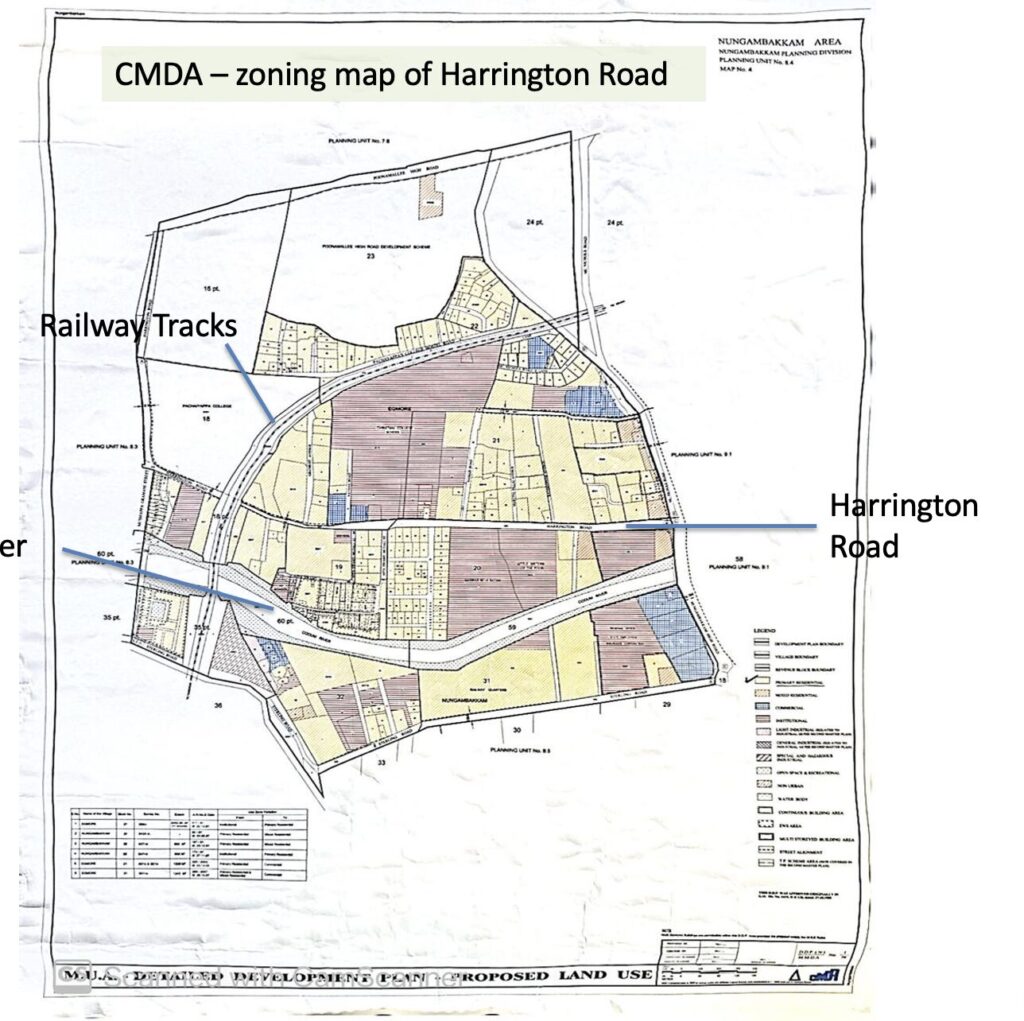
The result is that restaurants, cafés, offices, shops, and other businesses increasingly find their way into residential premises without sufficient assessment of whether the surrounding roads, electricity networks, water supply systems, drainage, and sewerage infrastructure can accommodate the additional demand.
The issue extends far beyond Harrington Road.
Across Chennai, similar tensions are emerging as zoning regulations are diluted, enforcement becomes inconsistent, and development proceeds faster than infrastructure upgrades. Harrington Road is only one of the examples of the consequences.
Residents have done their part
What makes this situation particularly frustrating is that residents have not been passive observers. They have repeatedly engaged with the Greater Chennai Corporation, the Traffic Police, and other authorities. They have raised concerns, proposed solutions, and participated constructively.
In an extraordinary demonstration of civic responsibility, community members have even appointed marshals to assist traffic police during peak hours. Residents have literally stepped onto the road to help manage the problem themselves. The question now is whether the institutions and authorities responsible for generating and regulating traffic will demonstrate the same commitment.
Read More: Citizens in the dark as Corporation and CMDA ignore zoning laws at will
Institutions must help manage the traffic they generate
Schools, hospitals, and auditoriums are vital to a growing city. No reasonable person is suggesting otherwise. Nor is it realistic to expect every institution to possess unlimited land for parking or expansion. The challenge arises when multiple high-traffic establishments are concentrated within a small geographical area, creating demands that exceed the carrying capacity of surrounding infrastructure.
In such situations, responsibility cannot rest solely with residents.
Schools should maximise school bus usage, encourage shared transportation, monitor and ensure vehicles enter campus premises for drop-offs and pick-ups rather than double- or triple-parking on public roads. Hospitals, auditoriums & other commercials should adopt similar traffic-management measures and actively assist in managing traffic generated by their visitors.
The principle is straightforward: if an institution/commercial generates traffic, it must also help manage its impact.
A practical path forward
Given the concentration of eight schools, three hospitals, and three auditoriums within a short stretch, government intervention is warranted.
One practical measure would be to mandate, and incentivise the use of school buses in areas where road capacity is limited. Fewer individual vehicles would mean reduced congestion, lower parking demand, improved safety, and reduced emissions.
Schools and hospitals should also provide adequate internal circulation and waiting areas so that public roads do not become extensions of their premises. Where feasible, institutions should actively assist in managing parking and traffic during peak periods and major events. These are not radical proposals. They are common-sense measures aimed at restoring balance between institutional activity and residential life.
What authorities must do
- Preserve the residential zoning of the avenues of Harrington Road and protect their residential character.
- Before granting licences or approvals for commercial activities in residential areas, the GCC should:
- Ensure compliance with zoning regulations.
- Assess the capacity of surrounding infrastructure.
- Evaluate traffic and parking impacts.
- Obtain a No Objection Certificate (NoC) from neighbouring residents.
- Ensure that any proposed changes to land use or traffic management are transparent and subject to meaningful public consultation.
- Strengthen enforcement against:
- Illegal parking.
- Encroachments.
- Zoning violations.
- Regulate parking on main road through designated parking meter zones and prevent spillover parking into residential streets.
- Require all student drop-offs and pick-ups by private cars and school buses to take place only within designated areas inside school campuses.
- Require institutions to implement effective traffic management measures to minimise congestion and disruption to surrounding neighbourhoods.
- Establish regular communication channels between residents, civic authorities, educational institutions, and enforcement agencies so that issues are identified and resolved before they escalate.
A tipping point for Harrington Road, lessons for Chennai
This is not an argument against schools, hospitals, restaurants, shops or community institutions. Cities need them, and neighbourhoods benefit from them.
The real issue is whether growth will be managed responsibly.
Better traffic management, greater use of school buses, stricter zoning enforcement, improved coordination between planning and licensing authorities, and genuine consultation with residents can restore balance. Protecting residential neighbourhoods is not merely about preserving property values or maintaining neighbourhood character. It is about safeguarding the everyday quality of life of the people who call these communities home.
If Harrington Road teaches Chennai anything, it is this: once a road outgrows its infrastructure, everyone pays the price.
Do you want to get information on local events in Bengaluru, Mumbai and Chennai, news updates, links to explainers, data and more? Join our WhatsApp broadcast channel, Citizen Matters – Civic updates for the Active Citizen.