Inside her 10×10 sq ft home in Pulianthope, Parvathy faces unbearably hot conditions during the sweltering summers from March to July. Green shade is a rare luxury in her neighbourhood, home to many marginalised families who earn a living making shoes. “We live right under the roof on the second floor, so it’s hot. Even if we open all the windows and doors, it does not help. Here, we end up spending more time on the streets to find respite,” she says.
As temperatures continue to climb, residents like Parvathy are left with little relief. Despite July’s arrival with hopes of showers, Chennai continues to sizzle with temperatures nearly reaching 40 degrees Celsius. A five-day heatwave in India could cause nearly 30,000 deaths, say researchers.
Across urban centres, a lack of green cover is linked to a rise in land surface temperatures. Chennai is no different. As the city grew hotter, its vegetation declined by 22% over the last two decades, according to a 2026 Tamil Nadu Green Climate Company report. While Indian state governments, such as Delhi’s, have acknowledged the role of urban greenery in combating air pollution, many studies have highlighted the benefits of canopy cover: bringing down ambient temperatures and providing critical habitats for urban wildlife.
Roads widen, but greenery shrinks…
Development is necessary, but at what cost? Concrete and tar swallow urban spaces as roads widen or metro corridors get constructed. Often, trees are among the first casualties. Compounding the issue, the Union Ministry of Environment, Forest and Climate Change recently reduced the mandatory green cover requirement from 33% to 10% for new industrial estates, parks, and individual industries under environmental clearance conditions.
While many of these infrastructure projects attempt to plant saplings and transplant trees, Deepak V, from environmental group Suzhal Arivom points out, “Planting saplings in large numbers for show cannot replace a lost mature tree; an established tree provides ecological value that takes decades to rebuild.” He adds that biodiversity is spread out across our cities, and green cover provides habitats for local species.
In Chennai, three projects that have majorly eaten green cover:
1. Chennai Metro construction with Phase II
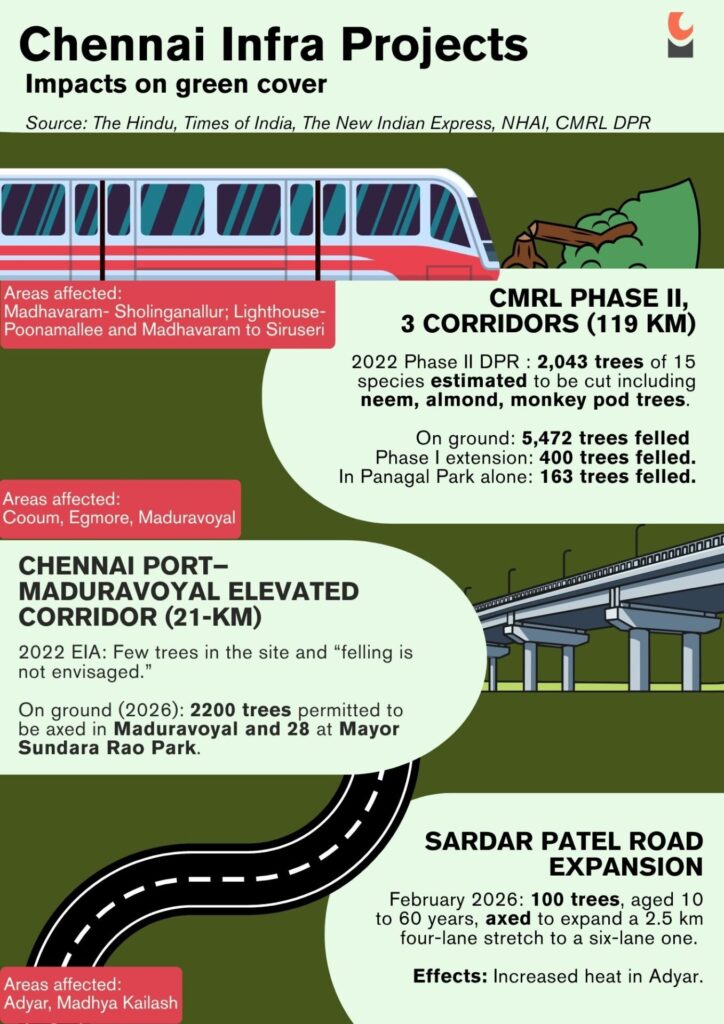
Across the city, the Chennai Metro Rail Limited is expanding. While the 2020 Phase II detailed project report estimated a loss of 2,043 trees, 5,472 have been felled so far.
By 2028, the metro is slated to be functional but total tree loss in affected areas would reduce oxygen production and carbon dioxide absorption. Between 2011 and 2025, Panagal Park in T Nagar alone lost over 30% of its green cover. Many of these trees support a wide variety of urban wildlife including mongoose, bats, squirrels, monkeys, mice, etc.
Citizens can get information on tree plantation by CMRL on this website.
Read More: Chennai to lose thrice as many trees as originally estimated for Metro Phase II
2. Expansion of Sardar Patel Road into six lanes
In February 2026, 100 trees were axed on Sardar Patel Road in Adyar to expand the 2.5 km four-lane stretch from IIT Madras to Chellammal College on GST Road to a six-lane one.
According to news reports, officials have said they are yet to narrow down where to transplant these trees. In 2023, the highways department felled 150 healthy trees to build the Madhya Kailash flyover and transplanted 75 trees from Sardar Patel Salai.
3. Chennai Port-Maduravoyal Elevated Corridor
The National Highways Authority of India (NHAI) is building a 21-km double-decker elevated corridor from Chennai Port to Maduravoyal, a project that has been in the pipeline since 2009. Estimated to cost ₹3,570 crore, the project has a proposed completion date of November 2027. However, the environmental cost of the project is huge: the cutting down of 2,200 trees near the Maduravoyal flyover alone.
The Forest Department planted these trees with an outlay of ₹6.64 crore, under the Ministry of Road Transport and Highways’ Green Highways Policy, 2015. Moreover, around 28 trees and saplings were to be cut inside the Mayor Sundara Rao Park in Egmore for the construction of three pillars last month. Currently, 25-27% of the work has been completed, and there is no official data on how many trees on the ground have been cut so far. Worse, the project’s 525 pillars are set to come up in the Cooum riverbed.
Role of trees in cities
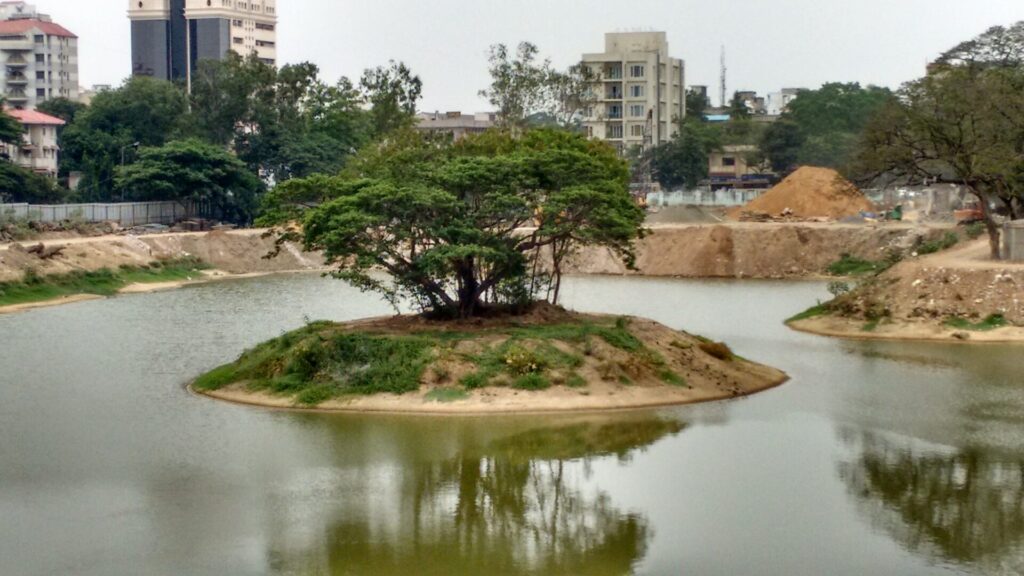
From Adyar’s Theosophical Society to the Anna Nagar Tower Park, the gradual cool respite from the canopy of trees is visible in green pockets across the city. But these pockets are steadily shrinking.
“When a tree transpires, it releases minute water droplets into the air around it that produce a cooling effect. When this moist, cooler air is gently carried by a breeze, it spreads that coolness further,” says botanist D Narasimhan, explaining the science behind the role of green cover in mitigating heat.
While we need roads and improved connectivity, projects like the Metro come at an ecological cost. “Areas that had decent tree cover actually helped reduce local heat. Now most of that is gone. In areas with high traffic and high concrete density, when you remove what little greenery is left, the heat only intensifies,” says Narasimhan.
Ecologies are also interconnected: shrinking canopies have also led to less migration of local birds that used the “hop-and-go mechanisms” between small green patches. Shrinking water bodies affect groundwater recharge mechanism, which is disrupted, and then affect trees, he adds.
Read More: The trees we forget: What a city loses when the canopy disappears
Meanwhile, in some areas like Valmiki Nagar, trees have been untouched and the result is felt in the shade and coolness they provide. “We are outliers, trees have not been removed here for infrastructure projects. Apartments are built around the trees, and in fact, our green cover has increased in the past few years by 10–12%,” says Bala Jaishankar, a resident. For Parvathy and the communities in her Pulianthope neighbourhood, there is an urgent need to increase tree cover.
Rise in Urban Heat Island effect and hotter days
Studies have shown a rise in Land Surface Temperature (LST) from 29.4°C in 2000 to 33.6°C in 2020 in Chennai and highlighted the connection between green cover and urban heat. Over time, the sustained high LST is symptomatic of and drives the escalating Urban Heat Island (UHI) crisis across cities. The UHI effect is a heat accumulation phenomenon within urban areas due to construction and human activities, leading to environmental effects.
Days are only getting hotter, warn experts. The average number of annual heatwave days in the state increased from 15 to 30 days between 2011 and 2019, and is likely to increase to 81 by 2050. Apart from the rise in heat, a 2024 study found urban greenery can contribute to the regulation of urban microclimates, reduce flood risk, and promote biodiversity.
The climate crisis and adverse weather events like droughts, floods and heatwaves are inching closer. “Unlike floods, heat is different, gradual, not as visible, and the suffering it causes is happening quietly, in the background. We need to change that — to bring heat into the same urgent discourse as flood-related disasters, because it has its own serious consequences, just like any other climate impact,” says Deepak.
Trees need legal protection
In an effort to conserve green spaces, the Greater Chennai Corporation has digitised the application process for the removal of trees and pruning of branches on its website and the Namma Chennai mobile application. These requests are approved by the District Green Committees (DGC), which have been operational since 2022.
However, the cutting of trees is often unregulated, and tree conservation requires a comprehensive central and state law, say environmentalists. A sensitive balance between ‘development’ and long-term safety of trees is key, points out Shobha Menon from NGO Nizhal. “Each citizen must stand up to safeguard the city’s environment, as a key stakeholder, for their own selves at least. Else all the awareness ‘created’ and all the ‘action’ that is unsustained and insensitive can only make things worse.”
Meanwhile, the state forest department announced the conduct a tree census and green space survey in six TN cities but there has been no update. This needs to be expedited, and the legislations to protect trees need to be defined and implemented soon, say Shobha and Deepak.
Recommendations from experts
- Urban infrastructure projects must be planned with greenery.
- Loop in greening experts during planning of projects
- Enact legislations protecting trees.
- For climate resilience, implement interventions such as vegetation like urban forests and avenue plantations aim to mitigate the urban heat island effect
- Ensure upkeep and maintenance of existing trees
- Mapping and marking mature, high-value trees