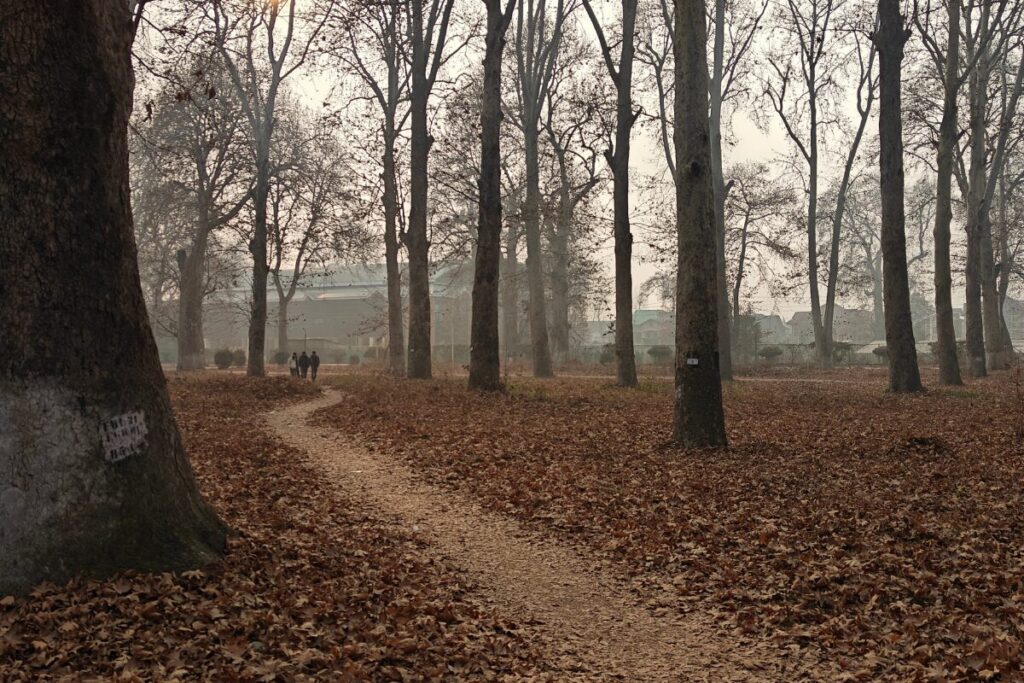
The University of Kashmir campus in Naseem Bagh, Srinagar, is thick with early morning winter fog. Monumental chinar trees fade into a blanket of mist as a few students move quietly across the grounds, shoulders hunched and hands buried deep in their pockets. “We have to plan properly according to the cold before coming to the university,” says Aijaz, a PhD scholar. As daylight fades early, pathways empty quickly, and students retreat to hostels, rented rooms, or wherever warmth is available.
Srinagar, the summer capital of Jammu and Kashmir, hosts many of the region’s universities and colleges, drawing students from across the Valley. Winter breaks for university students are brief, often lasting only a few weeks, meaning academic life continues through the coldest months of the year. Students must navigate freezing commutes, cold classrooms, and living spaces where access to heat is uneven.
Mornings are the hardest. Falak, a first-year Master’s student, describes leaving a warm bed to wake up in an “ice-cold room” as a daily struggle. She carries a plastic bottle filled with steaming water to warm her fingers on the way. For those without vehicles, the situation is worse. Umaira, a recent master’s graduate, recalls waiting 20 to 30 minutes for a bus in the biting cold. “Even shops are closed at that time,” she notes. Originally from Baramulla, she travels daily from a relative’s home, a more-than-an-hour-long commute to and from the university.
A constant struggle against the cold
Classrooms offer little relief. Uzma, a former Social Work student, explains that the chinar-lined campus stays shaded and cool in summer but feels “proportionately colder” in winter. Falak, a second-year Master’s student, says outdated building design worsens the experience. The main source of heat is often a coal bukhari placed at the centre of classrooms. “It’s useful only to those sitting close,” she says. Falak finds it difficult to concentrate and recalls “counting minutes until she could step into sunlight or find a warm drink.”
Sitting too close to the bukhari brings its own discomfort—students describe suffocation, headaches, nausea, and dizziness. During exams, Umaira says, teachers rotate seating every 20 minutes to manage exposure. Access to this sole heat source is inconsistent, as the university decides when bukharis are allotted, often misaligned with actual cold.
Beyond classrooms, department libraries and computer labs remain cold, limiting study time. Uzma laments, “There is no place to go, or simply to sit.” Umaira finds warmth only in a cup of tea at the canteen. In contrast, staff rooms and administrative offices are well-equipped with gas bukharis or ACs. “I wish for the warmth of the staff rooms,” Falak admits.
Hostel life is equally harsh. Aijaz, despite living nearby, visits the library less in winter. Commuting students often skip university altogether. Umaira struggles to finish her syllabus before winter break, while Aijaz admits, “Man nahi karta [I don’t feel like it].” Study hours drop drastically, and without reliable heating or electricity in hostels, concentration becomes impossible. Students rely on personal blowers, rationed electricity, or blankets, often at the cost of productivity.
At home, conditions are better even if not easy. Falak misses the consistent warmth of her family home in Pulwama compared to her rented accommodation. Uzma contrasts Srinagar’s inadequate winter infrastructure with her hometown Kupwara, where kangri and hammam systems efficiently heat rooms and water.
Mental health concerns
Students also speak about the emotional weight of winter. Some describe low mood, energy, and motivation, compounded by shorter days and scarce light. “Everything feels dead in winter,” Falak says, adding, “The gloominess of winter renders me unproductive.” Aijaz feels frustration when cold disrupts his study plans, leading to self-blame and regret. Uzma and Umaira openly use the term ‘seasonal depression’. “Winters are heavy on my heart. It feels like I’m only surviving till summer,” Uzma says.
Umaira describes effects on both physical and mental health, including low blood pressure and heightened social anxiety. From autumn onward, she feels her depression swell, withdrawing even from conversation, barely speaking to her mother while in Srinagar. “I’m only good, only useful in summer,” she mourns.
Falak does not identify with seasonal depression but acknowledges winter’s toll, especially when forced indoors around the clock.
Existing research on Kashmir’s mental health landscape notes a high prevalence of stress, anxiety, and depression among college students, while local reporting has linked reduced sunlight and seasonal shifts to mood changes in the Valley. For many students, however, discussing these experiences openly remains difficult. “In Kashmir, mental health is misunderstood to begin with,” Uzma notes, “Seasonal depression is seen as a naya chonchla [new fad],” so she prefers to stay silent on the matter.
Read more: Only the traditional kangris, not electricity, keep Srinagar residents warm in winter
Infrastructure, the missing link
All conversations repeatedly return to the question of infrastructure. Many say improved heating arrangements, more accessible study spaces, and reliable electricity could ease the strain of winter academic life. But Umaira feels that there is a fundamental lack of empathy for students within the system. Appeals to faculty about heating are met with responses like, “This is all we can do,” or “Take it up with higher-ups.” When students requested moving exams to warmer months, they were told to “simply manage,” and that “even teachers feel cold”. Sometimes, they simply hear “Yeh upar se order aaye hai [These are orders from above].”
While funding constraints are frequently cited, Falak feels that existing arrangements are simply not enough. Uzma also notes that winter preparedness, if addressed at all, is not holistic and seen only through the lens of physical realities. “The university doesn’t take mental health as an issue seriously enough to begin with. It’s hopeless to expect they will do anything about seasonal mental health concerns.”