“If the authorities go to Putlur Lake and actually listen to the residents there, how would a sewage treatment plant (STP) at this location in Madambakkam even get sanctioned in the first place? Either they are unaware, or lethargic towards community welfare,” says Anand R, a weather and waterproofing expert and a Madambakkam resident, who lives close to the proposed STP site.
Madambakkam, situated in the southern part of Chennai, is an old town with a long history, known for its ancient temple and open grasslands. Over the years, however, rapid urbanisation has begun to change its landscape. Recently, lake encroachment issues have brought attention to the area, sparking fresh discussions about indiscriminate development.
The Tambaram Municipal Corporation has proposed a 27 MLD centralised STP in Madambakkam to manage sewage from nearby areas through underground drainage. But residents oppose the plant’s location due to environmental and health concerns.
Current status of the project
The current proposal identifies a site near Madambakkam Lake for the STP. Residents allege that there were no adequate stakeholder consultations or public hearings before the project was proposed, leading to growing anxiety among people living close to the site.
The corporation, however, maintains that the project is still under consideration and that relocation remains possible if a suitable alternative site is identified.
Responding to concerns raised by residents, S Balachander, Tambaram Corporation Commissioner, told Citizen Matters:
“We understand that people have concerns, and objections are common. We respect genuine demands and will explore better alternatives if possible. Treated water will not be released into the lake here; instead, it will be directed towards the outlet connected to the Pallikaranai Marsh. For sludge management, we will use modern techniques to convert it into solid cakes and transport it to designated low-lying areas. A proper system will be in place.”
Read more: Treated water from one-third of BWSSB sewage treatment plants is unsafe
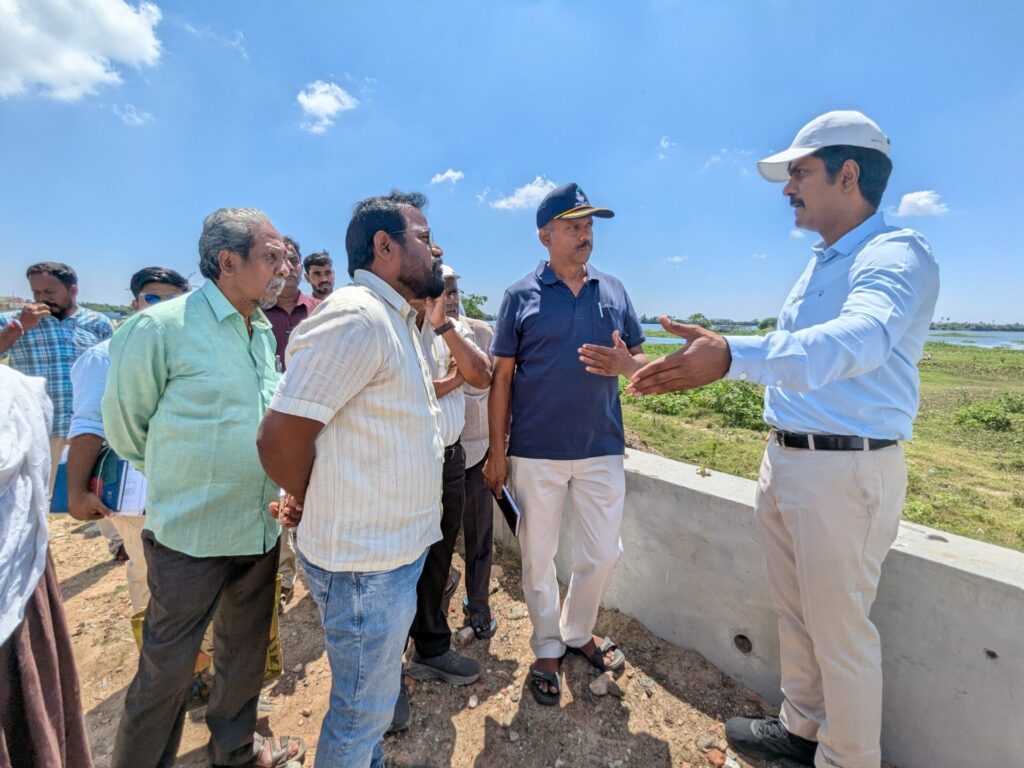
Officials emphasise that modern STPs operate under strict regulations and are essential to reduce sewage discharge into water bodies.
Citizens fear groundwater contamination
But residents are not convinced. They reiterate that they are not opposed to underground drainage systems or sewage treatment itself, but are against locating a large centralised STP within a densely populated residential neighbourhood with shallow groundwater levels.
“With groundwater just 20–30 feet below, setting up a 27 MLD plant here poses a serious risk of contamination. This location is not suitable for such infrastructure, and releasing treated water into the lake could further degrade groundwater quality. These plants work efficiently only with uninterrupted electricity. Any power disruption could halt treatment and increase the risk of large-scale contamination,” says Anand.
The CPCB’s operation and maintenance norms for Sewage Treatment Plants state that continuous power supply is essential for the efficient functioning of STPs.
“STPs should not be located near marshlands or water bodies, nor should they discharge treated water into eco-sensitive zones. Ideally, treated water must be used for afforestation,” says Anand. Moreover, the proposed site lies close to houses, schools, religious spaces and water bodies, he adds.
Treated sewage from STPs often still carries contaminants like heavy metals, nutrients, and ammonia, which can pollute lakes and groundwater. While the Tamil Nadu Pollution Control Board (TNPCB) permits treated effluent discharge into inland surface water bodies under prescribed standards, residents and environmental observers argue that Madambakkam Lake, being linked to drinking water and groundwater recharge in the area, requires stricter monitoring beyond minimum discharge norms. They point out that even treated water meeting TNPCB standards can gradually affect groundwater quality and the lake’s ecological balance.
“When this project was first proposed in 2009, the locality was not this crowded. Today, there are hundreds of apartments coming up and families living very close to the site. We are being told that nearly three crore litres of sewage will be processed here and pumped towards the Pallikaranai Marsh through multiple pumping stations,” says Arokiya Meetpan A, a resident living around 100 metres from the proposed STP site.
STP a danger to the environment, say residents
Radhika, a resident of AKS Nagar involved in lake conservation efforts, points to the shrinking extent of Madambakkam Lake itself. “Earlier, Madambakkam Lake was spread across 600 acres, but now it has shrunk to around 240–280 acres due to urban development. If an STP is planned near a lake, how can the government ensure that groundwater and water quality will not be affected?” she asks.
Health concerns have also emerged as a major anxiety among residents, who fear gas emissions, sewage leakages and groundwater contamination could affect both present and future generations.
“If methane gases are released or if the water gets contaminated, it could lead to breathing problems, bacterial infections and long-term health impacts for residents,” adds Meetpan.
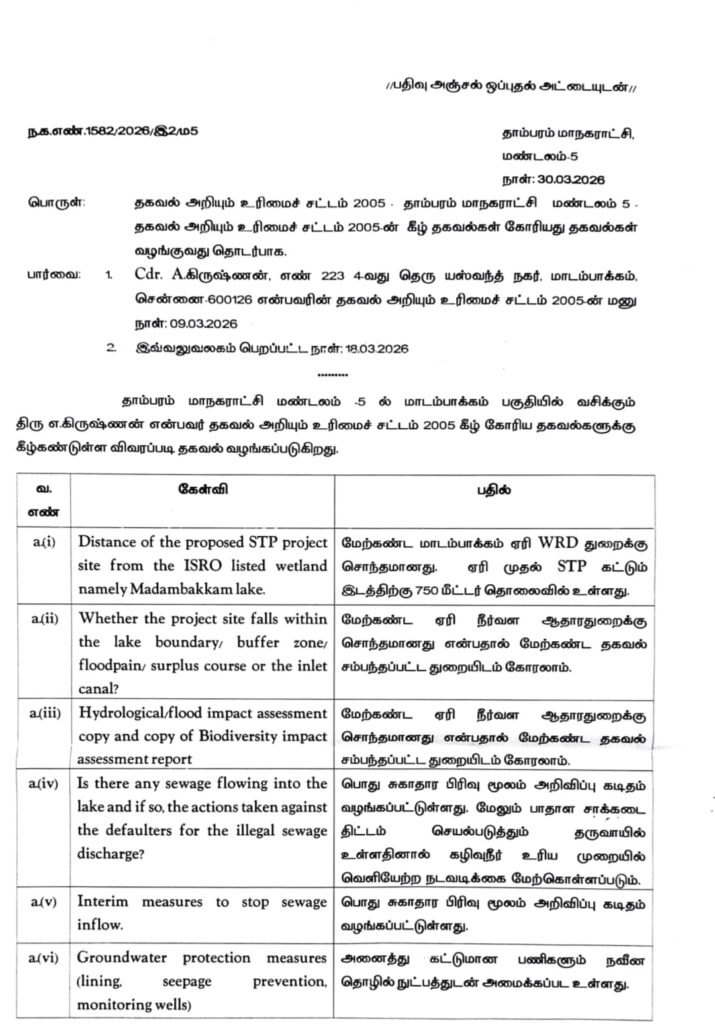
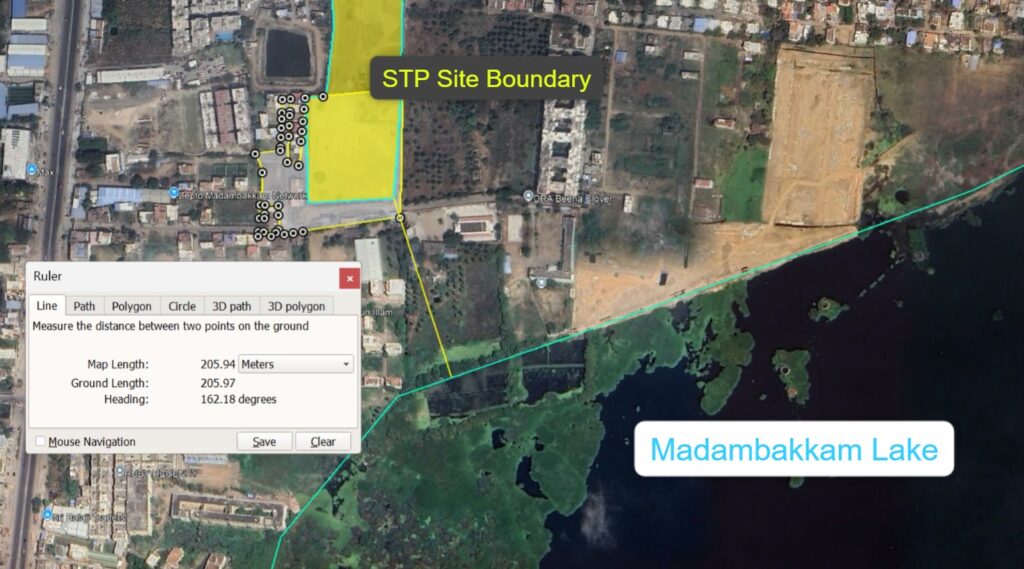
Krishnan, president of the Save Madambakkam Lake Committee (SMLC), a residents’ collective working on lakefront issues since 2018, questioned discrepancies in a response to an RTI query, which stated the distance between the proposed STP and the lake edge as 750 metres, while an independent assessment using Google Earth reportedly measured it at around 205.97 metres. “There are TNPCB siting criteria for such plants. There is also a temple tank near the site. When we inspected the site, the RTI response differed, which raised concerns over the government’s response,” he says.
Questions about efficient maintenance
Residents are also concerned about sludge transportation and emissions from the plant.
“Managing sludge would mean 200–250 vehicles a day commuting through the area, and the area simply doesn’t have the capacity; it will get choked. Along with that, gases like methane and hydrogen sulphide, and their periodic release, make this an unsafe fit for a residential locality,” Anand adds.
For any STP to function, it must receive an environmental clearance. “Today, many STPs are technologically sound, but the real problem lies in maintenance. Efficient upkeep is where systems often fail. Centralised STPs are not inherently problematic; if the government is willing to invest adequately in maintenance, they can be effective,” says Dr Ananth Kodavasal, Director at Ecotech Engineering Consultancy Private Limited, Bengaluru.
“If an STP is located within 500 metres of residential areas, gases released can settle at ground level and pose health risks. So placing an STP close to homes is definitely a serious concern. There are also unresolved questions about sludge management. While digesters may be used, it is still unclear how sludge will be safely handled. Typically, vendors are responsible for maintenance only for about 10 years,” he adds.
Where are these fears rooted?
Experts and residents say these apprehensions are shaped not only by the Madambakkam proposal, but also by the broader experience of sewage treatment infrastructure across India.
India’s sewage crisis is staggering. Cities and towns together generate about 72,368 million litres of sewage per day (MLD) — enough to fill nearly 30,000 Olympic-size swimming pools. However, the country has the capacity to treat only 37% of this sewage, and in practice, only about 28% is actually treated. Existing plants often struggle during monsoons, face frequent power cuts, and are not equipped to remove heavy metals or pharmaceutical contaminants.
A 2019 CPCB report on Ganga-front towns revealed a 45% treatment gap: while these towns generated 3,558.5 MLD of sewage, only 1,064.2 MLD was actually treated. In Delhi, of 38 monitored STPs, only two met fecal coliform standards, highlighting systemic inefficiencies.
For residents, these examples raise doubts about whether the government would ensure long-term maintenance and monitoring of the Madambakkam plant.
“They say the plant will be maintained properly, but we spoke to residents in Nagalkeni and Perungudi who complained about groundwater discolouration and foul-smelling water near STPs. We have spent the last six months researching these issues before submitting our petition,” says Meetpan.
Nandakumar E, CEO of the International Centre for Clean Water at IIT Madras, also points to the risks associated with leakages and infrastructure failures. “If someone lives right next to an STP and there is a pipeline leak, it could damage their property or affect their health. These are serious risks.”
Concerns also persist over the lack of clarity regarding the proposed outlet route, as officials have stated that the treated water would eventually be diverted towards the nearby Pallikaranai Marsh, but the specific water channel connecting the project site to the marshland has not yet been identified publicly.
How does a sewage treatment plant work?
Sewage treatment plants process wastewater through screening systems and sedimentation to remove solids. They use microorganisms to break down organic contaminants through biological processes such as activated sludge systems and filter beds. Next, nutrients like phosphorus are removed and the water is disinfected before release or reuse.
Modern STPs are highly automated with sensors and controls, reducing human error. Yet experts note that the real challenge lies in consistent maintenance, monitoring, and accountability, and residents often worry about risks when such plants are located near public utility spaces.
What alternatives do experts suggest?
Alternatives like bio-toilets and eco-sanitation reduce freshwater use and sewage generation, while grey water recycling helps reuse wastewater for non-potable needs. Stricter monitoring of STPs in apartments, commercial complexes and institutions is also vital to prevent discharge of partially treated sewage and compliance with TNPCB norms.
A decentralised model offers an option to large plants in dense areas. “An STP does not have to follow a single model—there are multiple technologies available,” says Tharun Kumar of EcoSTP Technologies. He explains their system mimics natural biology, uses minimal moving parts, and is already in use across Bengaluru.
However, he notes that decentralised units handle only up to one MLD, so multiple units must be combined thoughtfully.