The Brihanmumbai Electric Supply and Transport Undertaking (BEST), considered Mumbai’s second-biggest public transport lifeline, is far from its glory days. The bus accident in Kurla last December that killed nine passengers has brought sharp scrutiny on its operations. The company is also battling losses and recurrent workers’ strikes, the latest one being a flash strike by drivers last week at Wadala depot.
According to activists and the BEST Workers’ Union, the core problem is the wet-leasing model introduced in 2018, under which contractors own and operate buses on behalf of BEST. Since then, BEST has steeply reduced its own fleet, breaching an agreement with the workers’ union to retain over 3,000 buses. In the meantime, BEST took on a large number of wet-leased buses that are being criticised for their poor maintenance and services, and inadequately trained drivers.
By BEST’s own admission, the shift to wet-leasing has not benefited it financially.
Shift to contractualisation
BEST’s losses have been mounting over the years — Rs 858 crores in 2014-15, Rs 905 cr in 2015-16, and Rs 990 cr in 2018-19. For a while, the transport division’s losses were covered by the more lucrative electricity division of BEST. But following a court order, the transport division loss recovery (TDLR) surcharge — levied on the electricity bill and used to cross-subsidise the transport division — was scrapped in November 2016.
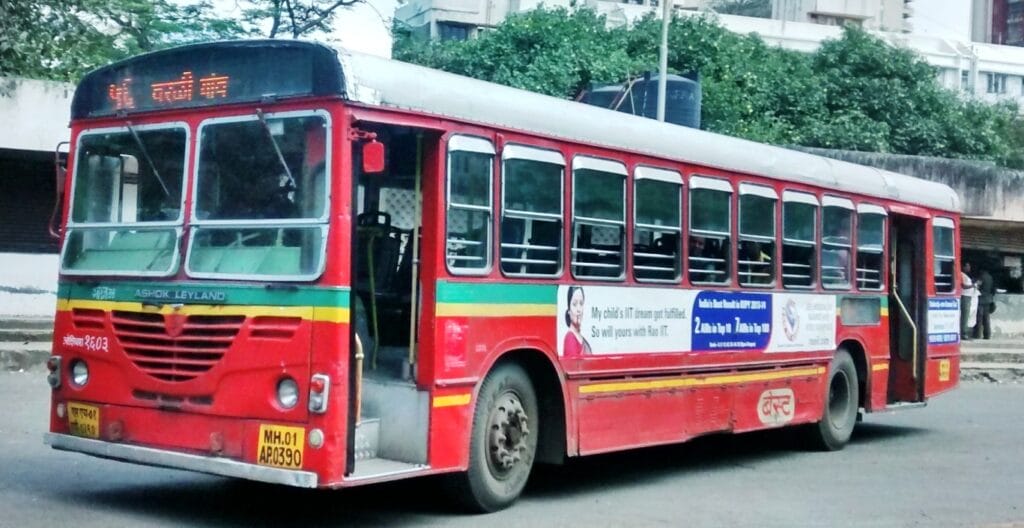
In 2018, BEST introduced wet-leasing. Sudas Sawant, Public Relations Officer of BEST, explains that under the wet-leasing arrangement, contractors own and operate buses, and are also responsible for staff recruitment, fuel and maintenance of buses. In return, BEST pays the contractors a fixed amount per kilometer of transport. Sandhya Gokhale of Aamchi MUMBAI Aamchi BEST! (AMAB), a citizens’ forum campaigning for better public transport, says BEST’s drivers and conductors are relatively well paid, and the wet-leasing arrangement was aimed at cutting this salary cost.
In 2019, BEST workers went on a nine-day strike demanding better wages, bonuses on par with BMC workers, etc. A few months later, the workers’ union and BEST signed an MoU, according to which BEST would maintain its own fleet of 3,337 buses and not alter the service conditions of its existing employees. The Municipal Corporation of Greater Mumbai (MCGM) would fund new buses to replace the buses scrapped from this fleet. Beyond this, BEST was free to acquire more buses through wet-leasing, the MoU said.
Read more: The case for merging Mumbai’s suburban public bus systems
Breach of agreement and a dimished fleet
Over the years, BEST breached the terms of the MoU, whittling its own fleet down by over a third – from 3,337 to just 920. In the meantime, it added to a burgeoning number of wet-leased buses, standing at 1,935 currently according to Sudas.
That is, even though BEST had agreed to maintain its own fleet of 3,337 buses, currently the combined fleet of its own buses and the wet-leased buses fall short of this number. People using BEST as a primary means of transport to get to work, schools, colleges and health centres have paid a heavy toll for this.
Worse, BEST is set to scrap more of its buses. Speaking to Citizen Matters, a senior BEST official said the company’s current fleet of 920 buses will shrink to 666 by April 1st. It will further shrink to 229 in another year – that is, by April 1st, 2026.
| Other than scrapping worn out buses, BEST has scrapped bus routes with low ridership over the years. An RTI response has shown that BEST scrapped 2,160 buses from its own fleet over the past five years. Though BEST should have replaced all these buses as per its MoU with the BEST Workers’ Union, it added a meagre 37. |
Clearly, the terms of the MoU have not been honoured, and the workers’ union has taken the matter to court, says Shashank Rao, General Secretary of the BEST Workers’ Union and a leading voice in demanding the scrapping of the wet-leasing model.
No benefits from wet-leasing
Despite wet-leasing, account books do not show a reduction in BEST’s losses, PRO Sudas says. Yet, he says, BEST cannot terminate the wet-leasing contracts as it does not have enough buses of its own. Outsourcing a vital public service like transport seems to have compounded the problems hounding BEST.
In Part 2 of this series, we explore how contractualisation has impacted the quality of BEST’s services.
Also read:
- Inaccessible public transport: Difficult and expensive travel for differently-abled
- Interview with Sudhir Badami: How transport in Mumbai is evolving
- Navi Mumbai is making public transport more enjoyable for travellers