For the average Chennaiite, the daily commute has become an arduous task of navigating peak-hour congestion, poor footpaths and an unreliable public transport system. Ahead of the Assembly elections on April 23rd, the gap between official promises and the reality on the road continues to widen.
Here is what the numbers say:
- Currently, the Metropolitan Transport Corporation (MTC) operates a fleet of 4,110 buses and launched 120 low-floor electric buses in 2025. However, experts say the city actually needs 7,000 buses for comfortable travel and better last-mile connectivity.
- Residents flag overcrowding and long wait times, which force many commuters, especially in suburban areas, to avoid public transport and opt for private vehicles. While the city has 22 feeder buses across 11 routes, its ridership is low, while costs are high.
- Meanwhile, private vehicles are on the rise — a study of 5091 mall-goers found that only one-third relied on public transport. Moreover, nearly 21.18 lakh vehicles were registered in Tamil Nadu last year, with a majority in Chennai, Chengalpattu, and Tiruvallur districts.
As part of the election campaign, Chief Minister MK Stalin took the Metro to interact with commuters from Chennai Central to AG-DMS. In 2021, he had travelled on the M-19B bus that runs from Kannagi Nagar to T Nagar. But the question is: would the system improve if elected officials had to use public transport every day, rather than just during election season?
In our fourth pre-poll conversation, we spoke to residents in Chitlapakkam, Velachery and Sholinganallur to discuss issues on public transport, walkability, and mobility in their areas.
Voices of Citizen manifestos
- Introduce additional direct suburban railway services between Tondiarpet and Avadi.
- Establish a suburban railway station near MKB Nagar.
- Reduce forced interchanges at Basin Bridge Junction, which affects daily commuters.
- Fast-track Metro Phase-2 with clear milestones.
- Enable universal access features for senior citizens and persons with disabilities.
- Remove illegal road encroachments that have narrow arterial roads.
- Publish a traffic and road-safety improvement plan for each locality.
- Ensure continuous, well-lit, and walkable footpaths across the city.
- Set up Electric Vehicle (EV) charging stations without obstructing footpaths.
We collated the above points based on manifestos released by several resident groups, including FOMRRA, Perambur Neighbourhood Development Forum, a cluster of South Chennai RWAs. The manifestos can be read on Opencity here.
Gaps in last-mile connectivity
In April, the Chennai Unified Metropolitan Transport Authority (CUMTA) and Chennai Metro Rail Limited (CMRL) launched a city-wide survey to finalise routes for 220 buses and assess last-mile connectivity to metro stations. This survey is an important part of CUMTA’s Comprehensive Mobility Plan, which has ambitious long-term goals for the city’s transit.
The plan aims to streamline public transport for 145 lakh people in the Chennai Metropolitan Area, by increasing bus ridership to 65 lakh and metro ridership to 45 lakh by 2048.
As CUMTA works towards finalising feeder bus plans and routes by the end of 2026, residents say the situation is already dire. The problem is starkest in suburban areas. Despite being home to major IT parks and large residential communities, only 45 of Chennai’s 730 MTC bus routes serve Old Mahabalipuram Road (OMR), according to a survey by the Federation of OMR Residents Associations (FOMRRA). Interior localities remain outside the reach of both MTC buses and private operators like share autos.
“The government is approving residential projects, but there is no infrastructure development or transport facilities to serve commuters. Just to reach the main road, we walk two kilometres,” says A Sivakumar, a resident of Sholinganallur. Small buses have been introduced in some areas. However, the need for full-sized MTC buses, metro connectivity, and proper bus stops remains unmet, he says.
Read more: How OMR residents strive for better last-mile connectivity and improved public transport
The situation is similar in Chitlapakkam in the Tambaram constituency. “While Grand Southern Trunk (GST) Road has big buses running, Medavakkam lacks a bus route for a 6-km stretch,” says resident Dayanand Krishnan. The S100 feeder bus, running from Airport Metro station to Tambaram East via Pallavaram, Chromepet, and Chitlapakkam, has helped; however, residents say it is not frequent enough, and more options are needed.
Commuter-friendly facilities needed
Narrow road bottlenecks and sharp curves between the GST Road and Tambaram-Velachery Road also prevent larger buses from operating on key stretches. The result is predictable: commuters default to private vehicles just to reach a public transport hub. “Until the last-mile connectivity issue is addressed, we can’t see a shift to public transport in this locality,” adds Dayanand.
In Ambattur, residents have called for pedestrian and cycling infrastructure, and better integration between Ambattur Railway Station and Ambattur Bus Terminus. In Velachery, TD Babu flags the neglected basic infrastructure at Mass Rapid Transit System (MRTS) stations — locked bathrooms and poor links to interior neighbourhoods.
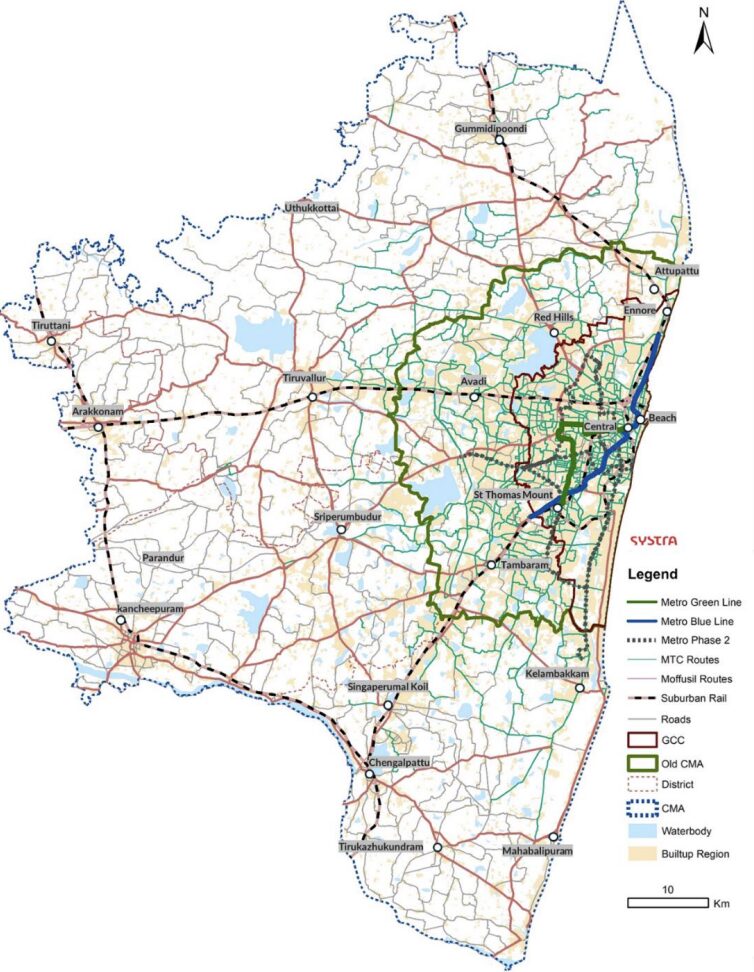
Across these localities, one ask is consistent: accelerate metro construction. The 118.9 km-stretch Phase 2 expansion, covering three corridors — Madhavaram to SIPCOT, Lighthouse to Poonamalle Bypass, and Madhavaram to Sholinganallur — is estimated for completion by 2028. Amid delays and scarce updates, residents say metro expansion remains their best hope for reducing road congestion and making public transport viable.
Need for infrastructure and walkability
Better routes are not be enough, if the infrastructure remains poorly planned or maintained. Residents across localities point to absent bus shelters, roofless foot-over bridges, poor bus frequency, and damaged pavements as barriers that make public transport impractical even when it exists.
Climate is an added pressure. Chennai’s intense heat and heavy north-eastern monsoons make it essential that bus stops and metro infrastructure offer adequate shelter and accessibility. Meanwhile, most bus stops in the city fall short of the Accessibility Guidelines for Bus Terminals and Bus Stops (2023), issued by the Ministry of Road Transport and Highways (MoRTH).
Read More: Are Chennai’s bus stops and terminals truly accessible? A reality check
As for walkability, Chennai was the first Indian city to adopt a Non-Motorised Transport (NMT) Policy. The state had aimed, by 2018, to build safe and continuous footpaths on 80% of all streets, increase walking and cycling trips to over 40%, and eliminate pedestrian deaths. Over 170 km of streets with footpaths were developed between 2014 and 2019 but experts say much of the city still falls short.
Take the example of Velachery. Despite being part of the Smart City Mission and undergoing beautification work, the area still lacks encroachment-free, continuous pavements, say residents. “Though we have AC low-floor buses, for me to walk out of my house is a big nightmare. I have no proper footpath, and no proper zebra crossing on the main road,” says Babu.
Raising concerns over the overall urban planning, Babu points to the recent widening of Sardar Patel Road in Adyar, where a 2.5 km stretch from IIT Madras to Chellammal College is being expanded from four lanes to six. The project has sparked backlash as it requires felling nearly 100 trees, some up to 60 years old.
For Babu, the broader request is: build infrastructure that reflects the lifestyle and mobility needs of residents. Residents urge their elected representatives to assess gaps in public transport coverage, utilise funds to bridge the same, and reduce congestion on roads and plan footpaths.
What residents want
Across Chitlapakkam, Velachery, Sholinganallur, and Ambattur, residents demand their elected representatives must:
- Develop a comprehensive plan before undertaking flyover projects.
- Consult residents and understand local needs ahead of infrastructure work.
- Improve last-mile connectivity and public transport planning to reduce private vehicle dependence.
- Expand bus bays across the city.
- Formally recognise and integrate share-autos into the public transport system to reduce congestion.
- Introduce annual vehicle registration ceilings at every RTO office.
- Address parking issues across the city.
- Streamline the Chennai One app, upgrade it to deal with transfers of stations.
- Fix the real-time GPS tracking of buses.
The problem isn’t just a lack of buses, but also a lack of integrated planning. Residents are ultimately forced to use private vehicles because public transportation is unreliable. An excellent article to serve as a reminder to candidates.