As visitors arrive at Kempegowda International Airport, they are welcomed by lush indoor greenery designed to showcase Bengaluru’s identity as the “Garden City.” Beyond the airport gates, however, the reality is starkly different. Roads and streets all over the city are losing the green cover that once defined its character, to make way for metro lines, elevated corridors, and road-widening projects. Development is essential for a growing metropolis. But when it comes at the cost of thousands of trees, it raises a difficult question: can Bengaluru continue to build for the future without erasing the very landscape that made it liveable?
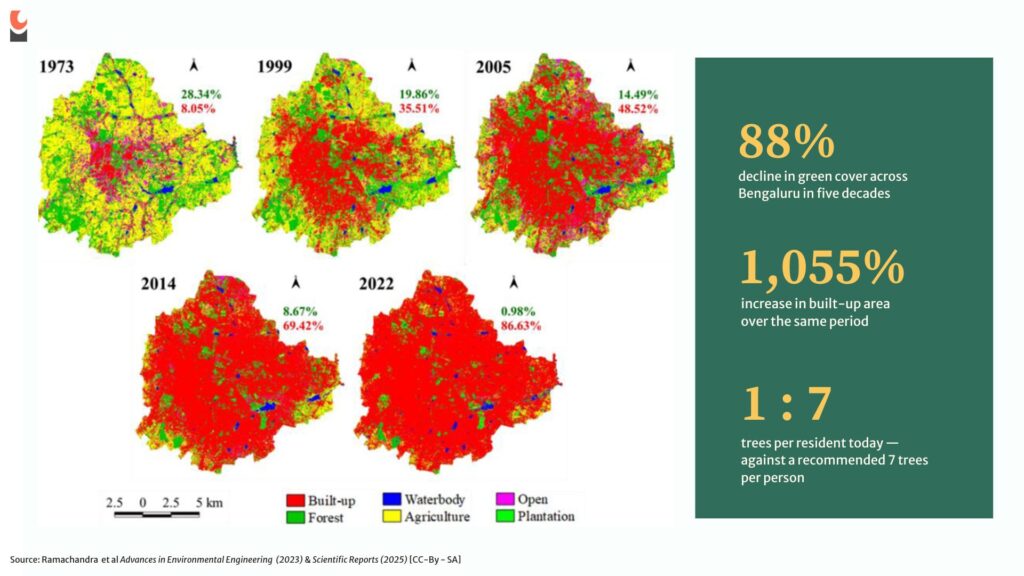
The city is getting hotter every year and this is not accidental. Unregulated expansion of Bengaluru, with increased concretisation, white-topped roads and diminishing greenery, is intensifying the Urban Heat Island (UHI) effect. In just five decades, tree cover has declined by 88% and the built-up area of the city has dramatically increased by 1055%.
In a 2025 study outlining Bengaluru’s evolution from ‘Garden City’ to ‘Silicon City’, TV Ramachandra, Professor, Centre for Ecological Sciences at Indian Institute of Science (IISc), points out a glaring imbalance: while ideally there should be seven trees for every person, Bengaluru currently has just one tree for every seven residents.
Timeline of urban sprawl
Ramachandra’s study draws the timeline correlating the urban growth, concretisation and reduced green cover.
1973-1992: Steady annual growth of 1% with establishment of nationalised public sector industries.
1993-2002: Globalisation and relaxation in markets resulted in the emergence of the IT sector.
2003-2012: Annual growth rates surged to 2.01% as a result of private industries expansion and Special Economic Zones (SEZ). The associated employment opportunities and population growth pushed peri-urban landscapes for residential and commercial development.
2012-2021: Intense urban growth, driven by the expanding IT sector and the resulting influx of population, pushed the annual urbanisation rate to 3%.
Post 2021: The city witnessed an annual urbanisation rate of 0.5%, driven by the expansion of residential layouts and low-density urban sprawl beyond then BBMP limits, which engulfed neighbouring agrarian spaces.
Recent infrastructure developments to accommodate Bengaluru’s growing population are causing major environmental damage. Between 2020 and 2025, around 20,000 trees were axed within corporation limits, many for metro construction.
Read more: No city is an island: Urbanists warn against Bengaluru’s unfettered expansion
Namma Metro, what about namma maragalu?
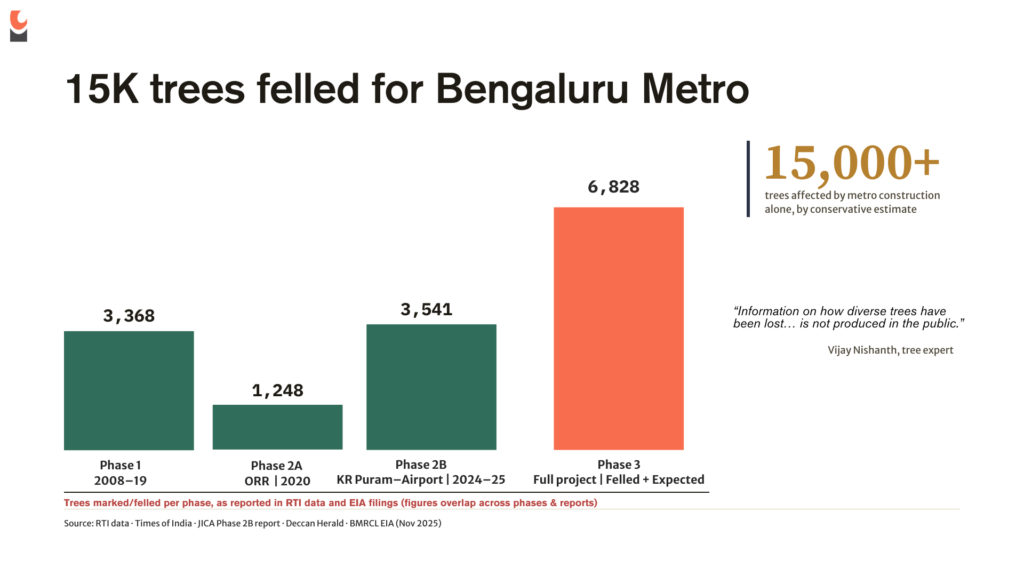
According to RTI data obtained by the Times of India, till 2021, Namma Metro construction caused the felling of 9,000 trees. The news report mentions that between 2008 and 2019, 3,368 trees were cut. And between 2019 and 2021, for Phases 2, 2A and 2B, the forest department and BBMP forest cell gave the nod for felling 5,786 trees.
Information regarding tree felling for metro construction is limited and scattered, as the Bangalore Metro Rail Corporation Limited (BMRCL) is yet to publish comprehensive data on green cover loss.
Bengaluru-based tree expert Vijay Nishanth notes, “The public lacks data on how many diverse trees have been lost to metro construction, as well as how this has contributed to impacts on the environment, local livelihoods, and biodiversity.” He emphasises that transparency is essential, adding, “Only then can citizens expect truly holistic and sustainable development.”
Now, post 2022, this is what we found after examining Environmental Impact Assessment (EIA) reports published in 2020, news reports and an EIA report published in November 2025:
Indiranagar elevated corridor project
The Bengaluru Smart Infrastructure Limited (B-SMILE) published a Detailed Project Report (DPR) in February 2026 for the proposed construction of an elevated corridor on Old Madras Road, from Swami Vivekananda Metro Station to Silk Board Junction on Hosur Road via Indiranagar. The DPR notes that the neighbourhood would lose 89 trees because of this project.
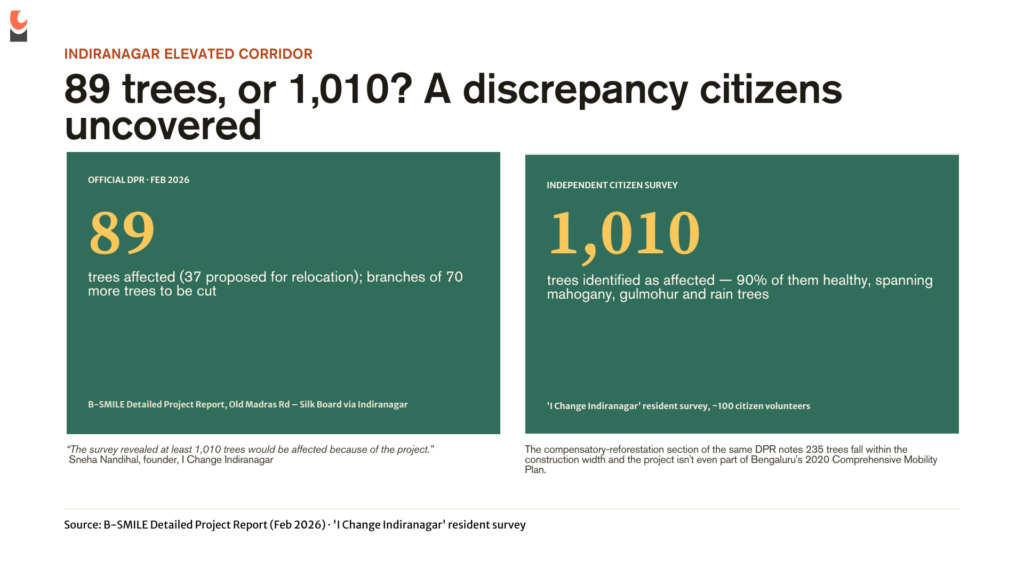
Sneha Nandihal, founder of the residents association, ‘I Change Indiranagar’ points out, “The proposed project is not even a part of the 2020 Comprehensive Mobility Plan and is not going to help ease traffic. She adds that tree felling would change the face of the locality.
Citizens noted that 90 per cent of the 1010 trees are in good health and include diverse species including mahogany, gulmohur and rain trees. Many of them support unique bird species. “Around 100 citizens participated in the independent tree census and another round of census is also being planned,” says an Indiranagar resident, who did not want to be named. The resident, who moved to Indiranagar around 20 years ago, laments that the area had already lost many trees and was experiencing increased heat and pollution because of tree felling.
Rains, tree felling and concretisation
Another concern is the uprooting of trees during the rainy season.
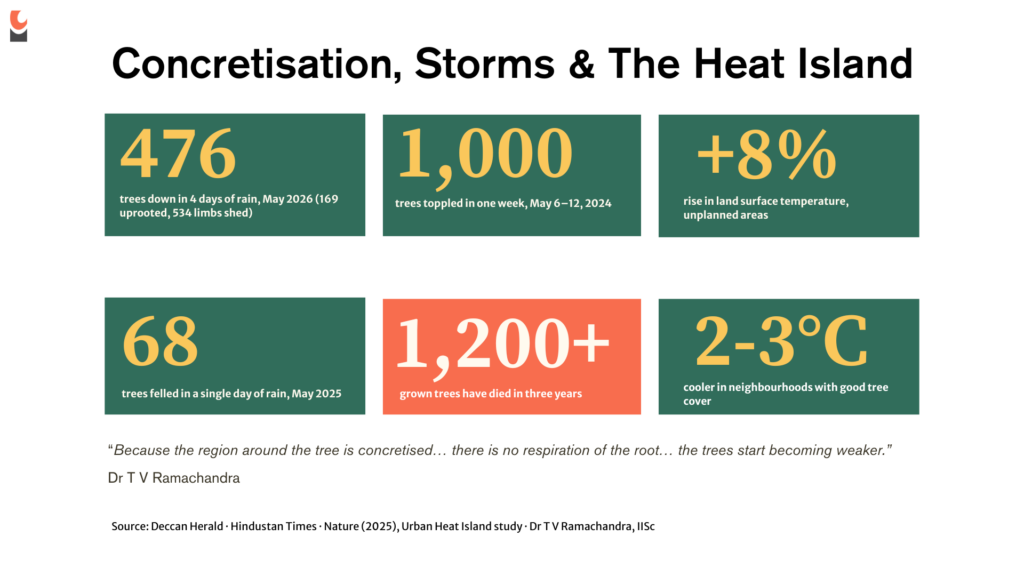
That is more than 1,200 grown trees falling dead in just three years. “Many of these trees fell prey to white-topping of the roads and urbanisation,” Vijay Nishanth says. White-topping of roads and frequent road cutting for drainage work weaken root systems, making trees far more vulnerable to storms.
“Because the region around the tree is concretised and the stem portion is blocked, the roots are not able to breathe and the nutrient exchange does not happen. Eventually, the trees start getting weaker,” explains Ramachandra. “When the trees become weaker, the pest attack happens.” He adds that the lack of scientific road design was the root cause of the problem. “It is removing trees without those losses even being counted as tree felling.”
Nearly 200 km of roads in Bengaluru have been white-topped so far, including major stretches such as JC Road, Outer Ring Road (ORR), and Seshadri Road (from Sangolli Rayanna Circle to KR Circle). As of January 2026, Bengaluru Smart Infrastructure Limited has achieved 51% progress on an additional 125 km of white-topping projects covering Nagawara Road, Tannery Road, Dinnur Road, and Holiday Village Road. Moreover, Chief Minister D. K. Shivakumar announced a Detailed Project Report (DPR) in October 2025 for white-topping another 500 km of city roads.”
Bangalore Political Action Committee’s (B.PAC) Urban Forestry Handbook for Bengaluru also points out that often buildings are constructed close to their gates, leaving little space for trees.
Ambiguity around the tree census
“Data and monitoring of trees is very important to protect them,” notes Vijay. “That helps to know the tree species, health, size, which would help compensatory planting to be more holistic”.
However, starting in 2019, the tree census has not been completed yet. Last year when we reported on this, Ms.Preeti Ghelot, then BBMP’s Special Commissioner for Forest and Environment, said that the errors in the census would be fixed and would be completed soon. The census has still not been finished and the Geographic Information System (GIS) data which was public at that time is now inaccessible.
Read more: Bengaluru’s tree census: Flawed data undermines efforts to protect city’s green cover
Effect on air, water and the environment
“The city will become unliveable,” Vijay warns, emphasising that destroying green cover is not holistic development. He says that massive tree felling triggers heat stress, water shortages, groundwater depletion, and biodiversity loss, adding, “We’re already seeing fewer birds and declining species diversity during the day.”
A study on Urban Heat Island (UHI) compared the rise in Land Surface Temperature (LST) in planned and unplanned cities. It revealed that LST in unplanned cities rose by 8% compared to 2.65% in planned cities. It is not just the numbers, but it is evident to every citizen that summers are getting hotter than ever before.
The consequences of losing Bengaluru’s trees extend far beyond a changing skyline. According to Ramachandra, trees and water bodies act as the city’s natural “heat sinks”, regulating the local microclimate by providing shade and releasing moisture through transpiration. When mature trees are removed and replaced with concrete, more solar radiation is absorbed and reflected by roads and buildings, causing neighbourhoods to heat up faster. “Areas with good tree cover can be 2–3°C cooler than those with sparse vegetation. Without tree canopies, solar radiation reaches the ground directly. Trees transpire and naturally help lower temperatures,” he adds.
Why it is important to act now
Shrinking tree cover and expanding concrete are driving Bengaluru’s Urban Heat Island (UHI) effect, making built-up areas warmer than surrounding green spaces. This loss of natural cooling worsens air pollution, increases energy demand for cooling and intensifies heat stress, especially for outdoor workers, children, and the elderly. “We are losing air purification, oxygen production, and temperature moderation,” notes Ramachandra, cautioning that unchecked development leaves the city vulnerable to climate change.
Groundwater in the city is already over-exploited. As vegetation gives way to concrete, less water percolates into the soil and more runs off the surface, reducing groundwater recharge. According to Ramachandra, this loss of permeability was one of the factors that contributed to Bengaluru’s recent water crisis. He warned that replacing green spaces with concrete not only intensifies heat but also weakens the city’s ability to withstand droughts and erratic rainfall under a changing climate.
But not all is lost. Citizen groups have long campaigned for saving urban trees, and here’s how they did it.
How citizen action saved trees
- In December 2025, Karnataka High court ruled against felling of 370 trees near Cantonment Station after months of citizen protests.
- Tree hugging protests in Bidadi are stalling the controversial township project that is expected to cut 2 lakh trees.
- Students protests in Bengaluru University Janabharathi Campus saved more than 400 trees from felling in November 2025.
“Citizen movements are a major reason that many trees are being saved,” Vijay said. Quoting examples of Hesaraghatta reservoir project that proposed around 200 trees to be cut, and the Bidadi township project that may claim two lakh trees, he concludes, “Citizen protests are the primary reason that these projects are stalled and the trees are being protected. If not for the citizen movement, the city would have much fewer trees now.”
For every tree axed, five trees re being planted, whitetopped roads in fact protect trees better than other roads. Article is biased