Amid global crises like climate change, concepts such as solastalgia (distress produced by environmental change), eco-grief, and eco-anxiety are becoming familiar. Climate change’s impact on mental health has only recently cropped up in research, with studies finding connections between the climate and depression, Post Traumatic Stress Disorder (PTSD) and suicidal thoughts.
Around 50% of Indian youth aged 14 to 25 experienced increased stress due to worsening climate, according to a survey by the Centre for Science and Environment (CSE). Other studies have found that repeated experiences with flooding, which occur particularly in eastern and southern India, appear to contribute to PTSD and eco-anxiety. Communities vulnerable to social hierarchies of gender and caste, or those working in climate-dependent occupations, such as agriculture and fishing, face intensified psychological distress.
However, the dialogue on mental health has largely consisted of journalistic and academic articles looking for pre-determined emotions or conditions like stress and depression. The use of tools and hands-on interventions to help the general public reflect on their full emotional landscape has been limited.
At Care Earth Trust, a biodiversity research organisation in Chennai, we used the ‘climate emotions wheel’ to help the public reflect on their emotional engagement with climate change beyond stress. We set it up during the Chennai screening of the All Living Things Environmental Film Festival (ALT-EFF) in December 2025. The day-long screening showcased seven films spanning several subjects, from wildlife conservation to the grief of species extinction.
The wheel showed us that emotions towards climate change are not one-dimensional, and ‘climate anxiety’ is not limited to one specific feeling, like worry. Moreover, being aware of these emotions can inspire us to rethink our relationship with the planet.
Mapping emotions about climate change
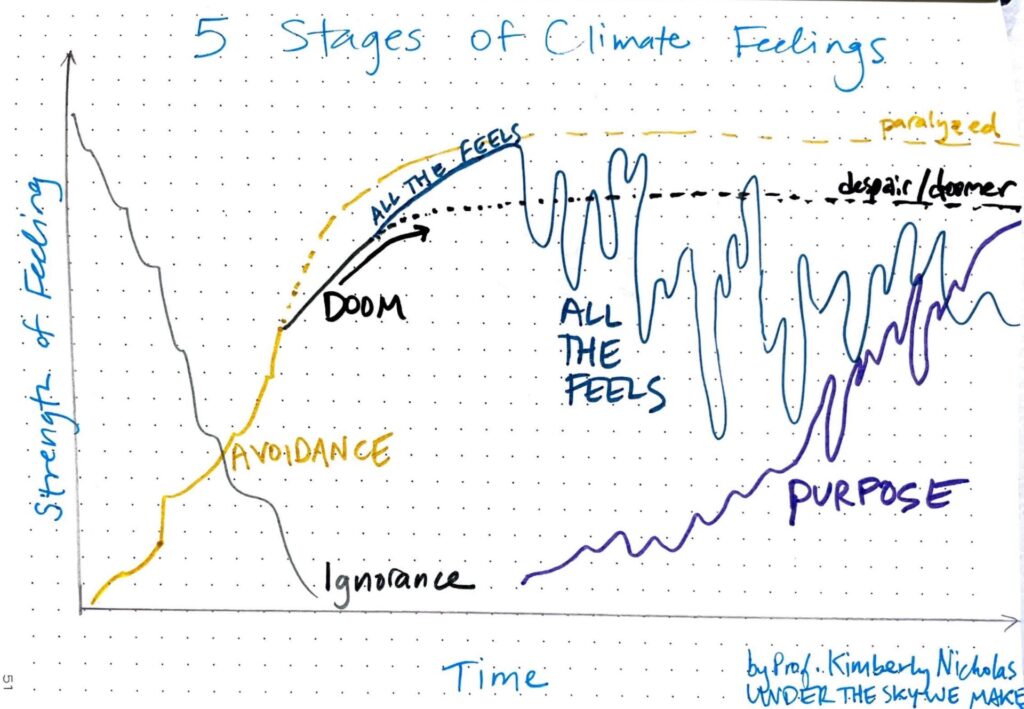
Visualising emotions is not new. In 1980, American psychologist Dr Robert Plutchik created the Wheel of Emotions – a graphic depiction of emotions that maps eight core emotions (joy, sadness, acceptance, disgust, fear, anger, surprise, and anticipation). Within the scope of climate action, there are alternative forms of visualisation, such as the climate scale or the Stages of Climate Feelings by Dr Kimberly Nicholas. At the film festival, we helped the audience visualise their emotions through ‘The Climate Emotions Wheel’ published by Climate Mental Health Network.
What is the climate emotions wheel?
Designed in 2022 by Panu Pihkala, University of Helsinki, the exercise helps people identify feelings in response to climate change. It also brings up questions to sit with that feeling. The wheel visually invites people to mark what feelings arise when they think of climate change.The wheel shows four major emotions— anger, sadness, positivity and fear—subdivided into 23 specific feelings. With this specificity, the wheel enables emotional granularity.
Read more: When the Earth hurts, we hurt: Understanding eco-anxiety and eco-grief
The Climate Emotion Wheel Guide also provides a helpful toolkit to further navigate the dynamics of climate emotions by evoking questions about the emotions. Each emotion is accompanied by a question, either linked to environmental action (such as ‘when and where have I felt empowered in climate action?’) or related to emotional regulation (such as ‘what level of worry is constructive?’).
During breaks at the film festival, participants were introduced to the wheel displayed on canvas. With the help of a visual guide, they chose and fastened to the wheel shapes fashioned from scrap fabric which most represented the sub-feelings they experienced.
Beyond worry, hope and anger
Over the course of the day, the activity recorded 89 responses from a diverse group of participants, including students, researchers, conservationists and sustainability practitioners aged 18 to 70 years old.
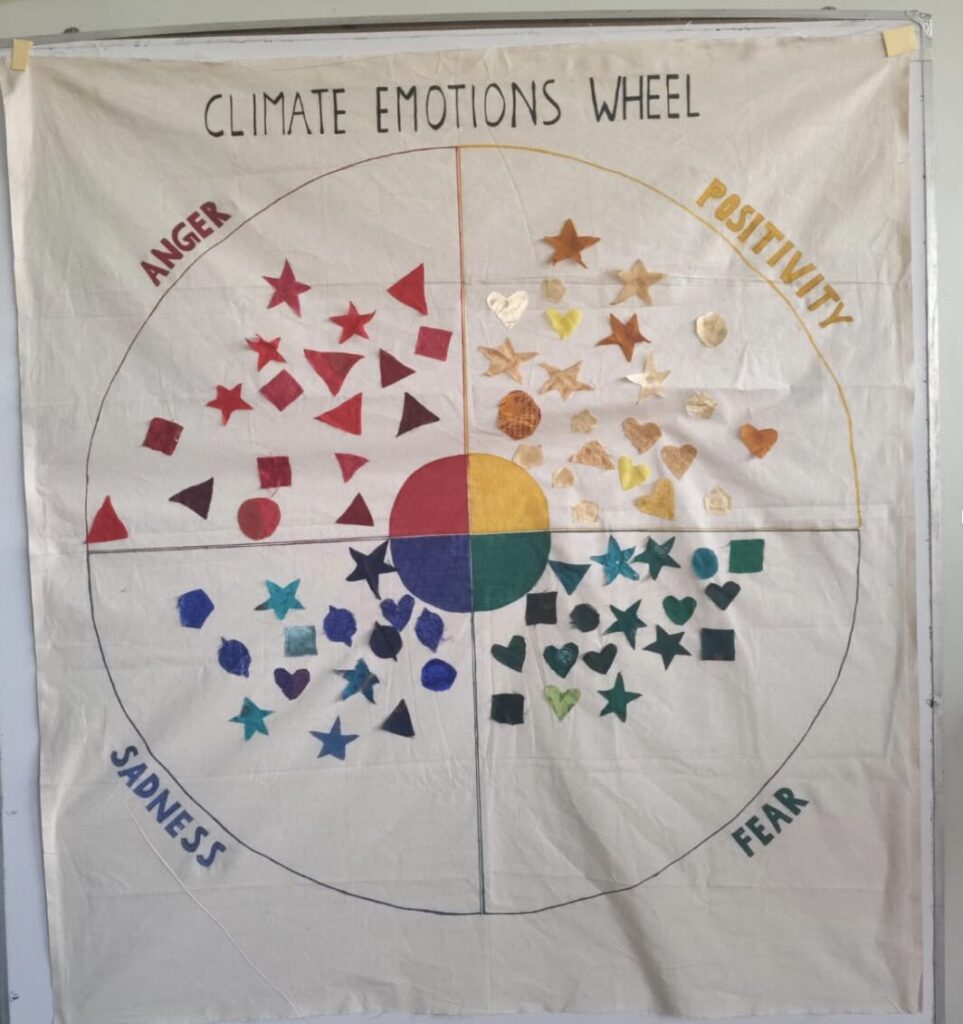
Before conducting the activity, we expected very few responses on the positive emotional spectrum, assuming that concern, fear or sadness would dominate. This is perhaps a reflection of our own biases regarding the response to climate change. However, the results were more nuanced, with more responses than the number of participants, indicating many did not limit themselves to a single emotion.
Positive emotions formed the largest overall category, with 26 responses. Participants expressed gratitude for ongoing environmental efforts and hope for collective action. Twenty-one responses were recorded for anger-related emotions, particularly with frustration emerging prominently.
In the fear category, which recorded 22 responses, worry and anxiety were among the most commonly expressed emotions, reflecting uncertainty about future environmental outcomes.
Another interesting insight was that the empowerment category received no responses at all, suggesting a gap between awareness and people’s sense of agency to act. This revealed thinking about climate change was multi-layered, evocative of a mix of concern, hope, frustration, and uncertainty.
These opposite feelings all co-exist, and can drive us to protect nature together. Indeed, the CSE eco-anxiety survey also found that 22% of youth are motivated to take action against the climate crisis.
What the tool can do
Post ALT-EFF, we have tried the wheel exercise at other gatherings, such as at a middle school and a professional training academy. It elicited more responses in fear and anger categories than positive categories, suggesting variations across demographics. The kind of environment in which participants report their feelings might also influence which emotions they identify.
As researchers and nature educators, we found the Climate Emotion Wheel to be a great starting point for conversations about climate action. Climate communication and community engagement efforts may benefit from first understanding the diverse responses and emotional baseline of audiences.
Different emotions about climate support may shape support for both regulatory and proactive policies and prompt action, finds a new study. Policymakers could then design campaigns for policy or design policy itself in cognisance of public emotions. Educators could use this to introduce activities or stories that address the emotions of students.
Research has shown the importance of labelling and identifying these feelings in the first place. Indeed, it could be considered the first step to emotional regulation, also suggested by the famous ‘Name It to Tame It’ technique framed by Dr Daniel Siegel, psychiatrist and author. The intensity of negative emotions can be reduced by being able to recognise and question them. This could pave the way for emotional resilience.
Going forward, the wheel can be used for:
- Starting conversations and identifying complex emotions related to climate change.
- Aiding self-reflection and discussion.
- Designing campaigns for policy or informing policy.
While several pathways are possible after the exercise, it is important to remember its inherent value. It aids in informing future action, as well as in identifying emotions and connecting with others about how we are doing, especially regarding climate change. By engaging with our emotions responsibly, our relationship with the environment can look less like loud issues and headlines, and more like experiences and action plans that can be meaningfully addressed together.