M Ravi, a 63-year-old resident of Sarvamangala Nagar in Chennai, fondly remembers the days when he would bathe in Sembakkam Lake before heading to college. “Early mornings were cold as we lived close to the lake. I neither had the time nor the means to heat water. A clean lake gave me not just a place to bathe but also taught me how to swim. Rain or shine, it was central to our social life,” he says with a smile.
Nearly five decades later, he stands before the same lake, now choked with sewage, and feels a deep sense of loss. “My heart feels heavy. The thought that my grandson may never see the pristine lake as I once did makes me worry about the future. I wonder if the lake will ever be restored in my lifetime.”
For Ravi, the lake no longer evokes nostalgia but dread. “Since the 2015 Chennai floods, even moderate rain, or news of floods elsewhere, reminds me of water rushing into our home.”
A place once associated with joy now triggers fear, grief and anxiety for Ravi. This emotional distress, linked to environmental degradation and climate change, is known as eco-anxiety or climate anxiety.
Eco-anxiety affects not just sexagenarians like Ravi, but is even more widespread among the youth. A recent survey reveals that 94% of Indian youth are grappling with eco-anxiety amid the climate crisis. The Intergovernmental Panel on Climate Change (IPCC) Sixth Assessment Report notes that anxiety, depression, and post-traumatic stress linked to climate change are expected to rise, worsening existing mental health issues.
Everyday manifestations of climate anxiety
MV Pavethra, a 22-year-old professional dancer from Velachery, notes that climate anxiety feels especially real in a city like Chennai, with its extreme heat, sudden heavy rains, and frequent flooding. “It has become a constant background worry. It is no longer just about the weather. It feels like everything is getting worse, and we are powerless to stop it.”
For instance, in areas like Velachery, waterlogging is a serious concern. “The roads become almost unmanageable, and at times it genuinely feels like a life-or-death situation. Every time a family member steps out for work, I worry about their safety, especially on days of unpredictable rain,” she says.
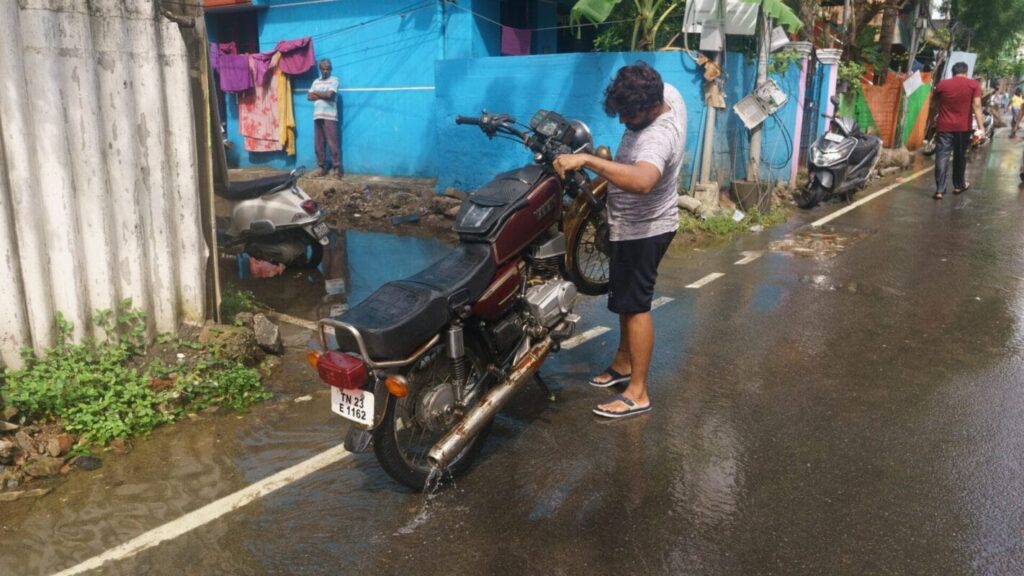
With remote and hybrid work now common, Pavethra says unannounced rain-related power cuts throw her routine into chaos. “Almost every aspect of our lives depends on electricity. When power is cut, work piles up, and the stress is overwhelming,” she adds.
MV Amudhini, a 24-year-old PR professional, finds air pollution from predictable events like Diwali equally distressing. “It triggers my asthma. Every December, during the monsoon season, I worry about rain damage, power outages, and how long I might be stranded at home.”
Heat brings its own set of challenges. Many people are unaware of heat-induced illness. Ayesha Ajmal, a 35-year-old Chennai resident, shares, “Even with an air conditioner, I suffer from skin irritation and eye infections during summer. I need daily medication to cope.”
Read more: SCARF’s 40-year journey in Chennai shows how mental healthcare has evolved
Climate anxiety and financial stress
As Ayesha notes, even access to an air conditioner comes with its own problems, from health issues to increased financial burden. From commute planning to managing monthly expenses, climate uncertainty is affecting everyday life.
“When I was younger, we never needed to use an air conditioner during the summer or monsoon. Now, even during monsoon months, I need it because of high night-time temperatures. Despite being mindful of my spending, small expenses like buying juice to combat heat exhaustion add up. These come out of my savings, leaving me feeling financially insecure. It increases my anxiety about handling a medical emergency for myself or my family,” adds Amuthini.
Malarvizhi, a 37-year-old homemaker from Madipakkam, says the weather now influences her financial planning. During Cyclone Michaung in 2023, her home was flooded, and her family had to be rescued by boat. All household appliances were destroyed. “The fear, uncertainty, and helplessness of waiting for help, especially for the safety of our children, made us reconsider our financial priorities. Although most of our savings went into replacing appliances, we now set aside funds to book hotels or travel to our hometown before heavy rains,” she says.
While those with financial means can plan to some extent, climate change imposes a much heavier burden on low-income communities.
Disproportionate impact of climate anxiety on low-income communities
Whether it is extreme heat or heavy rainfall, water is the central issue, says Mercy, a resident of Perumbakkam. Summer brings water scarcity. “Water supply is irregular. Power cuts are frequent. If women are not at home when water is available, they miss it. But staying home means losing a day’s income, as many of us are daily wage earners.”
Frequent power cuts also mean lifts in resettlement buildings do not work. “Women have to carry water up eight floors. The burden always falls on us. We feel tired, angry, anxious, and helpless,” she adds.
Vanessa Peter, founder of the Information and Resource Centre for the Deprived Urban Communities (IRCDUC), notes that domestic violence can erupt when men return home to find no water. To help, IRCDUC lets community workers in Perumbakkam begin work late on water supply days.
Mercy says that even with moderate rain, their locality gets flooded. Recovering from such events can take years. “For example, my husband’s auto was stuck in floodwaters for a week. Repairing it cost ₹30,000. We had no choice but to take a loan from microfinanciers. Most people here work in the unorganised sector, so extreme weather directly impacts our livelihoods. If my husband gets fewer passengers in a day, we can’t repay the loan. Then we have to borrow again, falling into a never-ending cycle of debt. How can we plan financially for disasters when we’re always trying to recover?” she asks.
Limited access to mental health support
Dr AR Shanthi, Secretary of the Doctors Association for Social Equality, highlights a significant disparity in access to mental health services for individuals from low-income backgrounds. She points out that even those suffering from severe and chronic mental disorders such as schizophrenia often struggle to receive adequate care. In such a context, seeking professional support for conditions like climate or ecological anxiety remains an unaffordable luxury for most.
“Only those from the upper-class or otherwise privileged backgrounds can afford private mental health services,” she explains. “Our public healthcare system lacks both the manpower and the infrastructure to treat even the WHO-recognised mental disorders. At the district level in Tamil Nadu, there are often only one or two mental health professionals available, and they are already overwhelmed managing everything from substance addiction to schizophrenia,” she adds.
Doctors Association for Social Equality also demands that the Tamil Nadu government appoint more mental health professionals in proportion to the increasing and emerging mental health-related cases.
Notably, the ‘National Health Action Plan on Climate Change and Mental Health’ outlines a framework for establishing infrastructure to address climate-induced mental health issues. Yet, it has not been effectively implemented on the ground, say mental health experts.
Read more: Expenses, social stigma deter urban poor in Chennai from seeking mental health care
How do people cope?
Although climate anxiety is becoming more common, most people remain unaware of how to manage it. Reflecting the thoughts of many, Pavethra says, “I barely cope with these emotions. It always feels out of control. All I can do is share my frustration with others who are experiencing the same. When it rains, I try to stay prepared, charging devices, carrying raincoats, and driving slowly. But even then, it feels exhausting.”
Though systemic change through government policy is vital, small individual actions can offer short-term relief. “I try to be mindful of my consumption and choose to use as little as possible. It may not change the larger picture, but it gives me a brief, perhaps even false sense of control,” says Amudhini.
Acknowledging that real change comes from holding the major businesses and industries that do the most damage, accountable, she says, “Taking action to pressure the government and policymakers to integrate climate conversations as a foundation to every policy decision, helps to take control and cope with the uncomfortable niggling in my chest. Engaging with the problem rather than dissociating from it helps me,” she adds.
In part two of this article, we speak to experts and explore coping mechanisms, the significance of community initiatives and the need for policy interventions.