The constant tug of war between legally registered property owners and Bruhat Bengaluru Mahanagara Palike (BBMP), now the Greater Bengaluru Authority (GBA), over stormwater drain (SWD) and lake encroachment clearance is not new to Bengaluru. The city remembers one of the most prominent instances of this face-off that surfaced in August 2016, when the BBMP demolished 10 structures in Shubh Enclave Layout on Haralur Road. City authorities claimed that the layout had encroached on a secondary drain connecting Kasavanahalli and Kaikondarahalli lakes.
In November 2024, BBMP, now restructured as GBA, declared that they had cleared up all SWD encroachments, despite the Revenue Department objecting to GBA’s claim. The civic body will take up no more demolition drives unless there are fresh bottlenecks.
But what happens after these demolition drives? Do the neighbourhoods enjoy the fruits and witness an improvement in terms of flooding? How does the municipal authority monitor and ensure that there is no further encroachment in the cleared areas?
We visited three sites that have seen encroachment clearance drives in the past to check the status and came upon a web of complexities that have arisen since.
Shubh Enclave: Of demolished houses and incomplete drains
In Shubh Enclave, one of the affected property owners has taken the matter to court, arguing that their house did not sit on an SWD. Residents who lost their homes asserted that they possessed valid khatas and approved building plans, and that they were never informed about their properties being on a drain.
A visit to the site today shows that the road slopes downward from the demolished area toward Shriram Chirping Woods apartments, under which another drain flows. Before 2016, rainwater from Shubh Enclave and the surrounding layouts naturally flowed into this secondary drain within the catchment area – the very spot where Shriram Apartments now stands.
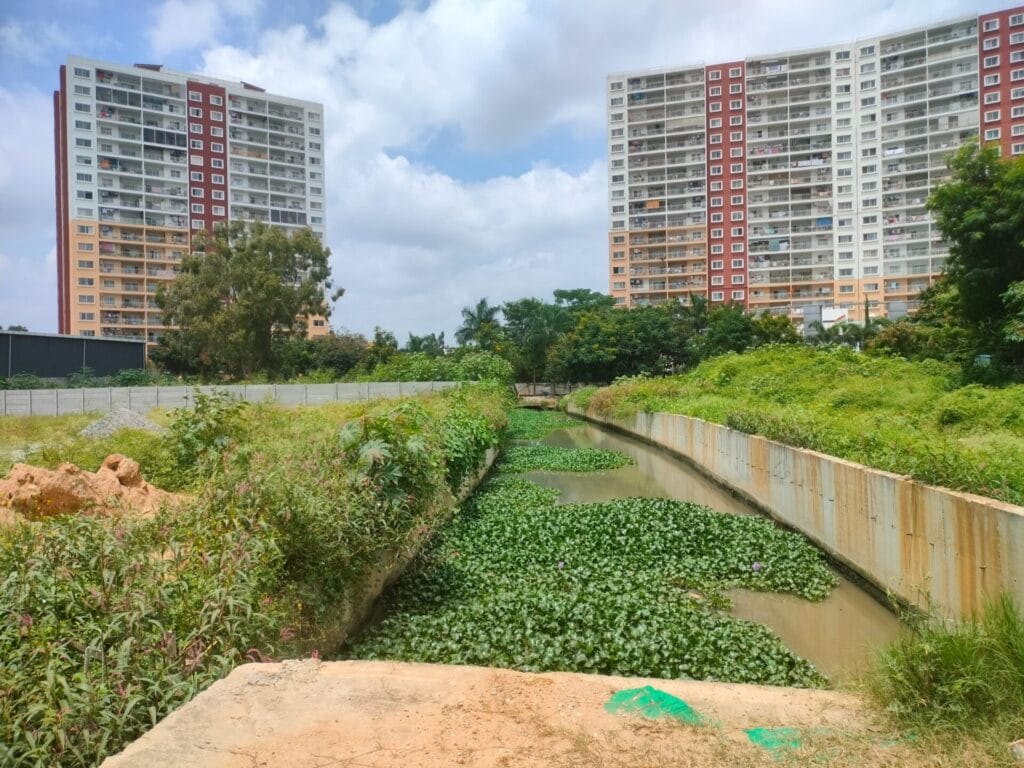
Pic: Harshitha Padmavinod
Drainage chaos deepens
In 2016, Shriram Builders came under the scrutiny of the National Green Tribunal (NGT) for allegedly encroaching upon the buffer zones of lakes and a drain (nala), leading to a halt in property approvals. However, it remains unclear how the builders later obtained NGT clearance and a municipal permit, a development that residents of Shubh Enclave suspect may have involved undue influence.
“The demolition of our properties was done out of spite since we were revolting against the apartment construction in the catchment area. There was no drain along the lines where they demolished properties,” says one of the residents of Shubh Enclave who wishes to stay anonymous.
BBMP also acknowledged that there was no drain at the site where the demolition drive was carried out. “When the Shubh Enclave layout was built, there was no exit drain there. So, the then Tahsildar identified kharab land in the area and mapped the drain to ease the inundation situation in the layout. We followed their orders, intimated those owners whose properties were on kharab land and proceeded with the clearance drive,” says the former executive engineer of the then Mahadevapura constituency who requested anonymity owing to the ongoing court case.
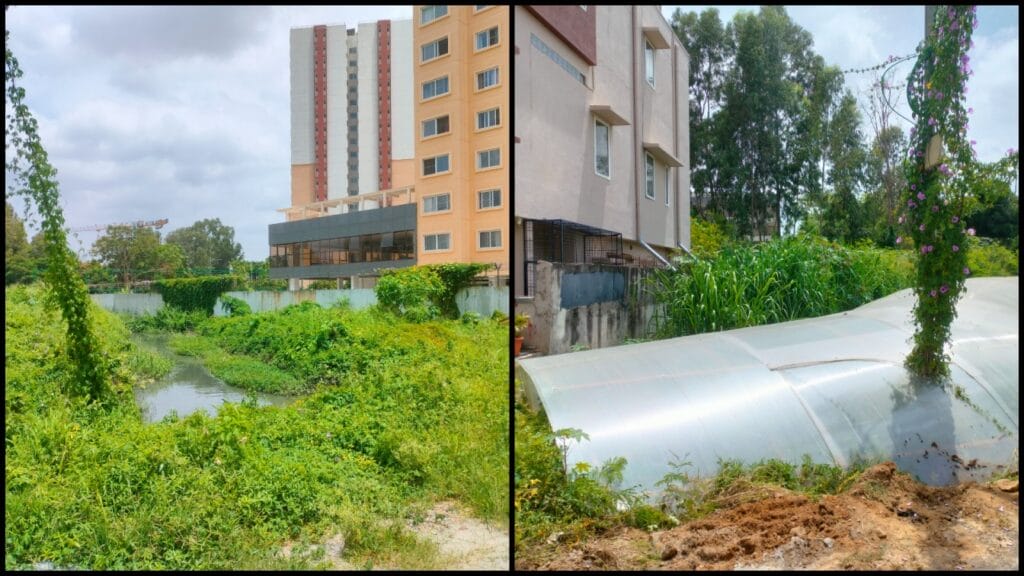
Residents grapple with increased flooding
This claim, however, is disputed by the layout’s residents, who maintain that they had never experienced flooding when the secondary drain in the catchment area was intact. This was the one over which Shriram Chirping Woods came up. Following demolition, a new drain was carved along the demolished Shubh Enclave properties to let out the water, but this was positioned at a higher elevation than the original catchment area.
For nearly a decade now, residents of Chirping Woods have been bearing the brunt of this politically-charged, unplanned demolition drive. They have no properly functioning drain to channel their rainwater. “Our basements are filled up almost every monsoon. Our drains cannot handle the capacity of the current water flow during monsoons, and we shell out lakhs every monsoon to fix our basement and water equipment,” says Purna Atluri, member of Shriram Chirping Woods Apartment Welfare Association.
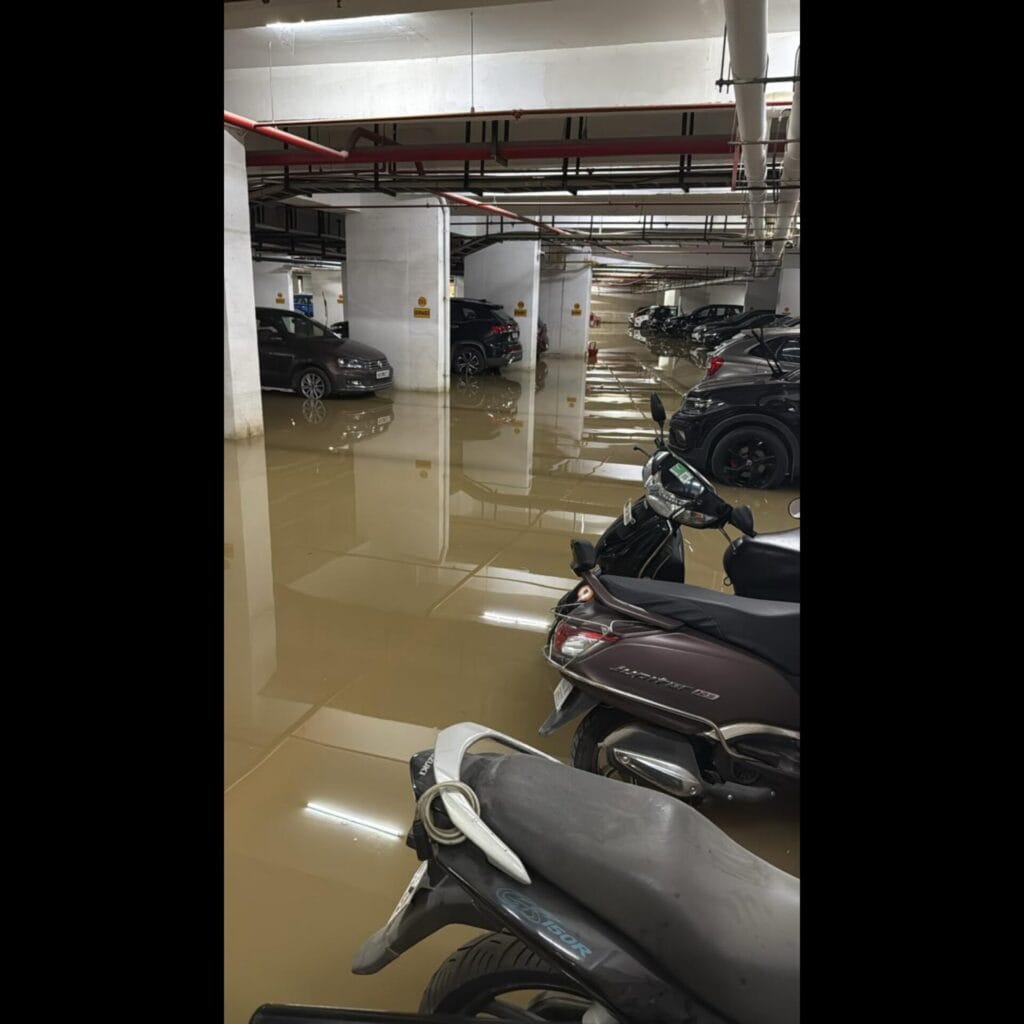
Source: Purna Atluri
Additionally, several apartment complexes have come up around the catchment area over the past decade. With the “newly carved drain” rendered nonfunctional due to the court stay order — and the original drain encroached upon — the overall carrying capacity of the drainage system has diminished, resulting in increased flooding, particularly in and around the Shriram property.
“We have widened the drain running beneath the apartment; however, a single secondary drain is inadequate to manage the increased volume of runoff caused by the growing number of apartments and layout houses in the area,” says Raghavendra BN, current executive engineer. Apartment residents however allege that this drain does not connect to the channels or lake at all, thanks to fresh encroachments.
Hosakerehalli Lake area: Cleared, but encroached again, this time by GBA!
In 2022, about six properties were cleared for encroaching the lake bund of Hosakerehalli lake. “Migrants and economically-vulnerable people resided in this region in one RK (Room and Kitchen) and two BHK (Bedroom, Hall, Kitchen) houses. On the opposite side of the lake, there are many apartments built on the buffer zone, however they have been spared,” says one of the residents who witnessed the demolition.
“We built our houses in 1995 and there was no intimation given then about the land being on the lake bund back then. In 2022, out of the blue, officials notified us and demolished three of our houses,” says Padma, one of the property owners.
Three years later, the area was once again encroached upon—this time by the Solid Waste Management Department. Garbage trucks now occupy the site, using it as a rest stop and a space for primary waste segregation.
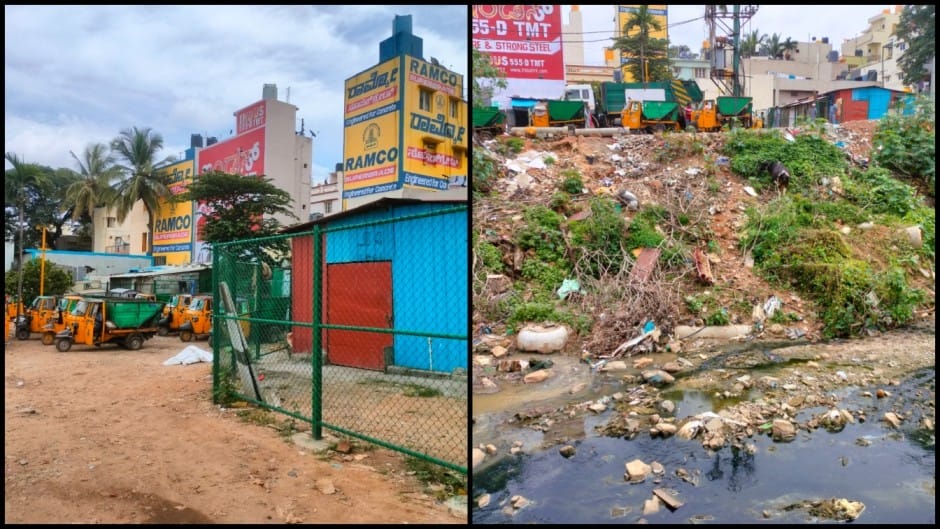
Pic: Harshitha Padmavinod
Living with garbage stench
“The smell is unbearable, and it’s become really difficult for residents and children to live with the filth around,” says Yashoda, who lives right behind the cleared area. Residents near the demolished area claim that bugs and mosquitoes have increased drastically since the garage trucks moved in.
“Post clearance drive, any area should be fenced and included within the lake property. Any activity on lake property, even if it is related to solid waste management, is considered illegal as per the Karnataka Tank Conservation and Development (KTCD) Act, 2014,” says V Ram Prasad, co-founder of Friends of Lakes.
Rachna Ravikiran, activist, who has been fighting for the Hosakerehalli lake rejuvenation raises a pertinent question. “What’s the point of tearing down homes built with people’s hard-earned money, when the authorities haven’t even restored the lake—especially if the demolitions are being done in the name of restoring the lake bund?” she asks. The lake presently is choked with weeds, and residents say they can smell sewage around it, suspecting that wastewater is flowing into the lake. Overgrown vegetation and poor monitoring have turned the area into a secluded dumping ground for waste.
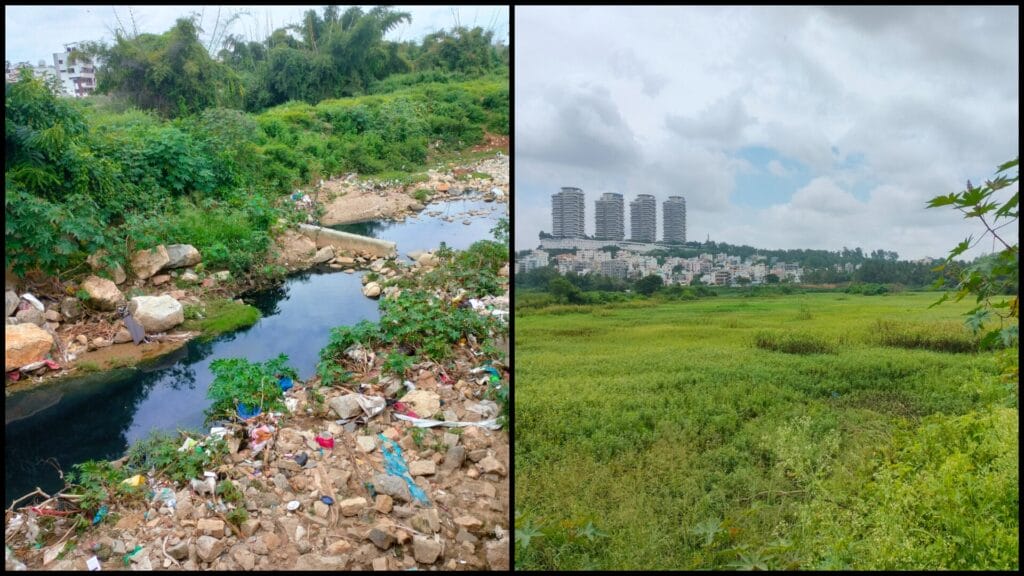
Violating buffer zone rules
To make matters worse, the erstwhile BBMP authorities began constructing a new diverted drain inside the lake premises about eight months ago, to address flooding around the lake. This, despite the fact that the KTCD Act strictly prohibits any kind of construction within lake boundaries or their buffer zones, including the building of drains. “People of influence kept their properties, while common citizens became scapegoats in the hands of the law,” says Rachna.
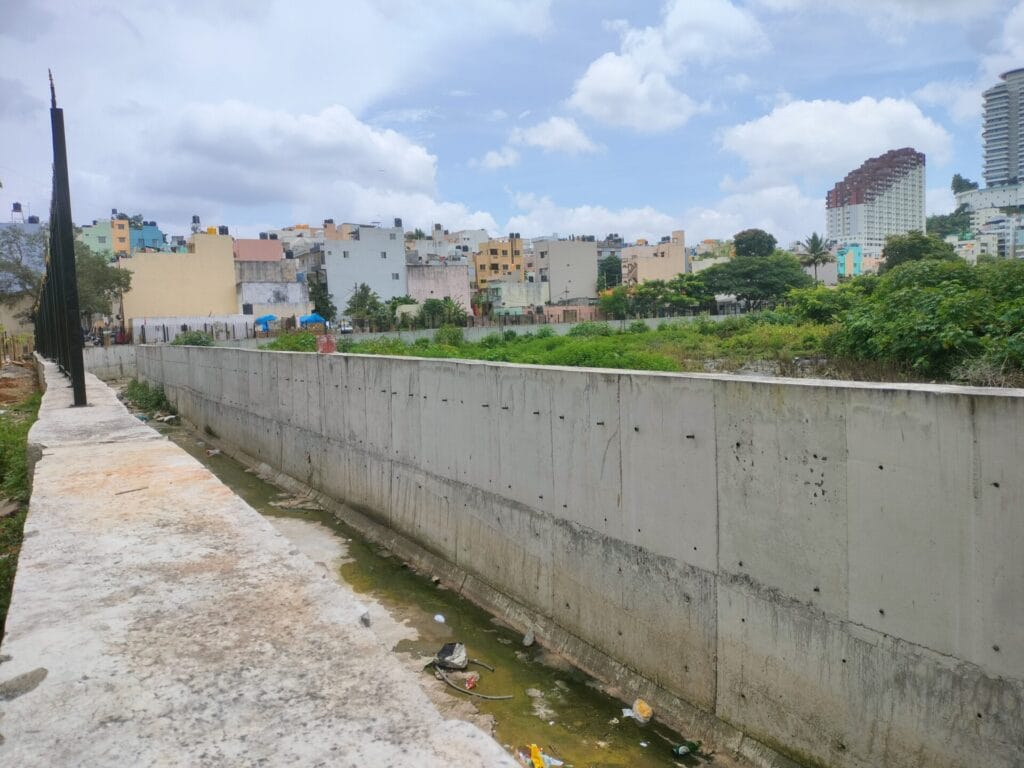
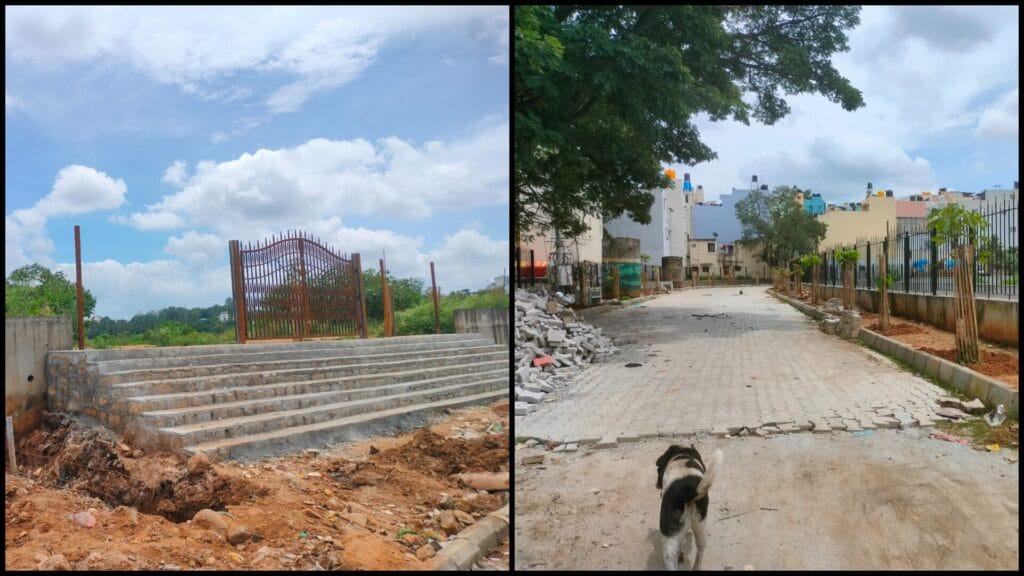
Hosakerehalli Lake is reportedly split between two constituencies—Rajarajeshwari Nagar and Padmanabhanagar—making it easier for authorities to shift blame. Today, one half of the lake—falling under the Padmanabhanagara constituency—is being ‘beautified’ with gates, walking paths, and streetlights, while the other half—under Rajarajeshwari Nagara—remains a muddy stretch overrun with vegetation and dumped waste, only for one new gate at the entrance. Essential lake assets themselves continue to be neglected.
Laggere: Dream homes gone, but for a better future?
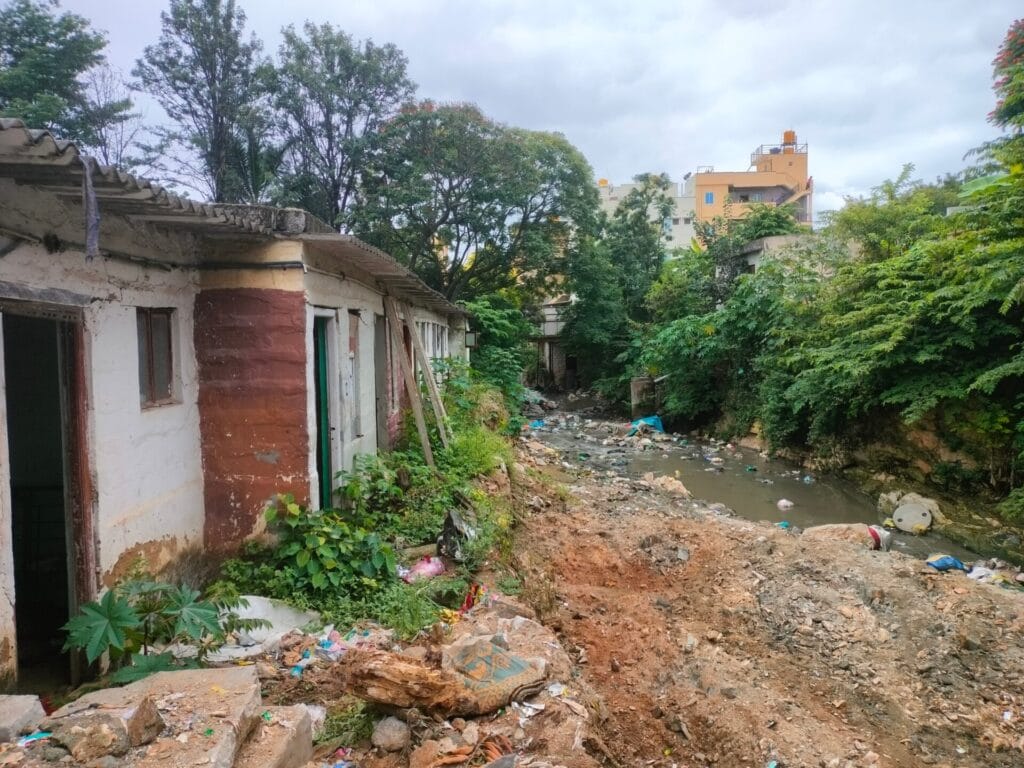
In June 2025, 10 houses were demolished in Laggere for encroaching a rajakaluve. “The drain was really narrow. Even just 30 minutes of rain would cause it to overflow, flooding the roads and sometimes even our homes,” says Suma, a resident staying behind the demolished property.
“The survey sketch indicated that our property was over the drain, but we obtained the khata and all other required documents. However, with the flooding problem worsening, we had to consider the safety of residents and the surrounding area, which is why we agreed to the demolition,” says GK Srinivasa Raju, property in-charge of the layout where the houses were demolished.
Pic: Harshitha Padmavinod
Two years ago, three other houses along the drain border had been verbally informed that they were situated on a rajakaluve, but no intimation of demolition was given back then. “As the project began, we saw that those three houses had to be partially demolished to widen the drain. With persuasion, we got written consent from all three owners,” says K Vasudevaraju, project supervisor, Laggere encroachment clearance drive.
Read more: Civic activists oppose government’s plan to shrink Bengaluru’s vital drain buffers
Residents bear the brunt
We’ve been paying tax since 2009, and we were not informed while registering the property nor while paying taxes. In August 2025, they issued a written notice and did not give us a choice but to sign it forcefully,” says Bhavana S, property owner of one of the three additional properties that need to be demolished for the project.
“It is the responsibility of buyers to conduct due diligence before purchasing a property. Compensation cannot be provided for the demolition of such houses,” says Raghavendra R, Assistant Executive Engineer at the SWD Department, Rajarajeshwari Nagar.
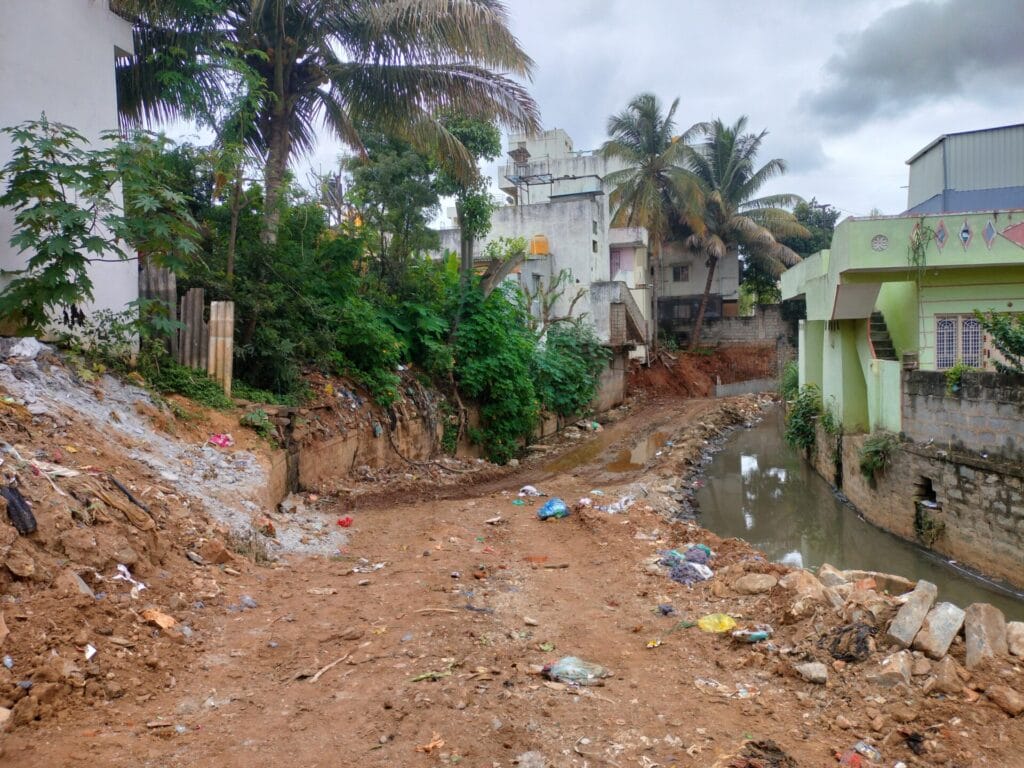
“After any demolition, we install fences and retaining walls to prevent further encroachments. But people must be conscious of not encroaching drains for their own safety, and in the interest of guarding against inundation,” says Vasudevaraju.
Due to the ongoing status of the clearance drive, the actual impact of the drain widening on inundation levels in the area is yet to be determined.
The real issue: Missing maps, vague terminology and regulation gaps
Mathew Idiculla, legal consultant and urban policy expert, notes that the complexity of encroachment clearance operations largely stems from three key administrative gaps: unclear definitions of buffer zones and encroachment laws, inadequate mapping of SWDs, and the selective demolition drives due to weak regulations.
Surveys by BBMP and Revenue Department are often done without proper regulation or just skipped altogether, allowing property buyers and residents to invest in encroached land.
“Furthermore, every new master plan (RMP) alters the buffer zone regulations. Lack of clear definitions and terminologies makes property investment a risky game for citizens,” says Mathew. As highlighted in the previously reported stories on Citizen Matters, SWDs are not accurately mapped in village maps, revenue maps or Bangalore Development Authority’s (BDA) Revised Master Plans (RMPs).
Mathew also feels that demolition drives have always been a selective game. The system ignores influential and powerful parties and holds common citizens responsible, sometimes even for their own systemic flaws. There is thus a real concern of people becoming homeless due to this arbitrary method of demolition drives. “We need a fixed protocol, not just to identify which properties can be demolished, but also to specify how these demolition drives may be carried out. When rules are arbitrary, such drives are defined by power play and do not take the city’s development into consideration, which is what we see today,” he concludes.
How can you check whether you’re investing in an encroached property?
- Obtain Occupancy Certificate and Encumbrance Certificate without fail. Khata only indicates that you are paying property tax, it does not define your property rights.
- Verify sale deed, title deed, and other property related documents to identify any disputes and ownership verification.
- Conduct physical surveys of the property to verify if the property is on any encroachments or buffer zones.
- You can confirm if your property is on an encroached drain via Rajakaluve Encroachment Finder
- Refer to applications like Bhoomi and Dishaank to verify ownership documents, land records, encroachments etc.
people who have gone to court r still waiting for results places where they have demolished r left like that only with stink n diet littered every where, everytime some or the other person comes to check takes some .. n go in the pretext of doing something, in ur whole article above ee mr. Raghavendra is there in different places but his initials r different like bn, c, r how come then there r people who r working in the same area from past above 13yrs they r not transferred if done also they come back within 3 days to the same area where they can make money, the most corrupted area is mahadevpura not a single road is proper n u will be targeted if u complain, no mayor no BBMP election even modiji is helpless about this area. only money matters n no work done
I don’t know what your motive in this report. you have reported factually incorrect data. there was study of facts . please improve with responsible journalism. there is no depth or deep dive in to facts
It is shameful for the Government for not clearing encroached properties on storm water drain and also unauthorised structures on lakes. Only for creating scene they do here and there nominal action,just to pat there own backs. Since these unauthorised structures belongs to powerful persons no result is seen in future.
Hi Harshitha, what would be a legal way of raising a complaint about structures encroaching road side drains, if you might be aware of?
it is so sad that the government does not publish proper maps with drains etc to builders or fine them for encroachment or fraud. They build and leave the tax paying citizens to suffer. it is so hard to use dishank etc..There is an anekal planning authorities map..and a Bmrda map..even their own maps don’t have the same structure..it is all making money business. if government wants to digitize..let me make mistakes so people come to change and again I will take bribe..This is what government and their officers are doing. sucking people’s energy and wealth.