On September 1st, the Urban Development Department of the Karnataka government issued draft regulations reducing court-mandated drain buffers for Bengaluru, inviting public comments. We responded with an open letter placing on record our analytical review and evidence-based objections.
Reducing buffers around drains (and lakes) will intensify floods, accelerate water loss, and foster encroachments already flagged by the Comptroller and Auditor General of India’s (CAG) audits. It also violates the Karnataka High Court and National Green Tribunal orders, undermines Bengaluru’s Climate Action Plan, and breaches public trust. We urge the government to halt these reductions and act on the CAG’s recommendations.
| Call to Action: Submit your objections We urge all citizens to submit their objections by September 30th. Download the pre-written objection letter here — update the date and your name/address (highlighted in yellow), print, and post. Unfortunately, UDD has not provided an email ID for submissions, so letters must be sent by speed post to the following address: To, Additional Chief Secretary to Government Urban Development Department Vikasa Soudha, Dr. Ambedkar Veedhi Bengaluru – 560001 |
Our open letter to UDD
To,
Additional Chief Secretary to Government
Urban Development Department
Sub: Objections and analysis concerning Draft Regulation No. UDD 468 MNJ 2025 (E) on Drain Buffer Reductions
Dear Madam/Sir,
We are writing to place on record our detailed objections, analysis, and comments regarding Draft Regulation No. UDD 468 MNJ 2025 (E), which proposes reductions in drain buffer zones in the Bengaluru Metropolitan Region.
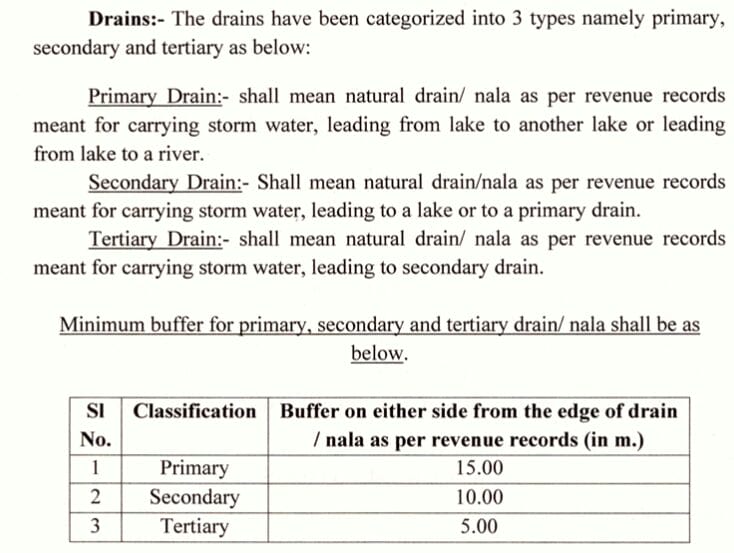
While we note that the Urban Development Department has specifically invited public comments on the draft regulation concerning drain buffer reductions (Notification No. UDD 468 MNJ 2025 (E)), it is ecologically, legally, and practically impossible to address drain buffers in isolation.
Drains (raja kaluves and their networks) are inseparably linked to the lakes and tanks they feed. The hydrological system functions as one — if drain buffers are reduced, siltation, pollution, and encroachments choke the drains, which in turn reduce the storage and ecological capacity of the connected lakes. Likewise, reductions in lake buffers inevitably push stress downstream into the drains, increasing flood risks and water insecurity.
Judicial pronouncements, such as the Karnataka High Court’s acceptance of the Justice N.K. Patil Committee report (WP No. 817/2008) and the NGT’s orders in Forward Foundation v. State of Karnataka (2016), have consistently treated lake and drain buffers together, recognising that the survival of one depends on the protection of the other.
Therefore, any regulation on drain buffers must be evaluated in conjunction with lake buffer reductions introduced through 2025 Karnataka Tank Conservation and Development Authority (KTCDA) amendments, which is what we will be doing here.
We present this issue systematically under seven sections
- Drain buffer reductions creates technical contradiction in the KTCDA Act: Law requires the “original capacity” of tanks to be preserved, while the government simultaneously authorises conditions that make this impossible.
- Foreseeable disastrous consequences drain buffer reductions: Intensifies flood vulnerability, accelerates water loss – quantitative and qualitative & fosters encroachers including government departments
- In direct contradiction to CAG’s constitutional audit findings: 2021 CAG audit stipulates securing NGT’s buffer drain buffer zones
- In conflict with binding judicial orders: Karnataka High Court (WP No. 817/2008, 2012 judgment) making 30 m buffer mandatory and also recommending progressive buffers. Supreme Court (Mantri Tech Zone v. NGT, 2019) affirming 30 m as statutory minimum.
- In violation of constitutional provisions and principles: Article 21 (Right to Life), Article 48-A (State’s duty), Article 51-A(g) (citizen duty), Public Trust Doctrine, Precautionary Principle
- In contradiction with government’s own climate roadmap: Bengaluru Climate Action and Resilience Plan accepted the government reinforces buffer zone protection
- Our collective charter of demands: STOP drain buffer reductions and implement the CAG recommendations along with statutory implementation of BCAP
- Drain buffer reductions create technical contradiction in the KTCDA Act
- The Karnataka Tank Conservation and Development Authority (KTCDA) Act, 2014 (amended in Aug 2025) places a statutory obligation on the State to preserve the “original capacity” of tanks. However, the KTCDA 2025 Amendment (allowing construction within lake buffers) and the draft drain regulation (proposing reduced drain buffers) directly undermine this obligation, creating a self-contradiction within the law.
- Buffers are not empty spaces; they are living ecological systems that perform vital hydrological functions. Among the most crucial is sediment control. Vegetated buffers filter silt before it enters drains (raja kaluves) and subsequently the tanks they feed. Without adequate buffers, sediment deposition increases drastically, leading to siltation and loss of lake capacity.
- The KTCDA 2025 Amendment weakens lake buffers, while the draft regulation weakens drain buffers. Taken together, these changes remove both protective layers that safeguard tank capacity. Thus, the law ends up requiring the preservation of lake capacity even as it enables conditions that guarantee its destruction.
- This is an inherent technical and legal contradiction. By imposing obligations that are hydrologically and technically unachievable, both the UDD notification for drain reduction and KTCDA amendment for lake drain reductions becomes not only scientifically irrational but also legally untenable.
- Foreseeable disastrous consequences of drain buffer reductions
- Reducing drain buffers will set off a chain of harms: tanks will dry up as water availability and quality decline, drains and lakebeds will face increased encroachment, floods will become more frequent and destructive, public health risks will rise, urban heat will intensify, and biodiversity will be lost. Of all these, the most immediate and devastating impact will be the sharp escalation of urban flooding.
- We must repeat for emphasis: the regulation on drain buffers cannot be assessed in isolation. It must be evaluated in conjunction with lake buffer reductions introduced through the 2025 KTCDA amendments, in order to holistically understand the disastrous consequences these drain buffer reductions will have on the city’s hydrology.
This section highlights three major and interconnected consequences:
- Intensifies flood vulnerability: Higher surface runoff, obstructed drains, and the collapse of natural flood moderation functions
- Accelerates water loss: Quantitative and Qualitative – diminished lake capacity, reduced groundwater recharge, and severe deterioration of water quality as buffers are eliminated.
- Fosters encroachers including government departments – the accelerated disappearance of smaller tanks, particularly those under three acres, due to encroachment and loss of feeder drains.
We also note that other consequences — such as the urban heat island effect, increased vulnerability to vector-borne and water-borne diseases, and the erosion of biodiversity — are equally serious. However, due to paucity of time, they are not elaborated in this submission.
2.1 Intensifies flood vulnerability
- Reducing the buffers, further strips the city of its last natural defense against floods, leaving it even more vulnerable than before.
- Bengaluru today is almost entirely paved over. Even the small patches of soil at the base of trees have been covered with concrete, along with much of the city’s lakes and stormwater drains. A 2014 study by the research collective Gubbi Labs estimated the loss of 376 km of streams — a figure that has only worsened in the past decade. With natural buffers erased and channels narrowed, concretised, and choked, stormwater now races through the remaining drains at dangerous speeds, overwhelming the system and flooding neighbourhoods, every year, even during normal monsoon rains. Almost every news report on Bengaluru’s floods points to narrow, paved, and choked stormwater drains as the cause of disaster, apart from the rain itself.
- Earlier this year in May 2025, the city experienced its heaviest May rainfall in eight years, resulting in widespread waterlogging, five deaths, and major disruption across the IT corridor and residential areas.
The Sep 2022 floods drew international attention for the massive damage it caused across the city, including the high-net-worth communities. It caused overtopping of many lakes in the eastern parts of the city including Bellandur lake. A viral meme — reported by the BBC — even showed an altered Uber booking page offering boats instead of cars.
Recording a few more incidents for emphasis:
- Hosakerahalli Lake breached in 2019 and 2023 . While the drains leading to the lakes routinely flood ( 2019, 2020, 2023, and again in 2025) inundating hundreds and thousands of homes in RR Nagar, Pushpagiri Layout, and Padmanabhanagar.
- In Nov 2019, the Hulimavu Lake breached, submerging over 1,000 houses and damaging key roads.
- Doddabidarkallu lake breached in Oct 2019
- The Vrishabhavathi River floods in June 2020, August 2022 devastated southern and western parts of the city, washing away mysore road, submerging homes, industries, and highways under toxic floodwaters mixed with sewage.
- In Sept 2018, Four lakes located in and around Bengaluru South – Dorekere Lake, Gubbalala Lake, Vasanthapura Lake and Doddakallasandra Lake breached.
- In Nov 2021, Yelahanka Lake, Singapura Lake, Allasandra Lake, Amanikere Lake, and Horamavu Lake overflowed, resulting in 3 deaths and damage to over 500 homes, trees, roads, and power supply
In 2022, The Hindu Reported: In the last two decades, the number of lives lost to floods have sharply increased in the State. In the last decade (2011-20) and the one before (2001-10), Karnataka’s share in India’s flood-related deaths ranged between 7-8%. In the 2000s, the State had the fourth highest share of flood-related deaths among major States. In the last decade, it had the seventh-highest share.
This clearly demonstrates that buffer reductions will result in widespread flood devastation and adverse economic outcomes to Bengaluru.
2.2 Accelerates water loss – quantitative and qualitative
- As buffer areas are converted into impermeable surfaces — through both legally permitted infrastructure and illegal encroachments — the loss of green cover accelerates siltation of lakes, reducing their storage capacity. More critically, the destruction of buffers severely undermines groundwater recharge, which is one of the most vital functions of lake ecosystems. This directly exacerbates Karnataka’s deepening groundwater crisis, which in turn translates into a drinking water crisis for all and an irrigation water crisis for farmers.
- According to the September 2023 report National Compilation on Dynamic Ground Water Resources of India, 2023 published by the Central Ground Water Board, only 62% of taluks in Karnataka remain in the “safe” category. The situation is particularly dire for Bengaluru with 100% over-exploited.
- The weakening of buffer protections will only intensify the ground water crisis which is also a drinking water crisis, which is also an irrigation water crisis. Anyone living in Bengaluru can attest to the drinking water crisis which now starts as early as January last up till the monsoon rains start. The most recent drinking water crisis was just last year. The Composite Water Management Index (CWMI) 2.0, released by NITI Aayog in August 2019, highlights that cities like Bengaluru face “high to extreme water stress”. CSE study warned that Bengaluru could be the first Indian city to run out of water.
- The reduction of buffer zones further exacerbates water quality degradation. In Bengaluru — as in most urban agglomerations — lakes have become receptacles for untreated waste, with both solid and liquid effluents routinely discharged into them. Industries add to this burden by releasing toxic pollutants. Much like encroachment, pollution has proved to be an intractable challenge for the government. Even NITI Aayog acknowledges that 70% of India’s water is contaminated, and the rising number of lake pollution cases before the NGT underscores the scale of the crisis. The most notorious example remains Bellandur Lake, infamous for catching fire due to its extreme pollution load — an iconic failure that epitomises the systemic regulatory collapse around lake management. Nothing more needs to be said to illustrate the extent of pollution in our lakes.
This data clearly demonstrates that buffer reductions will result in huge loss of water both quantitatively and qualitatively exacerbating water stress.
2.3 Fosters encroachers including government departments
The findings of the Comptroller and Auditor General (CAG) in its Performance Audit of Management of Storm Water in Bengaluru Urban Area (Report No. 2 of 2021) make it abundantly clear that the absence of buffer enforcement has already facilitated widespread encroachment. The audit recorded that boundary markings were never implemented, drains were incorrectly classified, and construction was permitted right up to and even across stormwater drains, obstructing their natural flow. By proposing further reductions in buffer zones, the State is not only inviting new encroachments deeper into areas that should remain protected, but is also effectively legalising existing encroachments that the CAG had flagged as violations.
It is important to point out Karnataka faces an extraordinary threat of encroachment of its commons — particularly lakes and drains. Over the past two decades, several official committees have repeatedly flagged this crisis
- 2007: A.T. Ramaswamy’s Joint Legislative Committee (JLC) released a detailed report on lake encroachments in Bengaluru Urban.
- 2011: V. Balasubramanian, as Chairman of the Task Force for Recovery and Protection of Government Lands, issued the report “Greed and Connivance”, documenting widespread encroachment of government lands, including waterbodies.
- 2017: The Koliwad House Committee Report on encroachments of lakes in and around Bengaluru was tabled in the Legislative Assembly. The report identified major encroachers among government agencies as the Education department, Forest department, BDA, BWSSB, BBMP, Bengaluru Electric Supply Company, Bengaluru Metropolitan Transport Corporation, Karnataka Housing Board, Railways, Defence authorities, National Highways,etc.
Despite the gravity and consistency of these findings, successive governments failed to take meaningful action. This history and data clearly demonstrate that reducing buffers does not curb encroachment — it rewards and fosters it, including by government agencies themselves.
3. In Direct Contradiction to CAG’s Constitutional Audit Findings
The Comptroller and Auditor General of India (CAG) is a constitutional authority established under Article 148. The findings of two separate CAG reports provide unequivocal constitutional evidence that the State and the Legislature have not only continuously neglected their duties in protecting lakes and their drains, but are now actively reversing the very recommendations made by the CAG — thereby undermining constitutional accountability and eroding the principles of environmental prudence.
The Report No. 2 of 2021 by the Comptroller and Auditor General of India (CAG), “Performance Audit of Management of Storm Water in Bengaluru Urban Area”, makes it clear that the Government of Karnataka and its agencies are failing to meet even the most basic requirements for managing drains in Bengaluru. The CAG highlights a fundamental failure to correctly classify drains as primary, secondary, or tertiary. Verification of the draft RMP-2031 showed that drains previously marked as primary or secondary in BBMP’s maps were downgraded to secondary or tertiary. This misclassification has serious consequences because the buffer zone mandated by NGT is determined by drain classification. By downgrading drains, the government is effectively shrinking buffer zones on paper, thereby paving the way for encroachments and construction.
The CAG report explains that buffer zones are areas of land adjacent to a drain or waterbody intended for essential utilities such as pipelines for water, oil, or gas, and to facilitate access for drain maintenance. Since these spaces were never properly secured, utilities like water and sanitation pipes, electrical and telephone lines, and optical cables were laid haphazardly across drains, obstructing natural flows. This has directly contributed to overflowing drains and floods, which is now a major problem every monsoon.
Yet, instead of addressing these failures, the government is seeking to reduce the buffer requirements around drains themselves. The reality is that the majority of buffer zones have already been lost, and whatever remains is badly compromised. Thus, the notification reducing drain buffers effectively legalises encroachment and places at risk what little protection remains.
It comes at a time when Bengaluru has repeatedly suffered immense flood damage in recent years — damage that is the direct consequence of mismanagement, encroachment, and neglect of drains. Instead of fulfilling its duty to protect and manage stormwater infrastructure, the State is dismantling the very protections that citizens had fought for and secured through judicial orders.
On these grounds, we strongly object to any reduction of drain buffers and call upon the State and its Legislature to implement the CAG’s audit recommendations:
- BBMP should prepare a comprehensive database of SWDs in coordination with parastatal agencies like BDA, BWSSB etc., to serve as a single source for effective planning and management of SWDs.
- BBMP needs to escalate its efforts to conduct robust surveys to identify and evict all encroachments on SWDs and maintain the stipulated buffer zone.
4. In conflict with binding judicial orders
Any reduction in these drain buffer areas—whether by rezoning, changes to municipal standards, or planning regulation—is in straightforward violation of the Karnataka High Court’s and the NGT’s orders.
4.1 WP No. 817/2008: The 2011 Report Preservation of Lakes in Bangalore City categorically stated: Lake preservation is not limited to lake area itself, but very much dependant on catchment area and the drains that bring rainwater in to the lake. Raja kaluves, branch kaluves are to be surveyed and encroachment therein evicted. The buffer prescribed for primary, secondary & tertiary drains in valleys as per Zonal Regulations has to be religiously implemented, more so in areas which are not developed yet, to facilitate appropriate storm water drains, sewerage lines, inspection paths etc., as when the area comes up for development/urbanization. Advance action in this manner is imperative, if the unplanned development of Core area Bangalore City is not to recur in future.
The tone of this report, especially the phrase “religiously implemented,” clearly underscores the non-negotiable nature of buffers. It does not in any way permit reduction. This report was accepted by the Karnataka High Court in WP No. 817/2008, and the Court’s final judgment dated April 11, 2012 made these guidelines binding across the entire State of Karnataka, including Bengaluru
4.2 O.A. No. 222/2014, Forward Foundation, Bangalore vs State Of Karnataka
In its judgment dated 04.05.2016, the National Green Tribunal (NGT) explicitly stipulated buffers of 50, 35, and 25 metres (measured from the edge of the drain) on either side of primary, secondary, and tertiary drains, respectively.
The Tribunal further held: This buffer/green zone would be treated as no construction zone for all intent and purposes. This is absolutely essential for the purposes of sustainable development particularly keeping in mind the ecology and environment of the areas in question.
Any reduction in buffer zones around drains in Bengaluru and the rest of Karnataka is a clear violation of binding court orders—the guidance and judicial mandates have been explicit, public, and repeatedly upheld by the Karnataka High Court and the National Green Tribunal.
5. In Violation of constitutional provisions and principles
The draft regulation for drain buffer reduction violates core constitutional provisions and established environmental law principles, some of which are listed below.
- Under Article 21 (Right to Life), citizens are entitled to water security, a clean environment, and protection from flood risks — all of which depend directly on the integrity of tanks and their buffer zones.
- Article 48-A imposes a duty on the State to protect and improve the environment, while
- A(g) obliges citizens to safeguard natural resources, an obligation rendered meaningless if the State itself dismantles protective frameworks.
- The Public Trust Doctrine, repeatedly upheld by the Supreme Court, recognises tanks as commons held in trust for present and future generations; diluting statutory safeguards amounts to a breach of fiduciary duty by the State.
- In addition, the Precautionary Principle requires that where there is scientific certainty of harm — as in the case of buffer reduction leading to lake extinction — the State must act to prevent environmental damage, not facilitate it.
- Finally, the principle of Intergenerational Equity demands that today’s governance choices preserve, rather than compromise, ecological resources for future generations. The 2018 and 2025 amendments stand in direct contradiction to these constitutional and legal mandates.
6. Government’s own Climate Roadmap contradicts buffer zone reductions
Bengaluru launched a Climate Action Cell (CAC) on 27 November 2023 under the leadership of Shri Rakesh Singh, Administrator of the Bruhat Bengaluru Mahanagara Palike (BBMP) and Additional Chief Secretary, Urban Development Department, Government of Karnataka, along with Shri Tushar Girinath, Chief Commissioner, BBMP. The CAC is mandated (though non-statutory) to anchor the implementation of the Bengaluru Climate Action and Resilience Plan (BCAP).
The BCAP itself highlights the central role of lakes, drains, and their buffer zones in managing stormwater, preventing floods, and ensuring groundwater recharge. It identifies “sponge spaces” — wetlands, green corridors, and buffer strips — as essential to reducing surface runoff and increasing infiltration. The plan explicitly sets a target of making 40% of the city’s surface area permeable by 2040.
It also records that poorly managed drains, encroachment, and loss of buffers have already reduced the carrying capacity of stormwater drains (SWDs). Encroachments and haphazard utility laying across drains obstruct natural flows, creating conditions for flash floods. The hazard assessment section of the BCAP identifies urban flooding as a “high-likelihood hazard,” alongside urban heat and drought. Stormwater management is listed as the primary sector of significance, directly linking the hazard to the condition of lakes and drains.
All of this reinforces that any reduction of buffers around tanks and drains runs directly contrary to the city’s own resilience planning framework, which stresses the need to expand, not reduce, natural protections.
It is especially significant that the very department now proposing buffer reductions — the Urban Development Department (UDD) — is the same department that only recently accepted the BCAP report. In effect, the Government has formally endorsed an actionable roadmap to strengthen climate resilience, only to reverse course by dismantling one of its most basic recommendations: protecting buffer zones around lakes and drains.
7. Our collective charter of demands: The buffer zones for lakes and drains are not expendable—they are the city’s first and last line of defense against floods, disease, water scarcity, and ecological collapse. Reducing or compromising these buffers has already resulted in systemic disaster; further reductions will only multiply Bengaluru’s flood, health, water security, and climate vulnerabilities.
For all these reasons, we demand the following:
- STOP the reduction of drain buffer zones
- Implement the CAG recommendations on drains as recorded in Report No. 2 of 2021, Performance Audit of Management of Storm Water in Bengaluru Urban Area:
- BBMP should prepare a comprehensive database of SWDs in coordination with parastatal agencies like BDA, BWSSB, etc., to serve as a single source for effective planning and management.
- BBMP must conduct robust surveys to identify and evict all encroachments on SWDs and ensure the stipulated buffer zones are fully protected.
- Make the Bengaluru Climate Action and Resilience Plan (BCAP) statutory and ensure its full and time-bound implementation, so that lake functions,stormwater management, groundwater recharge, and urban resilience targets are not undermined by contradictory policies such as buffer reductions.
Thanking you,
Yours sincerely
Concerned Citizen.
[This open letter was first published on Mapping Malnad and has been republished with minimal edits with the author’s permission.]