“Who walks on footpaths anymore?” asks Abhay Shanbagh, a Vile Parle resident in his sixties. He says the footpath in front of his house is not even fully visible because of the cars parked along it and sometimes on it. Neha Dholam, a domestic worker who walks about two hours daily in Ghatkopar and Vile Parle, has a similar response. She wonders which footpaths I am talking about since they are barely visible behind parked vehicles en route to her workplace.
This is the lived reality of so many Mumbaikars even though over half of all trips in Mumbai are made on foot. Moreover, nearly three-quarters of trips undertaken for education are on foot.
This June, the Supreme Court ruled that the right to walk on demarcated footpaths is a fundamental right under Article 19(1)(d) of the Indian Constitution. Yet, large parts of Mumbai lack well-designed, usable footpaths.
What makes a good pavement?
According to the Indian Road Congress (IRC:103-2022) guidelines, safety, security, continuity, comfort and liveability are the five principles to consider when designing pedestrian infrastructure. “These principles make walking more attractive over personal motor vehicle use especially for short trips,” it states.
Shriya Bhatia, architect, environmental planner and professor at Balwant Sheth School of Architecture, NMIMS University, explains, “Raised pavements and guard rails keep people safe from motorised transport. Safety is also about visibility, so that any kind of crime doesn’t happen. So good lighting and low railings are essential.” Further, to ensure pedestrian comfort, pavements should be shaded, well-drained, and spacious, with places to rest a while. Finally, Shriya says, walking should be a pleasurable experience that people look forward to. The IRC guidelines call this ‘liveability’, but she has a lovelier word for it: delight.
According to IRC guidelines, pavements should be divided into three zones. The first is the frontage zone (or dead width), a buffer zone of 0.5 to 1 metre in front of properties or shops. The second is the pedestrian zone, a clearly demarcated 2-metre-wide walking path, free of obstructions. The third is the furniture or multi-utility zone reserved for bus stops, trees, vendors, electric boxes, street signage, rickshaw stands, and landscape elements, with a minimum width of 1.5 m. The width of the zones can vary according to the designated land use of the locality.
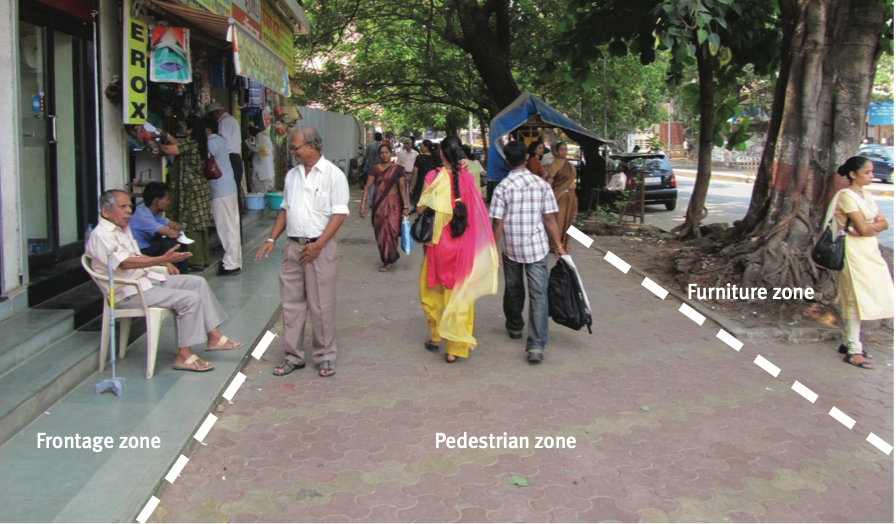
The guidelines, however, are not binding on municipalities. In Mumbai, they are more commonly flouted than followed.
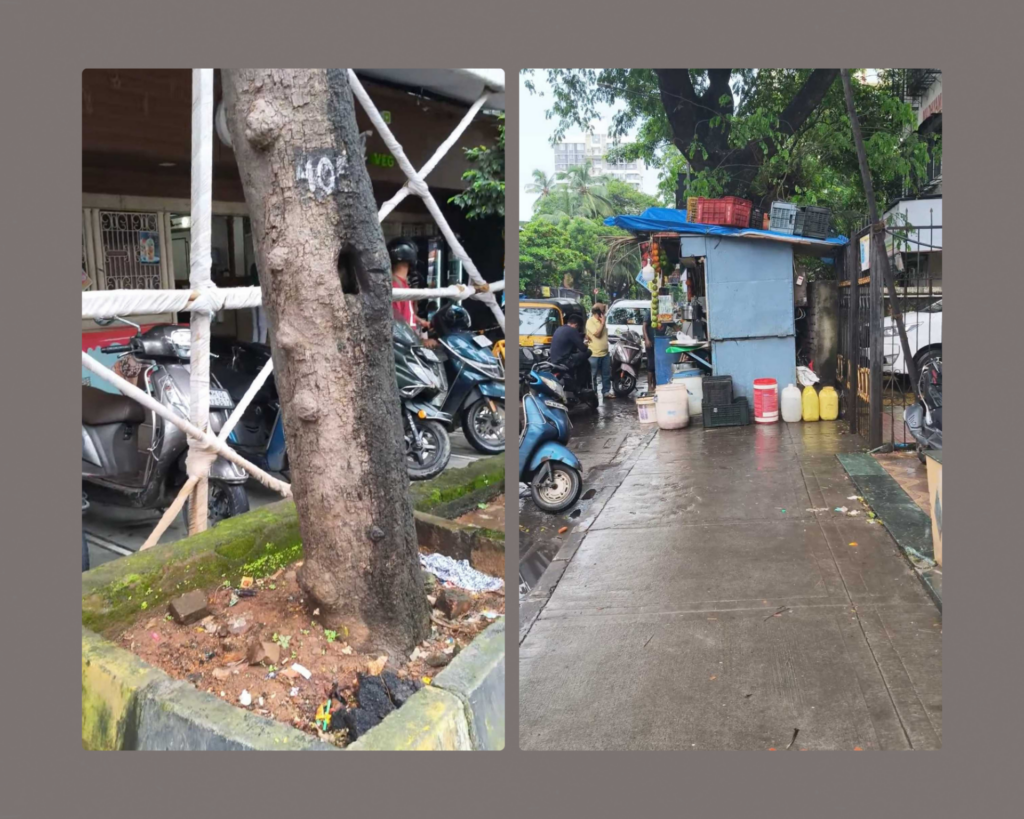
Many suburbs have no footpaths
Mumbaikars prefer to walk on safe pavements rather than streets. Neha says, “Where I can, I use the footpath, particularly in patches where there are many vehicles. I feel safer walking on them.”
An example of such good design can be seen at the Hindu Colony at Dadar. It is a leafy residential area with many lanes sporting 3.8-metre-wide cast-in-situ footpaths (built by pouring concrete directly into the site). Some of them are dotted with benches. Compare that to a pavement in another residential area like Goregaon, and you find that although the BMC has tried implementing similar features, it is not as effective because of a lack of space. Vedant Mhatre, Programme Manager at Walking Project, says some IRC provisions, particularly relating to footpath width, are difficult to implement in Mumbai due to space constraints.
In fact, in some areas, the BMC has built footpaths only on one side of the road, leaving the other for parking. This is a lopsided approach in a city where pedestrians outnumber car users.
Pankaj Joshi, Principal Director at the non-profit Urban Centre Mumbai, says conflict with vehicles is more prominent in suburban wards due to their rapid population growth over time. “There is a planning disconnect which we find post 1980. We have seen that suburbs which take care of nearly 75% of Mumbai’s population are virtually without clear, neat, walkable footpaths.”
Read more: Footpaths in Mumbai: walking may be injurious to your health
Many footpaths also have guard rails built along their entire length. Since guard rails are meant to direct pedestrians to proper crossings, they should be placed at intersections, says Vedant. If pedestrians have to traverse the entire pavement before getting off, they feel trapped and prefer to use the carriageway.
Mumbai does not implement its own footpath policy
In Mumbai, the BMC adopted the Universal Footpath Policy in 2023. The policy stresses the importance of providing a safe and comfortable experience to end users, especially pregnant women, persons using baby strollers, senior citizens and persons with disabilities.
Additionally, it states, “Footpaths must be continuous even at property entrances for uninterrupted pedestrian movement. The height of the footpath should remain the same.” It also mentions that the ramp to the property entrance should be constructed inside the building compound.
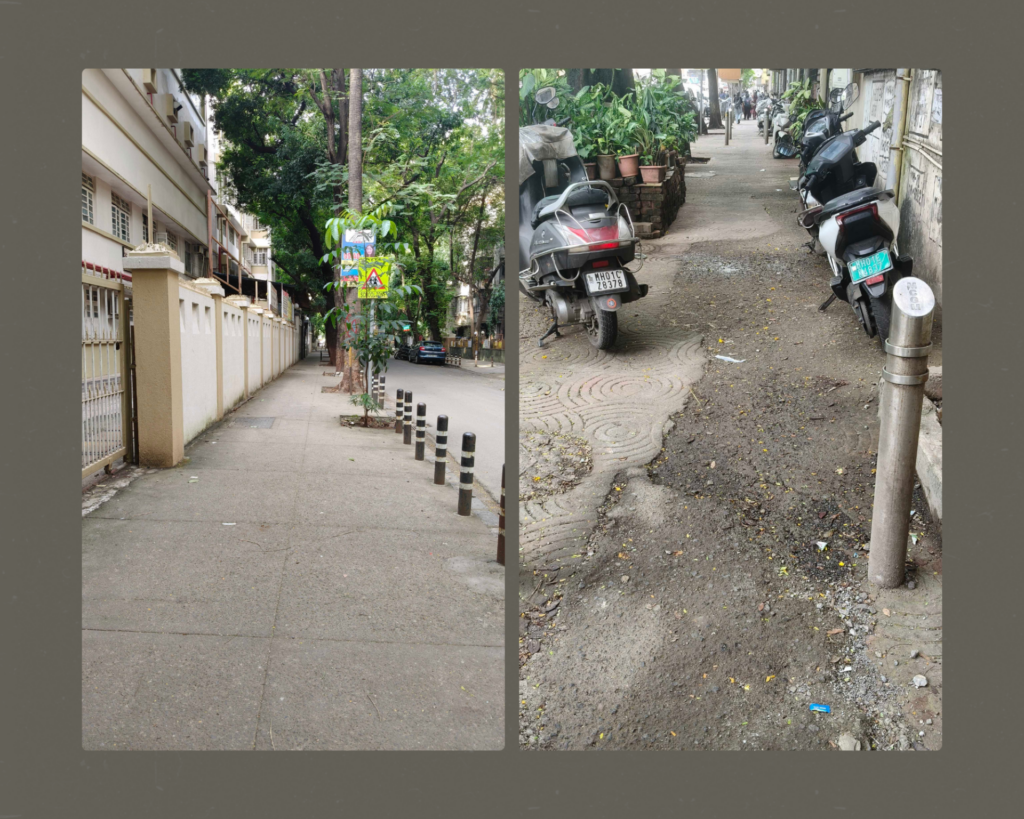
But the ground reality does not reflect the policy uniformly. For instance, in Abhay’s experience, pavements are slippery, particularly during the monsoon. He also finds walking on pavements difficult because of obstructions and a lack of continuity, especially at the entrance of buildings. Unevenly placed manhole covers on the footpath also affect continuity.
Vedant explains that pavements made of stamped concrete tend to get slippery and wear off easily, making them uneven. Whereas cast-in-situ pavements are skid-free and last 50 years or longer. Stamped concrete pavements are made by pressing wet concrete with pattern mats to give it the appearance of stone or brick–a decorative process not used in cast-in-situ construction.
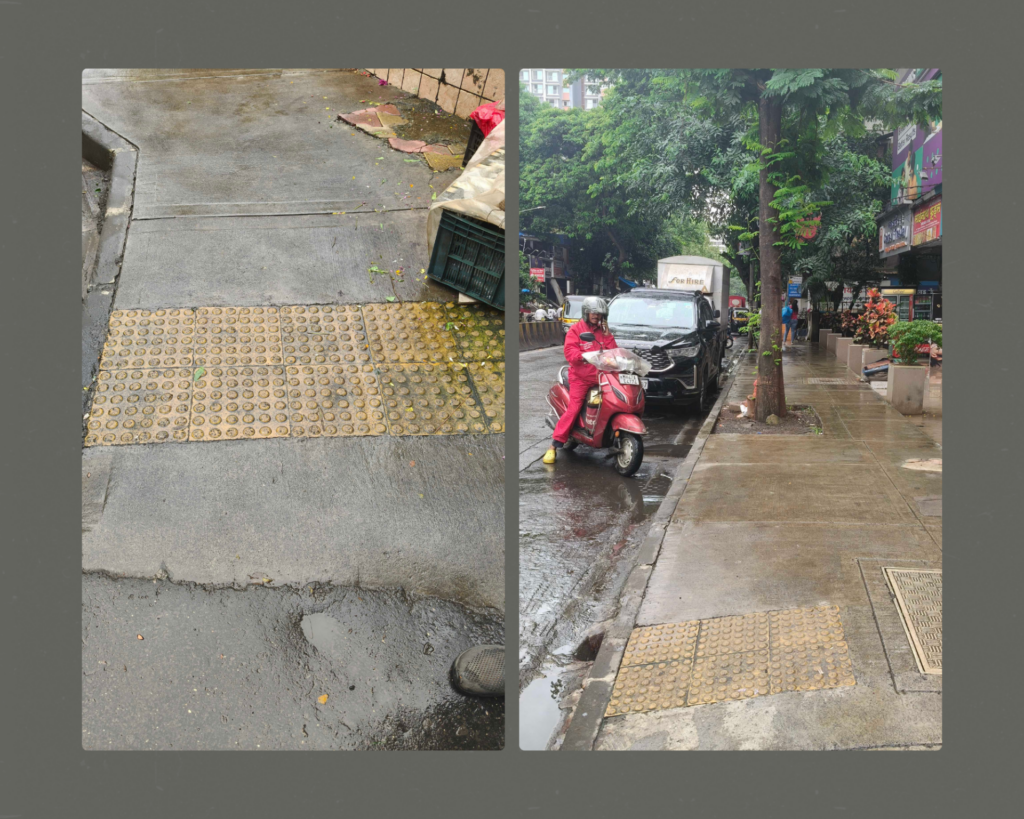
The Policy also mandates placing warning tiles at building entrances, intersections, pedestrian crossings, and the beginning and end of ramps. Additionally, footpaths must have guiding tiles, which are textured and have raised patterns, to guide blind persons. But these tiles need to be laid out carefully–if utilities, drain covers, or trees come in the way, they could lead to accidents.
Read more: Need footpaths more than flyovers: A call for a walkable Thane
The Policy also includes kerb ramps that bridge the height between the road and the pavement to improve accessibility. Additionally, footpath height should not be more than 15 centimetres, and should be maintained consistently. At Hindu Colony, this reporter observed that pavements were at an accessible height, with kerb ramps in place. Senior citizens were able to walk comfortably on these pavements. Whereas on MG Road in Goregaon, kerb ramps were not uniformly present. Moreover, the presence of vendors and trees on the narrow pedestrian zone made walking difficult.
Jasmina Khanna, a disability rights activist involved in drafting the Policy, says pavements are inaccessible to people with disabilities. She gives the examples of bollards that restrict wheelchair access. According to the Policy, a gap of 1.2 m should be provided between bollards to allow wheelchairs to pass–something rarely seen on Mumbai footpaths. Vedant says that bollards can have a turnstile at the height of the handlebars of two-wheelers–this would allow wheelchairs to pass, but not bikes.
Since 60% of public transport journeys in Mumbai start and end with walking, it should be considered as important as other transport modes such as trains and buses, says Pankaj.
Unfortunately, in a city which foregrounds the concerns of car users, the fundamental right to walk takes the back seat.
| Grievance redressal In Mumbai, complaints about pavements can be made to the BMC via apps like MyBMC and MyBMC MARG. You can also call the toll-free helpline numbers 1800221293 or 1916 Or you can lodge a complaint on the BMC website Residents can also visit the Citizen Facilitation Centre at their ward office and give the complaint. |
Solutions to making pavements more walkable
- Prioritise walking over car use.
- If a bus stop is on the pavement, leave space behind the bus shelter for people to walk.
- Use cast-in-situ pavements instead of stamped concrete.
- Divide the pavements into three distinct zones: frontage, walking, and furniture zone.
- Provide shady nooks and benches where walkers can restEnsure continuity of pavements.
- Make pavements accessible for everyone by leaving space between bollards for wheelchairs and prams, and by adding guiding tiles.
Also read:
- Scenes from a community walk in Mumbai
- 1.5cr people walk to work, but Mumbai doesn’t prioritise pavements
- All that it would take to make walking in Mumbai a world-class experience