Once a “city of lakes,” Thane’s population has roughly increased sevenfold since 1971. The city’s estimated population has crossed 27 lakh, making it one of the most densely populated cities in the country. As its population surges, new construction rises at a feverish pace, and infrastructure projects are announced with clockwork regularity. By all outward appearances, Thane is a city on the move. But the question to ask is: Is it moving in a better direction? Sadly, it is not.
I am a fourth-generation resident of this city. I grew up here and watched the city transform and lose something of itself in the process.
A city is not its infrastructure
Thane’s explosive growth has brought wealth and jobs, but its quality of life has not kept pace. Today, we are building monumental infrastructure at an impressive scale, but not creating a city. And both are not the same.
This conundrum applies to just about any other Indian city. In exchange for a higher standard of living, are we trading off quality of life? Quality of life is not determined by the length of a bridge or the height of a building, but by adequate, safe, and well-designed public spaces. In the case of Thane, this means our creek, our mangroves, and the magnificent Yeoor Hills. They are the very soul of the city — not amenities to be sacrificed at the altar of development.
There’s a mad rush of construction underway: Metro Rail, Ring Rail, tunnels, Coastal Road, and even a convention centre. From a distance, all these projects seem poised to propel Thane into a glorious future. But if you step back and think, There’s a frenzy of construction underway: Metro Rail, Ring Rail, tunnels, the Coastal Road, and even a convention centre.
At first glance, these projects seem poised to propel Thane into a dazzling future. But when you step back and think, it becomes clear that they are not truly transportation initiatives — they are construction projects, focused on building infrastructure rather than addressing the city’s deeper, underlying problems.
Urban Planning is not merely about building metros, flyovers, and widening roads. A city is not defined by its metro lines, flyovers, highways, or gleaming towers, but by its people — those who walk its streets, gather in its parks, and bring life to its public spaces. Large infrastructure projects must be evaluated not merely by their engineering ambition, but by the value they add to the quality of life.
Read more: Traffic jam 24/7: When a Thane service road leads to mall, tech parks and apartments
Potholed roads, crumbling infrastructure
In Thane, while an ₹12,000-crore Ring Metro is planned, its roads remain riddled with potholes, and existing footpaths and parks are poorly maintained. The city’s infrastructure is crumbling under pressure. Officials should reprioritise spending on urgent civic fixes before grandiose projects. This is the paradox of urban investment in India today. Billions are spent on mega infrastructure, but the most cost-effective strategy is overlooked.
Fix the footpaths, the bus stops and the street lights. Fix the crossings. These are not glamorous. But they are the difference between a city and an expensive collection of buildings. These are low-cost, high-impact interventions that would have the greatest positive impact on the city without massive spending. A repaired footpath costs a fraction of a flyover, yet it serves infinitely more people, more equitably.
The footpath that isn’t there
Step out of any building in Thane, whether at the Railway Station, on Ghodbunder Road, or on Gokhale Road; odds are you will encounter a broken footpath, a footpath occupied by a parked motorcycle, a footpath that simply ends mid-block, or no footpath at all. You will negotiate with moving traffic, leap across drains, and side-step construction debris.
This is not a minor inconvenience. It is a public health and safety crisis, especially for the elderly, people with disabilities, or children. According to the Ministry of Road Transport and Highways’ Road Accidents in India 2023 report, over 35,000 pedestrians were killed on Indian roads in 2023 alone. And pedestrians now account for over 20 per cent of all road fatalities in the country. Most of these deaths are not accidents but the inevitable consequences of cities designed around cars rather than people.
What walking actually does for a city
- Pedestrian-friendly design is fundamentally about equity and health. Widening sidewalks and adding shade trees helps shift many trips from cars to walking, cutting pollution and saving lives. It also makes streets safer.
- Environmentally, every pedestrian trip reduces exhaust fumes and noise pollution and prevents the destruction of the natural environment.
- Economically, lively sidewalks support street vendors and small shops, increasing retail sales and jobs. According to one study, walking-friendly streets can boost retail turnover by up to 30%.
- Socially, when people stroll down shared sidewalks and squares, they interact more, forging the community ties that make cities feel safe and happy. Here, the city comes together to celebrate, to protest, to shop, to mourn, to relax, to fall in love. Streets become what they have always been meant to be — the “outdoor living rooms” of a city.
- Pedestrian infrastructure is an extremely equitable space where the rich and the poor both have easy access. Streets are where democracy is practised daily, not just in voting booths. These streets should be designed with this sacred purpose in mind.
- Research by several international organisations, such as the American Heart Association, has found that walkable street networks are directly correlated with lower rates of obesity, diabetes, asthma, and heart disease. Regular walking, according to research, cuts early mortality risk by 22 per cent.
The true measure of progress
A city is remembered not for its highways or metros, but for its streets, markets, waterfront promenades, and tree-shaded parks. The healthiest and most beautiful cities around the world — Paris, Barcelona, Copenhagen, Tokyo, Melbourne, Kyoto — are the most walkable, designed for people on foot and on bicycles, not just cars. Their public spaces are generous, shaded, safe, and alive with human activity. Walkability is a powerful litmus test for a city’s priorities. When there are thriving footpaths, plazas, and parks, people of all ages and incomes can walk safely and in good health.
So, what now?
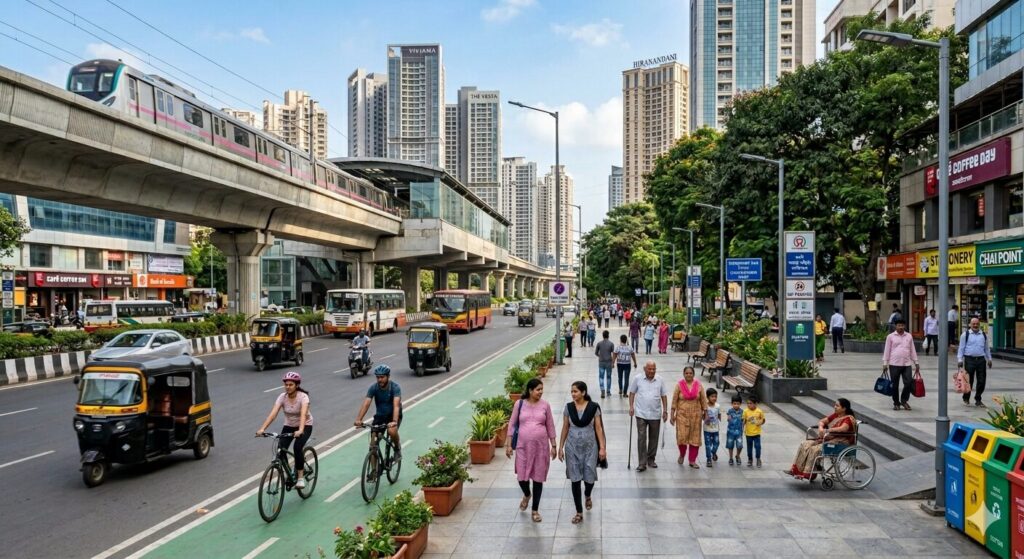
Development, absolutely. Growth, yes. But not at the expense of the environment, public spaces, and the right of every Thanekar to walk safely. Thane’s new developments are hardly creating any new democratic, inclusive public spaces. Malls are not public squares. Gated societies are not communities. Air-conditioned gaming arcades are not maidans. We are trading the commons for commerce, and the hidden cost of environmental degradation and loss of public spaces, which no balance sheet captures, will be a childhood without play, an old age without dignity, a city without soul.
The path forward requires will, not wealth. Thane must move beyond piecemeal road-widening and invest in genuine urban design — treating streets as public spaces, not mere traffic corridors. Thane needs a Streetscape Master Plan, a comprehensive, design-led document that maps every footpath, every crossing, every tree cover, every public space in the city, and charts a phased path to making them safe, accessible, and beautiful. It needs a pedestrian network that connects the lakes to the hills, the markets to the maidans, the railway station to the neighbourhoods — an equitable network.
The city already has planning tools at hand. Its “Complete Streets” policy (enforced in the Smart City programme) requires that street upgrades allocate space for all users. The proposed “Soft Mobility” streetscape plan, for example, would reconfigure 13 km of major roads to widen footpaths and bike lanes. All we need now is a vision, will, and resolve to deliver.
Thane’s policymakers should adopt a people-first agenda. Transparency, accountability, and public participation are the cornerstones of democratic governance. All major publicly-funded or citizen-affecting projects must include a mandatory public consultation process.
Through a collaborative effort among government, consultants, and citizens, and investment in walkability, Thane can become a model of liveability.
Excellent article very aptly put. I second every thought applied in the write up. In today’s world walkable footpaths and streets, parks and breathing spaces are the need of the hour.
yes,indeed! our cities need safe and properly designed footpaths. Pedestrian safety and universal mobility should be our high priority .