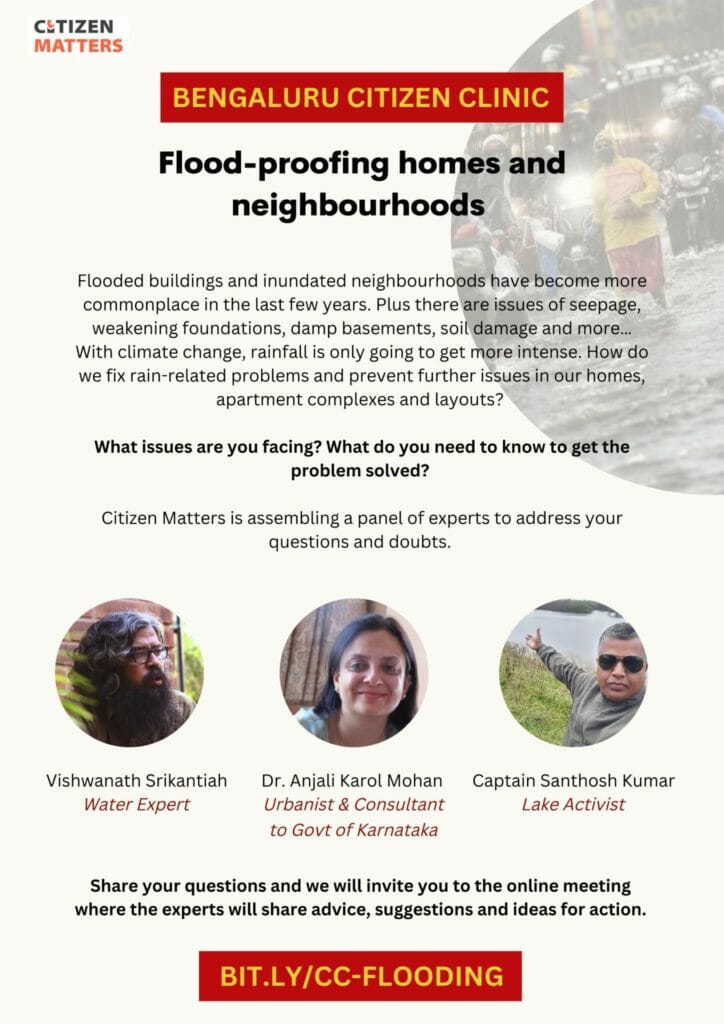
Flooded buildings and inundated neighbourhoods have become more commonplace in the last few years. In addition, residents have to deal with seepage, weakening foundations, damp basements and soil damage, not to mention potholed roads and footpaths.
With climate change, rainfall is only going to get more intense. How do we fix rain-related problems and prevent further issues in our homes, apartment complexes and layouts?
What issues are you facing? What do you need to know to get the problem solved?
Citizen Matters, Bengaluru will host a panel of experts to address your questions and doubts on November 4th (Friday), 6 pm onwards.
Please share your questions in this form (https://bit.ly/CC-FLOODING) by November 1st (Tuesday) and we will invite you to the online meeting where the experts will share advice, suggestions and ideas for action.
Read more: An unequal monsoon: The impact of the floods on Whitefield’s poor settlements
Some broad concerns to be addressed
- Is your home affected? How can you prevent your basement from getting flooded? Are you also worried about weakening foundations due to regular flooding? Is your roof leaking and seepage a common problem?
- What are the interventions to consider: Water recharge pits, planned sloping and elevation, waterproofing and structure strengthening?
- Is your neighbourhood at risk? Do you suspect some of the properties have encroached buffer zones? Are there poorly designed drains that overflow easily?
- How can we learn more about our neighbourhoods, location and status of drains, kaluves and lakes?
- What mitigation measures should be undertaken by the local authorities? What is BBMP’s role in maintaining lakes, roads and drains and how to make them do it?
Read more: Disaster management in Bengaluru: Temporary fixes touted as solutions as city floods again
Panel:
- Vishwanath Srikantiah (Zenrainman): He is a well-known Bengaluru-based water expert, water activist, and an educator
- Dr Anjali Karol Mohan: She is an urban and regional planner with a PhD in e-governance
- Capt Santhosh Kumar: He is a lake activist and an environmental worker for protection and promotion of rajakaluves in water bodies.