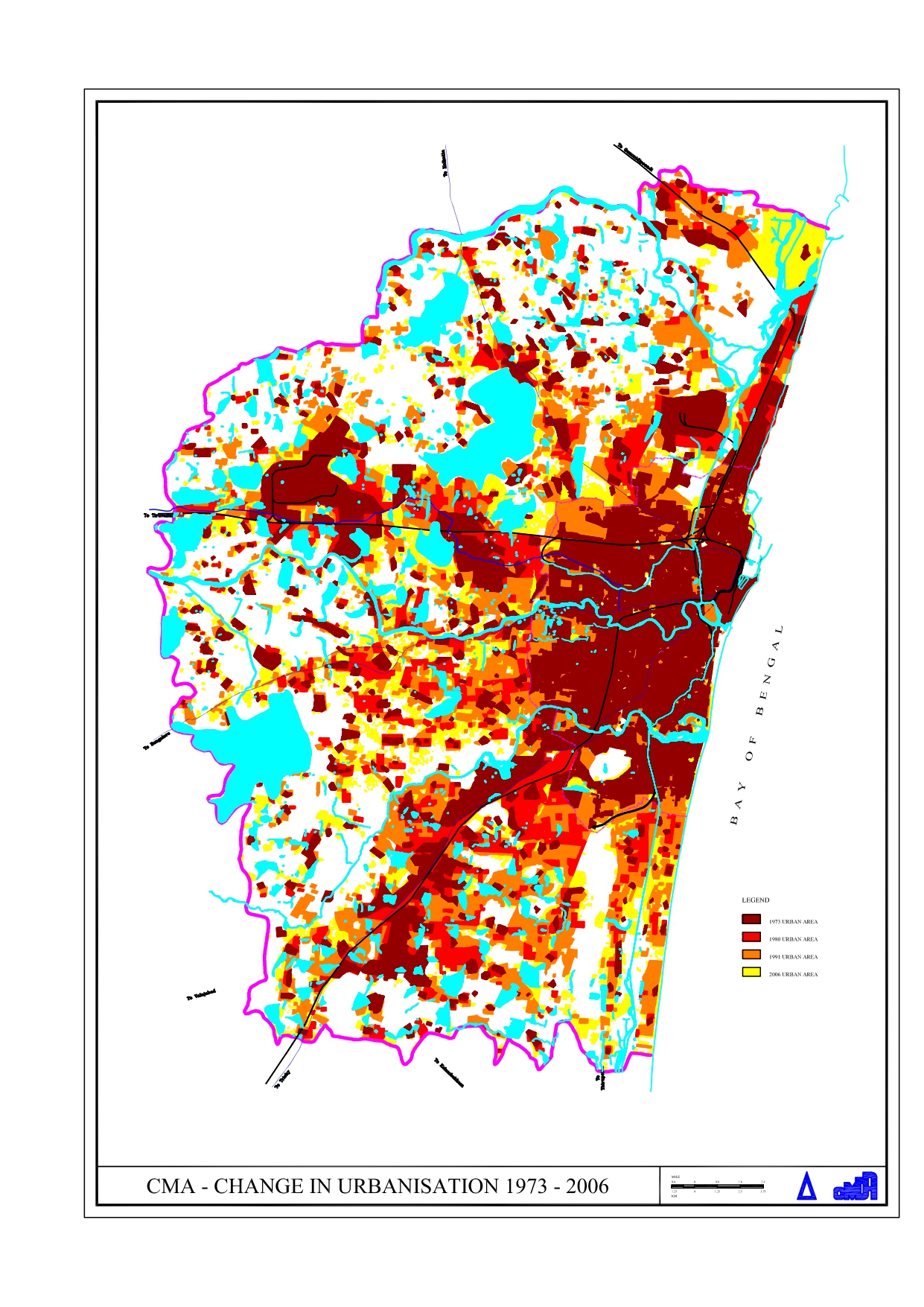
As cities grow rapidly, traffic, buildings, and loss of green cover inevitably follow. In 1974, the Chennai Metropolitan Area (CMA) covered 1,189 sq. km; by 2022, it had expanded to 5,904 sq. km, bringing with it challenges of governance. Gaps in governance are foremost on the minds of the 28.3 lakh Chennai voters set to elect their Members of Legislative Assembly (MLAs) on April 23rd.
The ruling Dravida Munnetra Kazhagam (DMK) government made 505 promises in 2021, of which it claims to have met 80%. But as residents and citizen groups come up with their manifestos ahead of the April elections, it is clear that there are ample concerns across the city around issues of zoning, commercialisation of residential areas, unchecked development and the indirect effects of the same on roads, traffic, congestion, etc.
A statutory body under the Tamil Nadu Town and Country Planning Act 1971, the Chennai Metropolitan Development Authority (CMDA) prepares master plans laying out a roadmap for the city’s growth. It is chaired by the Minister for Housing and Urban Development and has several government officials among its members. The second master plan of the (CMDA) notes zoning and building byelaws as primary tools of urban planning. Its goals were “decongesting urban areas, preserving environmental resources, and promoting economic growth in line with modern urban standards,” according to a recent policy note.
Voices from citizen manifestos
However, citizen concerns around urban planning and the spiral effect on daily livability are evident in some of the demands that they have made in their manifestos, a sample of which can be seen here:
- Enforce ‘infrastructure-first’ approvals.
- Comply with master plan; no post-facto regularisation of violations.
- Include resident representation in planning reviews with full public disclosure of permissions and deviations.
- Post Metro works, expedite safe pedestrian work access
- Ban unregulated posters on Metro pillars, flyovers, and road furniture.
- Designate Buckingham Canal as protected blue infrastructure with regular scientific desilting.
- Remove all encroachments from waterbodies, and create park or green space around waterbodies
- Walkable footpaths across the city.
- Electric vehicle (EV) charging stations to be planned and installed without obstructing footpaths and pedestrian movement.
- Mandatory institution-operated buses to reduce congestion, pollution, and road safety risks.
Ahead of these Assembly polls, we spoke to active citizens and welfare associations in Chennai to understand how such issues manifest in their respective neighbourhoods and constituencies. In the first conversation, resident welfare associations (RWAs) in Harrington Road, Ambattur Old Town, Thiruporur, and CIT Colony discussed urban planning, footpaths, and governance.
Unchecked commercialisation, encroachments
Commercialisation at breakneck pace has burdened residential areas in south and central Chennai. Homes converted into restaurants, offices, and shops have increased noise, traffic, and loss of privacy, disrupting daily life, say residents.
In February, Chief Minister MK Stalin inaugurated a 500-m pedestrian plaza on Khader Nawaz Khan (KNK) Road to promote walkability. However, this second pedestrian-focused commercial street (after T Nagar) caused spillovers into residential areas. Citizens in Rutland Gate and Wallace Garden soon started facing traffic snarls and unchecked parking.
Two kilometres away, Harrington Road’s 750-m stretch from Shoppers Stop to Subway contains nine schools, three hospitals, two auditoriums, and several commercial establishments. Parking for restaurants spills into residential lanes. In Thiruporur, under Chengalpattu district, parking spillover from Navalur’s commercial establishments blocks inner roads. Residents also cite electricity, sewage, traffic, air, and noise issues.
In newer areas like Ambattur Zone 7, residents highlight unclear zoning and confusion in revenue records. “While the CMDA reclassified the lands two decades ago, people are suffering because they don’t have patta. The revenue department has not yet implemented the change and there is no digitisation of these records,” says Ramalingam, a resident.
Residents of Old Mahabalipuram Road near Pallikaranai marsh have demanded clarification of the Ramsar buffer zone. All these cases reveal a broader gap: land-use changes approved without matching infrastructure planning or enforcement.
What are the zoning and reclassification laws?
Zoning classifies municipal lands into residential, commercial, mixed, and more. The CMDA frames and enforces Development Control Rules (DCR) for zones.
The Tamil Nadu Town and Country Planning Act, 1971, requires reclassification of land use zones to be based on consideration of “the suitability of the site, accessibility, compatibility with the adjoining developments, impact on the environment etc.” Section 32 allows landowners to request changes. The CMDA website provides guidelines for reclassification.
The procedure includes publishing a call for objections in newspapers, allowing 21 days for suggestions, and considering public input. Remarks from local bodies are taken, and No-Objection Certificates (NoCs) can be obtained from Departments like Public Works, The procedure includes publishing a call for objections in newspapers, allowing 21 days for suggestions, and considering public input. Remarks from local bodies are taken, and No-Objection Certificates (NoCs) can be obtained from Departments like Public Works, Greater Chennai Corporation, and Chennai Metropolitan Water Supply and Sewerage.
Residents may lodge complaints with the Corporation’s helpline 1913, requesting transfer of the same to the Works Department. They also point out that notices must be posted outside the land parcel being converted.
“Town planning must grow beyond permissions,” says Sabina Narayan of Harrington Road. She adds that bodies like CMDA must think about infrastructure and city planning before the project, instead of later. “We must think about how we’re managing the infrastructure around (commercial areas)? Can these bodies plan to widen roads or can they plan to create the infrastructure first before the actual project takes place?”
Read more: How blue areas become grey: Reclassification of waterbodies in Chennai
Walkability, footpaths, infrastructure
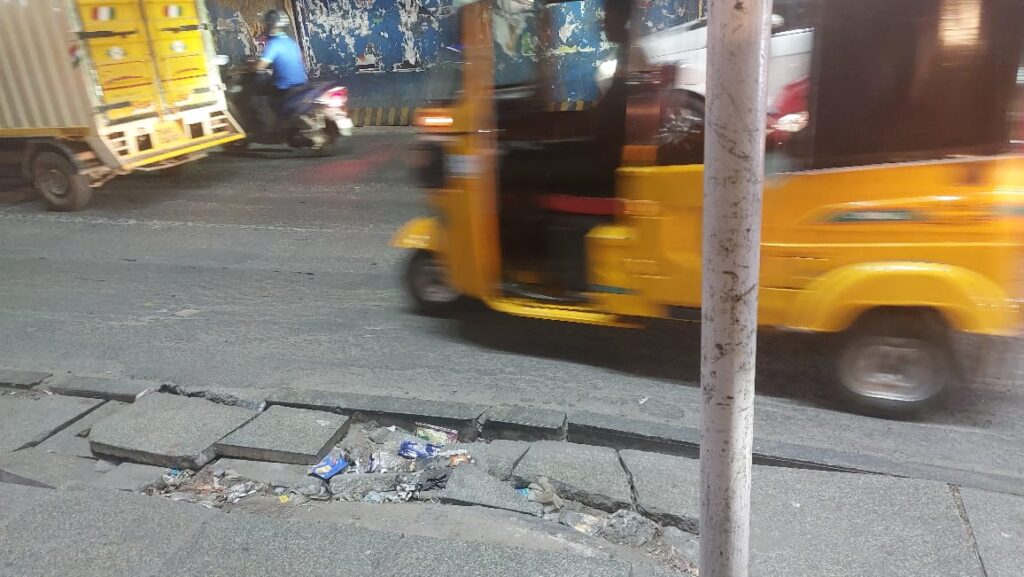
Despite pedestrian-friendly commercial streets, footpaths in Harrington Road, Anna Nagar, and Mylapore are lacking. “In CIT Colony, around 70% of pavements are unusable,” says resident Ramdas Naik. Residents cite cracked roads, broken pavements, and damaged bollards as daily hazards.
In Ambattur, pavements are absent along the Ambattur-Puzhal State Highway from Ravi Theatre to Kallikuppam, despite the presence of 10 schools, three hospitals, and multiple marriage halls on this 4-km stretch. Heavy traffic forces seniors and children to walk on roads. “The highway is encroached by shops on all street corners. There are 4700 roadside eateries in Ambattur Zone,” says Ramalingam, a resident. Despite representations to the GCC, CUMTA and City Roads Department, no action has been taken, allege residents.
“The highway is encroached by shops at every corner. There are several roadside eateries in Ambattur Zone,” says Ramalingam. Despite representations to GCC, CUMTA, and City Roads Department, no action has been taken, allege residents.
Residents demand widening of Chennai–Tiruvallur High Road (CTH) to 120 m, and widening Karuku Road, removing encroachments, to prevent the frequent pile-ups that occur. They also flag bus shelters encroached by autos and eateries.In these areas, lack of sewage treatment has led to sewage flowing into Puzhal Lake. Residents highlight the absence of government hospitals and schools. Bus shelters are used to showcase the MLA or other advertisements, instead of bus timings and route information. In Adyar, bus stops lack shelter altogether.
Read more: How OMR residents strive for better last-mile connectivity and improved public transport
‘Development’ vs Liveability
As the third Chennai Master Plan nears release, residents worry also about vertical development. In 2024, amendments to the Tamil Nadu Combined Development and Building Rules (TNCDBR), 2019, removed height restrictions for high-rise industrial buildings with minimum width of 30 m on plots of 4,000 sqm, and raised permissible floor space index (FSI) for all categories from 1.5 to 2. Ramdas warns vertical growth will reduce open space and worsen congestion.
Among other projects, the state has sanctioned ₹261 crores for a 44-acre Global Sports City in Semmancheri. Residents fear traffic congestion and flooding. The proposed sports city is behind the Sathyabama Institute of Science and Technology, which regularly floods during the monsoon. “On the other hand, as part of the same project, they have planned water sports in OMR, a water-scarce area reliant on tankers due to high TDS in the groundwater,” says resident Raj Elangovan.
Residents are also concerned about the 20-km, four-lane, elevated Chennai Port–Maduravoyal Elevated Corridor Project. “Construction creates dust, noise, and restricted mobility; post-construction, lack of noise barriers and safeguards could degrade air quality, increase noise, and damage the Cooum river,” fears Sabina.
Residents’ demands
- Inform residents of zoning or urban policy changes
- Protect residential areas; define land use and specify noise limits for mixed zones
- Ensure commercial buildings provide parking
- Fine and tow vehicles parked in residential areas
- Use CCTV for wrong-side driving and parking violations
- Enhance Ambattur Railway Station with express train stoppages
- Widen CTH Road, Padi Flyover, and Karukku Road in Zone 7
- Share project proposals like the sports city with residents for consultation