Step out on any morning in an Indian city, and you will find women contributing significantly to the vibrancy of urban life: walking children to school, waiting at bus stops, navigating crowded markets, heading to work, stitching together livelihoods and families across multiple trips and responsibilities. Urban India is home to about 181.6 million women, nearly 48% of its population. Yet, women hardly have a voice in how cities are planned, designed, and governed.
Globally, there is growing recognition that women-centric urban planning and governance work better for everyone. A 2021 study by UN-Habitat found, for instance, that gender-inclusive planning improves outcomes in cities. It leads to more efficient public transport, reduced crime, better access to water and sanitation, and higher citizen satisfaction with Urban Local Governments (ULGs).
India has taken important steps to bring women into the fold. The 74th Constitutional Amendment, introduced by Sheila Kaul, one of only two women to ever lead India’s urban development ministry, mandated one-third reservation for women in ULGs. 16 states raised this to 50%, opening city councils to tens of thousands of women, many from marginalised communities.
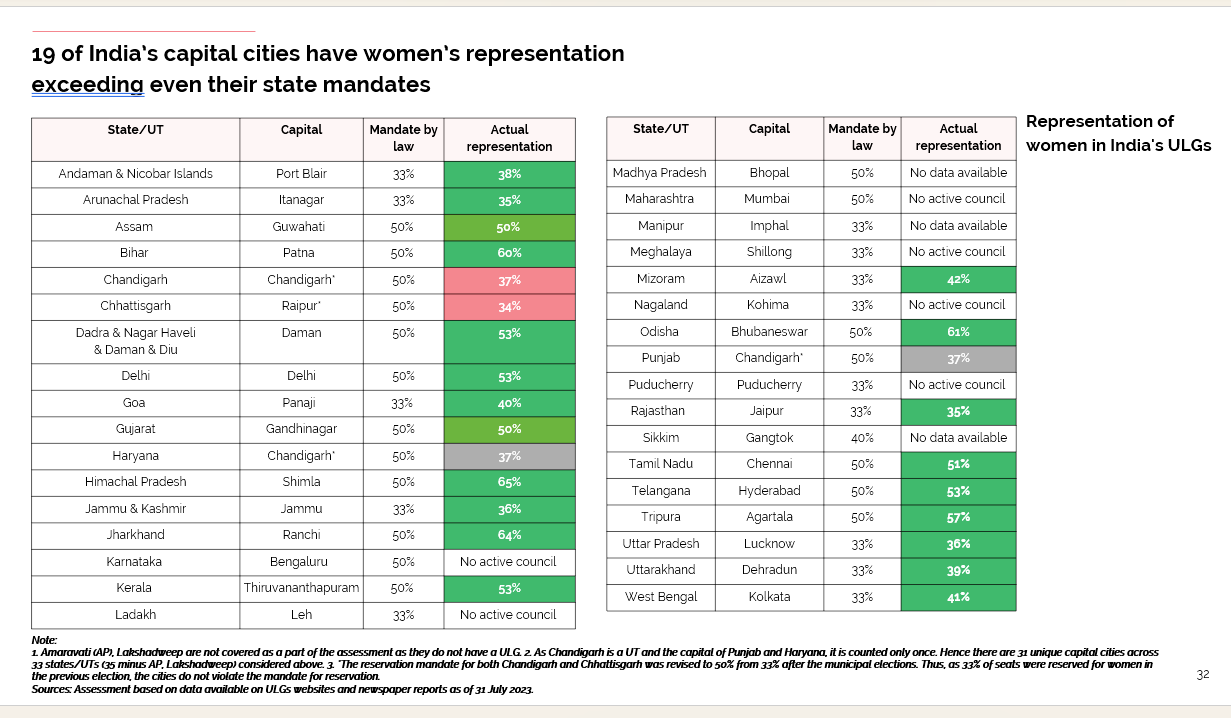
Today, women hold 46% of ULG seats (40,118 women councilors out of a total of 87,215 councilors), with 17 states providing 50% reservation, going above the constitutional mandate of 33%. This is far higher than their representation in Parliament (14%) or state legislatures (10%). Notably, 19 of 24 state capitals with active councils are led by women mayors.
But are numbers enough?
Women’s representation in city councils alone is not enough. Proxy leadership remains common, and many women councillors lack access to training, networks, and institutional support. Janaagraha’s City Leaders study highlights the urgent need for systematic leadership programmes for women councillors, particularly to build their confidence and capabilities in finance, technology, and communication.
While women are adequately represented in elected councils, they are largely absent from the rooms where budgets are decided, plans are approved, and infrastructure priorities are set. Without women at these tables, the urban agenda continues to be shaped by a narrow, often “default male” perspective, leaving cities ill-equipped to serve everyone.
As of April 2025, not even one state in India has a woman minister for urban development, and only five states have women serving as principal secretary for urban development. Only three of the 35 capital cities have women serving as municipal commissioners. Although gender-disaggregated data is scarce, it is evident that women are significantly underrepresented in the ULG workforce, especially in core functions such as planning, engineering, finance and public health.
Empowerment cannot rest on individuals alone. Gender must be systematically embedded in urban laws, policies, and institutions. Our review of municipal legislations across 10 Indian cities (Bengaluru, Cuttack, Faridabad, Guwahati, Indore, Jaipur, Kochi, Mumbai, Panaji, and Patna) shows that women’s perspectives are barely embedded in legal frameworks. None explicitly mandates gender inclusion in planning and design. Only Cuttack requires women’s involvement to some extent during resettlement processes.
Provisions for women’s participation in citizen platforms are sparse, with isolated examples in four cities. Even gender-neutral language is inconsistently applied, with only six laws carrying partial references.
The consequences of such underrepresentation in both numbers and policy show up daily in how women move, work, and experience public spaces. A recent study by the Jana Urban Space Foundation, Everstone Group, and We4Her Foundation indicates that 70% and 66% of unemployed urban poor women (annual income INR <3 lakhs) consider the lack of transport and safety, respectively, as impediments to their employment. Census data shows women walk (45%) and use buses (22%) far more than men, reflecting trip patterns shaped by caregiving and informal work. Yet transport systems continue to be designed for linear, peak-hour commutes generally undertaken by men.
Our streets rarely offer safe footpaths, adequate lighting, accessible toilets, or reliable emergency response. Our cities have not even begun to consider childcare and elder care facilities, even for urban poor communities. For women, simply stepping out of the home involves negotiating risk, time poverty, and dignity.
Read more: A few simple steps towards designing safer public spaces for women
Towards women-centric cities
There are inspiring models for India’s cities to learn from. Naga City’s Women Development Code and Vienna’s Gender Mainstreaming Department integrate gender priorities into administrative structures, while Buenos Aires’ SIGBA platform and Reykjavik’s gender budgeting link legal mandates with accountability tools.
Gender quotas in bureaucracy also merit attention: Nepal reserves 45% of civil service positions for women and minorities; Madhya Pradesh already reserves 35% of government jobs for women.
Closer home, Chennai’s Gender and Policy Lab is integrating mobility and safety audits into everyday governance. Mumbai’s Revised Re-Development Plan 2034 shows early promise. Bogotá’s CARE model demonstrates how placing essential services within a 15-minute walk can transform women’s access, autonomy, and participation in public life.
If India truly wants economically vibrant, inclusive, and resilient urban futures, it must centre women at the heart of planning, design and governance.