As election day inches closer in Chennai, there is deeper scrutiny of the issues in the city’s 16 constituencies and the changes called for. Waste management is one such problem area that the city has been grappling with for years. The state and local governments have failed to come up with an effective policy and strict implementation of rules, and voters have voiced their concerns and called for concrete changes in their manifestos.
India generates 62 million tonnes of waste annually, which is projected to triple by 2030. In Chennai, 6150 Metric Tonnes (MT) of garbage is collected and ferried to Kodungaiyur (~ 269 acres) and Perungudi (~ 200 acres) dumpyards, every day!
Starting April 1 this year, the new Solid Waste Management Rules (2026) have been in effect. These mandate that the waste be source-segregated into four categories – wet, dry, sanitary, and special care waste. Replacing the 2016 version, these new rules also aim to develop a centralised online portal to track all stages of solid waste management. It calls for the mandatory creation of a buffer zone for processing areas with an installed capacity exceeding 5 tonnes per day.
But while these rules await on-ground implementation, residents say that the very basics of segregation and waste disposal-collection-processing are still not in place in Chennai. Earlier this year, Chief Minister MK Stalin announced that the Greater Chennai Corporation (GCC) had cleared nearly 50 lakh MT of legacy waste out of a total of 90 lakh MT through biomining. The corporation noted it has reclaimed 100.29 acres of land so far in Perungudi and Kodungaiyur dumpyards.
Ahead of the Assembly polls, however, citizens continue to flag persistent waste management woes and the need to enforce strict compliance with rules. Experts and practitioners emphasise the need for a decentralised ward-level policy to deal with waste.
In several manifestos (which can be read on Opencity), including those from The Federation of OMR Resident Associations (FOMRRA) and resident welfare associations from southern Chennai, there is a call for:
- Mandatory segregation at source, and removal of large roadside dumpster bins.
- Biogas plants, composting centres and recycling and material recovery facilities in every ward with local reuse of compost and biogas.
- Formal integration of waste pickers with dignity, safety, and social security.
- Removal of all construction debris by the responsible agency.
- Material Collection Centres (MCCs) in non-GCC panchayat areas.
- Prevention of open dumping and monsoon drain clogging through proactive measures.
- Public dashboards for SWM monitoring.
- Timeline for restoring Perungudi dumpyard to its original marshland.
- Punishment for open dumping on lakefronts and vacant lands.
To understand the root of these demands better, we spoke to people from a few constituencies — how they perceive the problem and the changes they seek. We reached out to residents in Gandhi Nagar, Perungalathur and Thoraipakkam and below is what we learnt from them.
Uneven policy: Planned neighbourhoods vs outskirts of the city
In planned neighbourhoods like Adyar’s Gandhi Nagar, households segregate dry and wet waste that is then collected by private sanitation firm Urbaser Sumeet. “The area has a dry waste bin and the waste is collected in battery-operated vehicles (BOVs),” says Ramshankar N, a resident, who creates compost out of wet waste in his home. In south Chennai, resident welfare associations such as Swacch Gandhi Nagar and Residents of Kasturbanagar Association (ROKA) have taken the lead in managing their waste. For instance, ROKA holds collection drives, collecting mattresses, electronic waste and other items.
Despite these larger efforts, however, Gandhi Nagar and surrounding areas battle overflowing garbage bins. Ramshankar flags the irresponsible disposal of cots, broken toilets and commodes in particular.
Newly-developing areas like New Perungalathur, Thoriapakkam, and Sholinganallur tell a different story. In New Perungalathur SSM Nagar, in Alapakkam Village, residents estimate there are roughly 3000 apartments. “Builders collect the waste in my area and dispose of it in Porur dumpyard. Many other places dispose of it in open land nearby,” says SP Jayaraman, a resident.
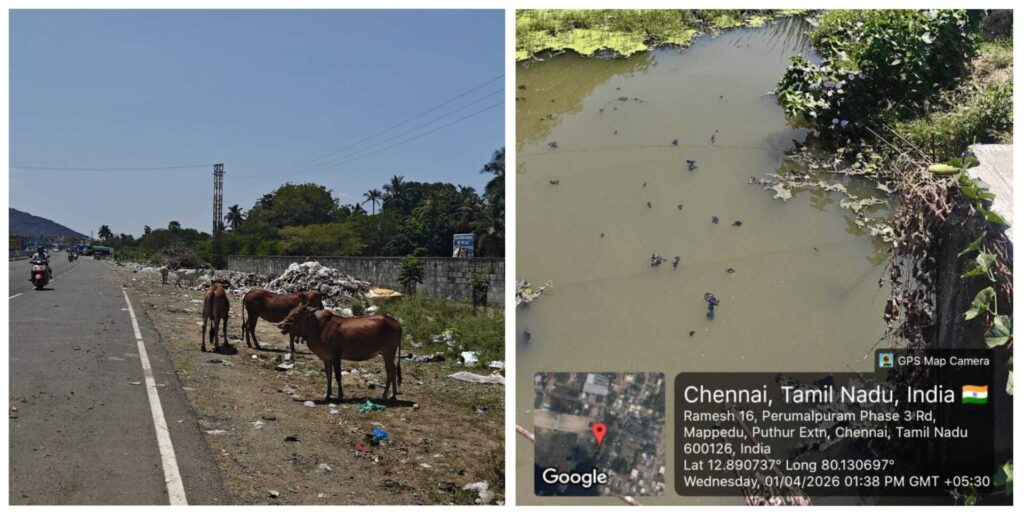
There are separate garbage bins for dry and wet waste, but residents rarely follow this mandate, he adds. In this area, residents have tied up with Spreco Recycling Pvt Ltd for dry waste but wet waste processing is still in very nascent stages.
“We don’t have separate garbage godowns. Often, in some of the small localities, the panchayat picks up the waste and dumps it on the 150-ft bypass road. The solid waste management is pathetic here,” Jayaraman adds.
He also flags the improper maintenance of the six Sewage Treatment Plants (STPs) in SSM Nagar, where the discharge is partially let into Stormwater Drain (SWD)s, which leads to the nearby Puthur lake.
Living in the shadow of landfills
Where does the collected waste of the city go?
According to the GCC, wet waste is processed at micro composting centres and biogas plants, while dry waste is sent to material recovery facilities and recycling centres. Non-recyclable waste is incinerated, and inert waste is sent to landfills. It may be noted however that the GCC shut down 168 MCCs and 88 MRFs across the city in 2025, owing to their location on burial grounds and public opposition.
Read more: The journey of waste: Ever wondered where all the trash in Chennai ends up?
New reports have shown that for decades, waste from Zones 1-8 was dumped at Kodungaiyur, while zones 9-15 ended up in the Perungudi dump yard. Around one km away from Perungudi dumpyard, the stench lingers in the home of A Francis in Thoraipakkam, leading to sleepless nights. “Around 2500 MT is being dumped here daily, and it was once like a mountain. They began biomining but also continue to dump waste here,” says the resident.
Perungudi dumpyard is near the Pallikaranai Marshland, which was declared a Ramsar site in 2022, and is home to 115 bird species. This area had seen massive development in the 1990s but lacked solid waste management rules or proper garbage collection, notes Francis. He highlights how underground water is affected by legacy waste leaching into the ground, and flags cases of health issues such as asthma and cancer in the area.
Previously, residents protested dumping of construction debris in Perungudi and the proposal to set up an integrated solid waste management facility in an eight acre area here. Citing the need to protect the ecologically sensitive area, they demanded the relocation of the dumping grounds.
Proposed Waste-to-Energy Plant in highly polluted north Chennai
In March 2026, the GCC announced plans to set up a municipal waste-to-energy plant and a scientific landfill at Keerapakkam. Spread across 75 acres, it aims to process 2,400 tonnes of municipal solid waste a day from the Tambaram-Avadi cluster. WTEs aim to burn the waste to generate power.
This comes after the plan to set up a WTE plant, at a cost of 1026 crore in Kodungaiyur. It aims to burn 2,100 tons of mixed garbage a day or about 33% of the city’s total garbage generation in Chennai. But a single plant will emit 3,400 tons of carbon dioxide daily.
However, the existing 50MTPD (Metric Ton Per Day) incinerator facility currently operating in Kodungaiyur fails environmental and regulatory compliance, as noted in a recent study conducted by the Centre for Financial Accountability and released by the Federation of North Chennai Residents Welfare Association (FNCRWA) and the Alliance for Incinerator Free Chennai.
The study found that 90% of the emission parameters mandated under the SWM rules 2016 was not monitored even once since the plant was commissioned in 2021. These emissions include hazardous bottom ash or fly ash.
The report also flagged health issues such as wheezing and coughing in the neighbourhood. In this context, residents have protested the WTE proposal citing that pollutants from this plant would contaminate the already polluted and industrialised north Chennai and nearby waterbodies.
Meanwhile, the National Green Tribunal has also flagged high levels of toxic metals in the Manali waste incinerator.
Read more on why WTEs are a bad idea:
- Why a waste-to-energy plant is not the answer to Chennai’s garbage problems
- Explained: The five big problems with India’s Waste-to-Energy plants
- Green Chennai Initiative: North Chennai coalition challenges toxic Waste-to-Energy plans
- Status check: Key concerns remain as Chennai moves ahead with WTE plans
- Let’s rethink waste: Why cities must move from incineration to cleaner solutions
Jayaram points out, “If the government wants to ensure that the city environment is safeguarded, there needs to be strict implementation of policy.” Such policies need to factor in health hazards and the realities on ground, point out citizens.
Meanwhile, citizens hope the state government will reassess policies like WTE and incineration, and target better scientific management of legacy waste in Chennai’s two landfills. In the outskirts of the city, there are demands for better garbage collection and transparent processes.
Residents now want their MLAs to utilise their financial and administrative powers [such as the Member of Legislative Assembly Local Area Development (MLA-LAD) funds] to increase decentralised waste processing capacity and infrastructure.
Resident demands
- Drop plans for WTE plants
- Decentralise waste collection in different wards
- Enable sharing of expertise of local communities and tailor it for other communities
- Raise awareness on segregation and correct practices of waste disposal, collection and processing