Monitoring groundwater level is like keeping a tab on your income and expenses—if you are spending more, it is a warning sign. You can cut down spending or find ways to earn more. Similarly, a city must decide whether to reduce extraction in certain areas or improve recharge methods, such as rainwater harvesting, wastewater treatment, or preserving open spaces. So, does Bengaluru have enough groundwater monitoring systems?
While a WELL Labs report estimates the city’s groundwater consumption as 1,392 million litres a day (MLD), BWSSB’s groundwater outlook report states that the extraction is only 800 MLD. This suggests a significant discrepancy in estimates, mostly because of insufficient data and inadequate monitoring points, highlighting the urgent need for proper tracking of groundwater resources.
Why is improved groundwater monitoring important
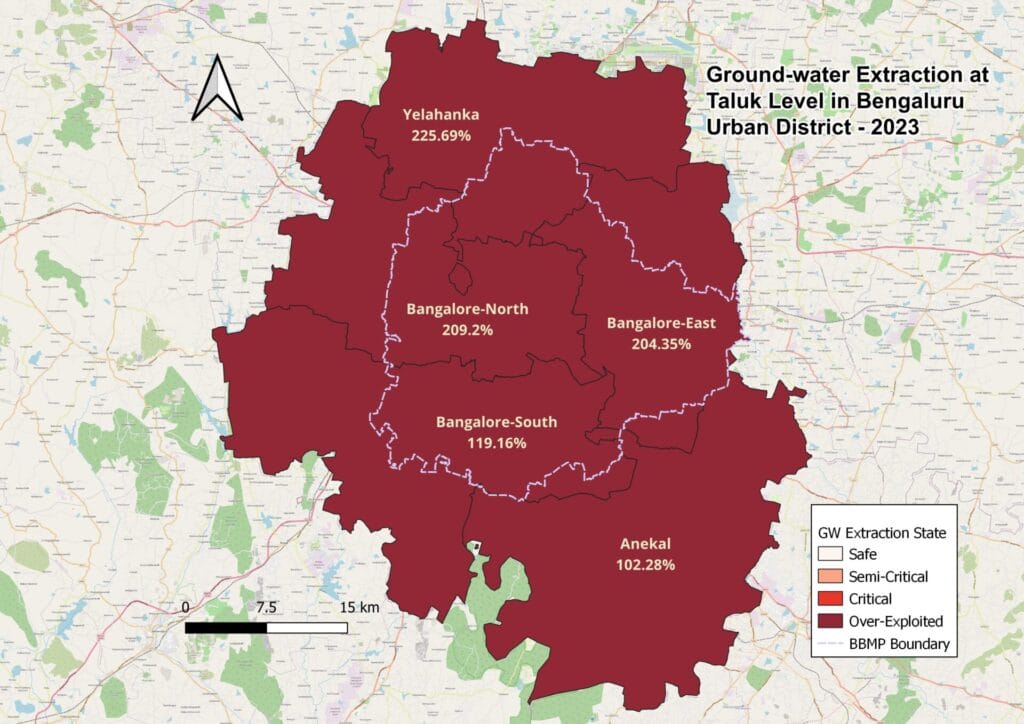
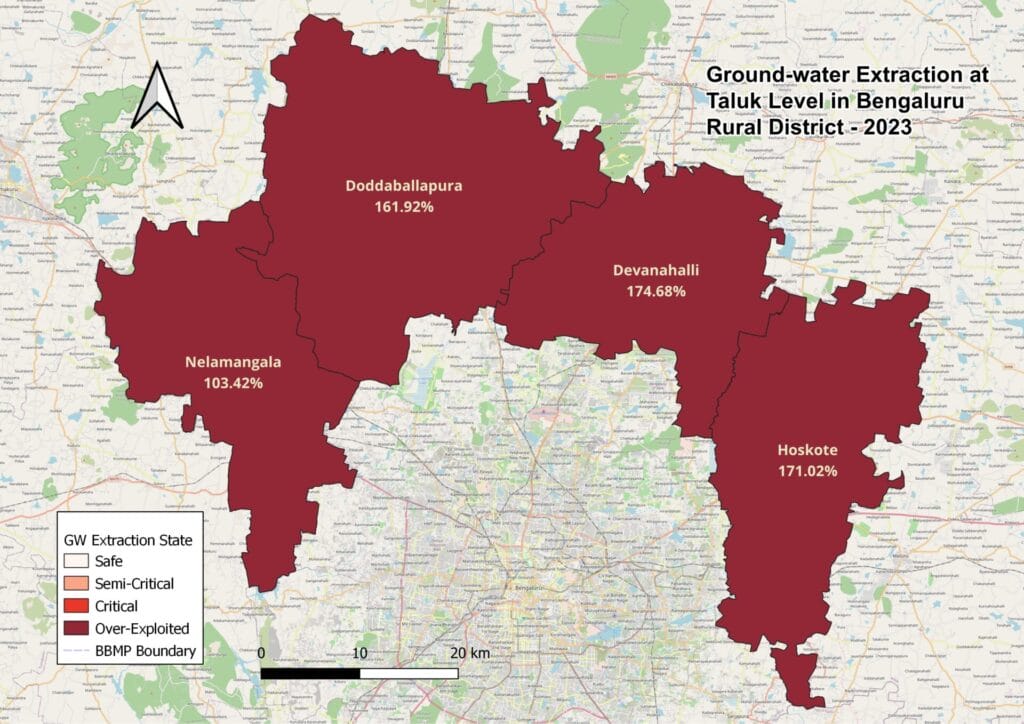
According to the groundwater resource assessment by the Central Ground Water Board (CGWB), groundwater resources are over-exploited at all 10 assessment units in Bengaluru Rural and Urban districts.
Sekhar M, a faculty member at the Indian Institute of Science’s Interdisciplinary Centre for Water Research (ICWaR), emphasises the need for optimal aquifer use by combining artificial and natural recharge. To achieve this, it is crucial to identify areas with high extraction and potential recharge sites, which requires monitoring at multiple points within a given region.
“Groundwater is not visible, and we can make the invisible visible only with data. With such local data, decision making becomes easier—to understand critical places, invest more in recharge and also reduce usage,” Sekhar points out.
Read more: Digging a borewell in Bengaluru? Here’s a guide to groundwater extraction rules
Lack of adequate monitoring systems
While experts suggest one monitoring well for each ward, the numbers are much lower, which makes it difficult to track extraction.
According to Jayaprakash H P, head and Scientist D at the Southwestern Regional office of CGWB in Bengaluru, CGWB monitors around 35–40 deeper aquifers and 20–25 shallow aquifers every month. Among these, 18 digital recorders collect water level data every six hours. The rest are piezometers, which require manual intervention. The State groundwater authority also monitors around 30 to 35 wells with a combination of digital and manual monitoring stations.
Also, CGWB does not release monthly data; instead, it publishes seasonal data once every three months.
Challenges in ward-level monitoring
Jayaprakash states that CGWB faces manpower constraints, with only 25 employees handling all operations in Karnataka and Goa.
He adds that this is set to improve as there are plans to increase the monitoring. The CGWB, IISc and BWSSB together have signed a Memorandum of Understanding (MoU), and CGWB has recommended ward-wise groundwater level monitoring. BWSSB is procuring IoT (Internet of Things)-based groundwater monitoring systems to collect data on groundwater levels.
The CGWB acts as a technical advisor to the state departments and develops recommendations. Thus, the implementation is in the hands of BWSSB, for whom this is the first time taking up groundwater monitoring. The IoT-based monitoring project and a groundwater task force within BWSSB were announced in April 2024 but no progress has been made till now.
How to improve groundwater monitoring
The key to ensuring sustainable utilisation of groundwater is to monitor recharge and extraction at a granular level. “The typical national plan to monitor groundwater is to have one monitoring unit every 80 square kilometres. However, as the usage and extraction are much higher, there should be at least one monitoring point in each ward, and it should be slowly developed into one in each square kilometre,” suggests Sekhar. That would be around 2,200 monitoring wells in Bengaluru Urban District alone.
“The monitoring done by the Central Groundwater Board is not very dense,” says Avinash Krishnamurthy, co-founder and director of Biome Trust. He adds that the Karnataka State Disaster Monitoring Centre (KSNDMC) could integrate groundwater monitoring systems as they already have ward-level monitoring mechanisms for disaster management.
CGWB has dedicated wells for monitoring groundwater levels, but Avinash suggests using sensor-based water level detectors in existing wells. These sensors can automatically collect data every minute or two, minimizing manual intervention and reducing manpower needs.
He also recommends a participatory monitoring approach. In addition to deep aquifers, shallow aquifers, such as open wells near lakes, can be observed. Well owners can contribute data to help assess how lakes impact groundwater levels. Since measuring water levels in open wells is straightforward, they are easy to monitor.
Read more: Analysts examine Bengaluru’s water security indices and data challenges
Citizen participation is the key to monitor extraction
Involving the community could give a boost to the exercise. Experts suggest monitoring groundwater extraction at the domestic level—in individual houses and apartments. This will help understand the demand for groundwater in different parts of the city.
“Along with institutional management, participatory management is also essential. The government institutions should incentivise a citizen-led monitoring system,” adds Avinash.
“People may resist metering, fearing it could lead to charges, and enforcement won’t be effective. Instead, encouraging participation is key,” says Sekhar. Even without meters, keeping simple records of estimated groundwater use at homes, buildings, and borewells can help track usage and support better water management, he adds.
What does UNESCO say?
The theme for UNESCO World Water Day 2022 was ‘Groundwater: making the invisible visible’. According to a report by UNESCO, groundwater is central to the fight against poverty, to food and water security, to the creation of decent jobs, to socio-economic development, and to the resilience of societies and economies to climate change.
The report notes that the reliance on groundwater will only increase, mainly due to growing water demand by all sectors combined with increasing variation in rainfall patterns. Unlocking the full potential of groundwater will require strong and concerted efforts to manage and use it sustainably. And it all starts by making the invisible visible—which is developing knowledge.
Groundwater as a public resource
In most places, groundwater is publicly owned, but in some regions, including India, it is considered private property tied to land ownership. The Groundwater Governance Project-Vision 2030 aims to promote responsible, collective action to ensure its sustainable use for both people and ecosystems. Despite legal and practical challenges, the project advocates for bringing groundwater into the public domain, allowing the state to regulate extractions and assign use rights to ensure sustainability, equity, and efficiency.
Monitoring the quality
There are also two aspects to monitoring. “Along with monitoring the quantity, it is important to monitor the quality of the groundwater as well,” Avinash says. This could facilitate using treated water from Sewage Treatment Plants to recharge the aquifer. However, groundwater quality is being monitored only once every year. This frequency should be increased.
If monitored and managed properly, Bengaluru will have enough water resources to meet its needs sustainably. Reliable groundwater data can guide smarter policies, balance usage, and support long-term aquifer recharge.
Way forward
- Groundwater monitoring must take place at every ward in the city.
- Citizen participation should be encouraged to monitor groundwater extraction.
- Quality, along with the quantity of the groundwater, should be monitored.
What could be the outcomes?
- Policy makers can use groundwater data to facilitate equitable access to groundwater.
- Areas that need intensified groundwater recharge, can be identified.
- Over-exploited regions must be recognised to allow authorities to implement usage restrictions.
- Groundwater management can be optimised based on supply-demand principles.
In Bellandur and Varthur lakes water is not stored for 3+ years due to lake rejuvenation work. thease are the 2 huge lakes in this area, Obviously ground water level is expected to go down in surrounding areas.Bwssb has not given Kaveri water to most of these areas so we are heavily dependent on Borewell water or tanker supply. In Vibgyor school road Kaveri water supply was cut during 2024 February to lay pipelines to take water to Whitefield area, It is not restored till now..