Mylapore is one of the 16 constituencies in Chennai, Tamil Nadu’s largest district, encompassing areas such as Alwarpet, Santhome, Raja Annamalaipuram, and F.S. Estate and Mandaveli. Steeped in history yet firmly rooted in the present, the constituency blends cultural legacy with contemporary urban life.
It is home to prominent places of worship—Mylapore is renowned for its temples, while Santhome is closely associated with churches. The area holds deep historical and spiritual significance: the revered Tamil poet Tiruvalluvar and the saint Peyalvar are believed to have been born here, and Santhome marks the martyrdom of Saint Thomas the Apostle, who preached Christianity in India.
The constituency comes alive during the December–January music season, when sabhas and cultural institutions host a vibrant array of programmes in music, dance, and drama. Artists, including many from the global Indian diaspora, participate enthusiastically, drawing large crowds that often lead to congested roads — an issue further exacerbated during the rainy season.
Adding to its charm is the scenic Marina Beach, which enhances the area’s appeal. Mylapore thus stands as a unique confluence of heritage, spirituality, artistic vibrancy, and modern lifestyle.
Following the recent Special Intensive Revision (SIR) of electoral rolls, the total number of voters stands at 1,94,731—a notable decline of about 28% compared to the 2021 figures. Interestingly, women voters outnumber men by around 4%, a demographic tilt that could play a meaningful role in shaping electoral outcomes.
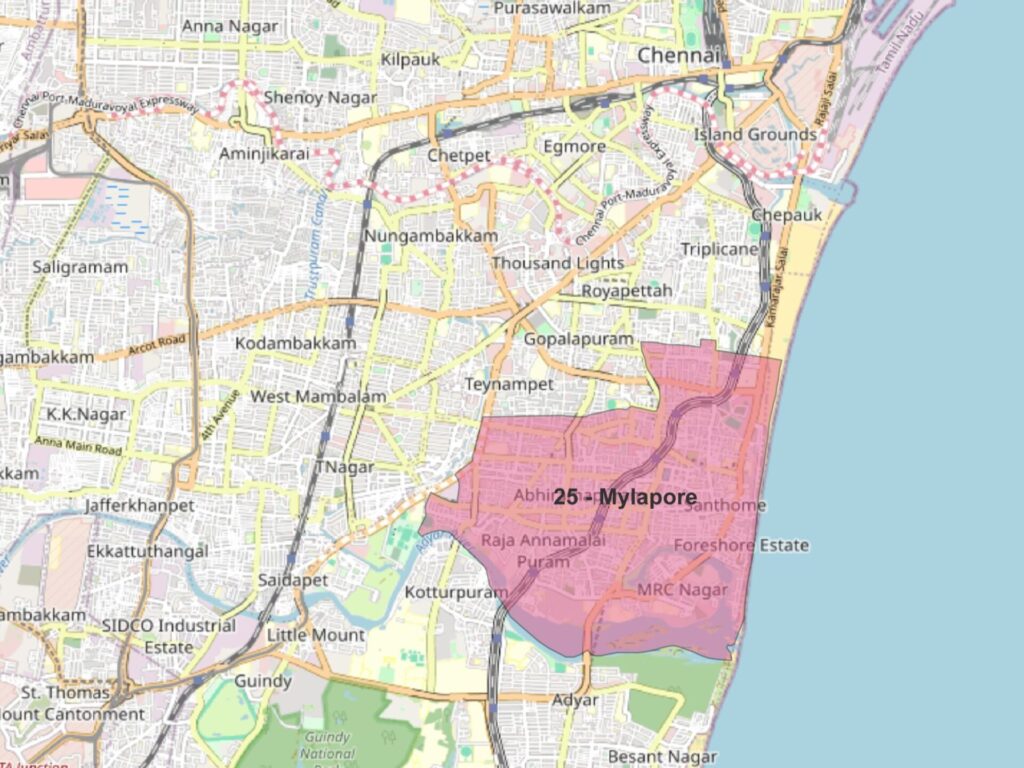
Map showing Mylapore constituency. Pic courtesy: OpenCity.in
Political representation
The Mylapore Constituency is not a reserved seat but one that comes under the general category.
Candidates for 2026 polls
Politically, Mylapore has largely been a battleground between the two Dravidian majors—AIADMK and DMK—since 1977. Of the elections held during this period, the AIADMK has secured victory six times, while the DMK has won on four occasions, reflecting a competitive but slightly AIADMK-leaning history.
The 2026 election carries added significance with Bharatiya Janata Party, an alliance partner of the AIADMK, fielding Tamilisai Soundararajan as its candidate. Her prior tenure as the Lieutenant Governor of Puducherry adds both visibility and political weight to the contest.
| 2026 | Candidate | Party | Sex | Age | Link to affidavit |
| 1 | Velu.Dha | DMK | Male | 55 | Download here |
| 2 | Dr. Tamilisai Soundarrajan | BJP | Female | 64 | Download here |
| 3 | Venkataramanan. P | TVK | Male | 48 | Download here |
Details of all the candidates can be found at the ECI here
2021 polling snapshot
- Total number of voters: 270536
- Male voters: 131152
- Female voters: 139344
- Others: 40
- Polling percentage: 56.24
Source: Election Commission of India
Previous results 2021
| 2021 | Candidate | Sex | Party | Age | Votes polled (Share of vote %) |
| 1 | Dha Velu | Male | DMK | 50 | 44.95% |
| 2 | R Nataraj | Male | AIADMK | 70 | 36.65% |
| 3 | Sri Priya | Female | MNM | 65 | 9.8% |
Source: Election Commission of India
Previous results: 2016
| 2016 | Candidate | Sex | Party | Age | Votes polled (Share of vote %) |
| 1 | R Nataraj | Male | AIADMK | 65 | 43.67% |
| 2 | Karate Thyagarajan | Male | INC | 56 | 34.23% |
| 3 | K Nagarajan | Male | BJP | 56 | 7.55% |
Source: Election Commission of India
Incumbent MLA
Dha Velu is an active DMK Leader working for the development and strengthening of the roots of his Party. His victory in 2021 was the first and the elections in 2026 will .be a tough fight against BJP’s Tamilisai
- Age: 56
- Educational qualifications: BA (Economics), LLB
- Contact details: 98404 22222
- Email: veluom@gmail.com
- Criminal cases: Nil
- Social media presence:
- Instagram: https://www.instagram.com/mylai_velu/
- Facebook: https://www.facebook.com/velumylai/
- X (Twitter) :(@mylaivelu71) / X
MLA in the media
Mylai D. Velu is facing growing criticism from sections of the fishing community, a crucial voter base in the constituency. His standing among them appears to have weakened, with concerns emerging over unmet expectations and implementation gaps in key promises.
One of his major electoral commitments was the establishment of dedicated fish markets. While the infrastructure has been created, fishermen allege that poor planning and unresolved allocation issues have limited their usability. Despite court directives, many vendors continue to operate along Marina Loop Road rather than relocate to the designated complexes. Significantly, even some of those who have been allotted shops have not shifted, indicating deeper concerns about viability and accessibility.
Further discontent stems from housing assurances. The MLA had promised residential units within fishing hamlets stretching from Nochikuppam to Srinivasapuram, covering nine villages. However, allegations suggest that several units constructed by the Tamil Nadu Urban Habitat Development Board have been allotted to beneficiaries from outside these local communities. Of the 1,188 units built in Nochikuppam, only about 400 are reportedly occupied by local fishermen, raising questions about equitable distribution and fulfillment of commitments.
Together, these issues have contributed to a perception gap between promise and delivery, which could prove politically significant given the community’s electoral importance.
Key citizen demands
- Housing project for the fishing community.
- Housing Project in Srinivasapuram planned under Slum Clearance Board
- Construction of bus terminus.