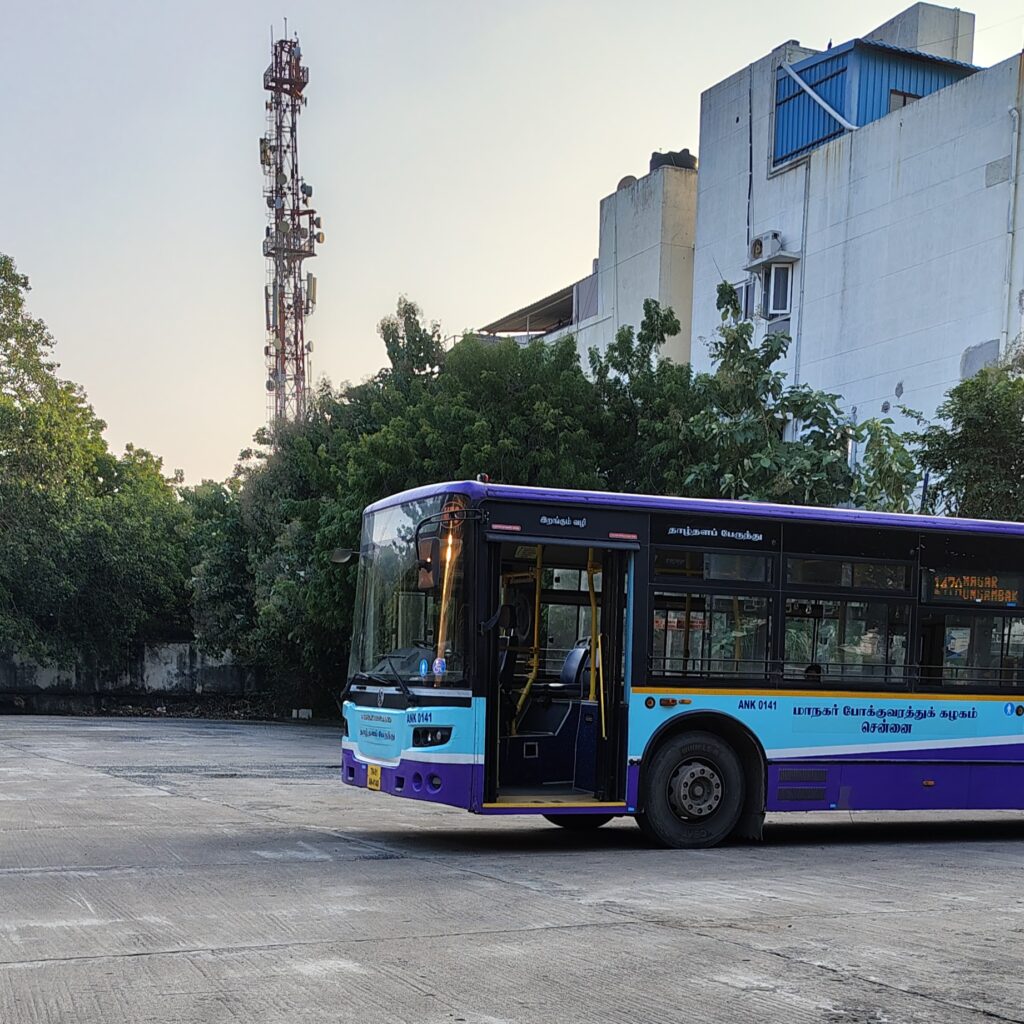
When Chief Minister M K Stalin flagged off Chennai’s first batch of low-floor electric buses in June 2025, the programme was presented as a major step towards cleaner and more modern public transport. The first phase alone involves acquring 625 electric buses at a reported cost of ₹697 crore. The fleet includes 400 non-air-conditioned and 225 air-conditioned buses and is being operated from five depots: Vyasarpadi, Perumbakkam, Central, Tondiarpet-I and Poonamallee.
The investment is substantial. Chennai has not inducted a fleet of this size in years. The buses are low-floor, wheelchair accessible and equipped with passenger information systems, CCTV cameras and charging infrastructure. They are also expected to reduce emissions from an ageing diesel fleet and improve passenger comfort.
Yet, one basic question cannot currently be answered from public documents. Has this investment improved mobility in the parts of Chennai that depend most on buses? That is not a rhetorical question. It is an accountability one. The available information tells us where the buses are being deployed. It does not tell us whether deployment aligns with where dependence on public transport is greatest.
But are these buses reaching those who need it the most?
The Perumbakkam depot’s electric buses connect Siruseri, Sholinganallur, Kelambakkam and the airport. Metropolitan Transport Corporation (MTC) officials have explicitly stated that these services were introduced to meet growing demand along the OMR corridor. Additional services from the Central, Tondiarpet-I, and Poonamallee depots connect destinations such as Red Hills, Tambaram, Koyambedu, and Kilambakkam. Around 50 routes across the city and its suburbs are expected to be served under the first phase.
These are important corridors. Chennai’s metropolitan expansion has increased commuting distances and intensified demand on arterial routes. That’s why, better services on these corridors can reduce dependence on private vehicles and improve integration with Metro and suburban rail systems.
The route lists published by the MTC tell only half the story. They identify where buses operate, their origins, destinations and stopping points. They do not indicate whether the routes were selected using ward-level indicators such as population density, public transport dependence, accessibility gaps or socio-economic need. They tell us where buses run. They do not tell us who has benefited.
There is no publicly available map showing electric bus coverage by ward. There is no overlay of EV routes with population density, occupational structure or dependence on public transport. There is no published indicator showing whether wards that rely heavily on buses have experienced greater improvements than those that already had multiple transport options.
The city knows where buses operate. However, citizens do not know whether the places most dependent on buses have received proportionate benefits from a ₹697 crore investment.
Who benefits from the EV investment?
That distinction matters because Chennai does not have a single commuting pattern.
A software professional travelling from Siruseri to Guindy and a worker travelling from Tondiarpet to a nearby industrial cluster use public transport differently. One often depends on long-distance corridor connectivity. The other may depend on short trips, affordable fares and services close to home.
Both are public transport users and both should matter in decisions on route allocation. But has the State measured whether or not both have benefited from electrification?
The Government of Tamil Nadu’s electric bus rollout announcements, the Metropolitan Transport Corporation’s depot and route allocations, and the Comprehensive Mobility Plan for the Chennai Metropolitan Area (2023–2048) describe the scale of procurement, the routes selected and the city’s broader mobility objectives. However, they do not publish any ward-level assessment showing whether electric bus deployment corresponds to public transport dependence, accessibility gaps or socio-economic need.
The absence of such information is significant because Chennai’s transport needs are uneven.
Census of India 2011 data and the Comprehensive Mobility Plan for the Chennai Metropolitan Area show substantial socio-economic differences across the city. Parts of North Chennai, including Tondiarpet, Royapuram and Perambur, have relatively high concentrations of industrial, construction and informal-sector workers who rely heavily on bus services for daily travel.
By contrast, several southern and western corridors increasingly accommodate professional and service-sector employment associated with longer commutes and greater access to multiple transport options.
These differences do not imply that one set of commuters deserves better services than another. However, they do suggest that identical transport interventions can have very different effects across neighbourhoods. Yet, Chennai has not published the evidence required to examine those effects.
Questions of accountability and accessibility
Fares complicate the picture further. MTC has decided that non-air-conditioned electric buses will operate as Deluxe services, and air-conditioned buses will follow AC fare categories. A journey of around nine to ten stages costs approximately ₹15 on an ordinary service and around ₹30 on a Deluxe service. AC fares are higher.
This does not establish that electric buses are unaffordable, although it raises an important policy question. Could higher fares themselves become one of the reasons why some lower-income neighbourhoods experience limited demand for electric bus services and therefore receive little or no EV coverage?
Transport demand is determined not only by whether a service exists. It is also determined by whether people can afford to use it.
A worker making two trips every day may continue using an ordinary bus even when an electric bus operates on the same corridor. Lower patronage on routes serving poorer neighbourhoods could then make those areas appear commercially less attractive for future EV deployment. In that case, limited EV coverage becomes partly an affordability issue rather than simply a route-planning issue.
Read more: A four-hour commute: The daily transport struggles of women from Chennai’s resettlement areas
Dearth of details on commuter patterns
Publicly available information does not allow us to test this proposition.
MTC has not published ward-wise ridership profiles for electric buses. It has not published the socio-economic characteristics of users. Nor has it released evidence showing how fare categories influence access across different parts of the city.
The debate, therefore, is not over whether electric buses are affordable, but whether that affordability has been measured. This becomes increasingly relevant because Chennai’s own planning documents place equity at the centre of transport policy. The Comprehensive Mobility Plan for the Chennai Metropolitan Area 2023-2048 repeatedly refers to equitable access and a higher public transport mode share.
Yet, there is no public route-equity map or ward accessibility report showing whether transit-dependent communities have actually benefited from electrification. As a result, the programme risks being assessed almost entirely through inputs such as, number of buses procured, depots upgraded, and routes served. These inouts are important. However, public investment should also be assessed through outcomes.
Which neighbourhoods received better connectivity?
Which communities experienced shorter travel times?
Which wards gained access to services that previously did not exist?
Who benefited first?
The policy responses do not necessarily require additional expenditure.
Read more: A roadmap for MTC: Share plan with bus commuters in Chennai
Next steps for MTC
First, the Metropolitan Transport Corporation (MTC) should publish route-level operational data, including frequencies, ridership and service performance, while the Chennai Unified Metropolitan Transport Authority (CUMTA), as the city’s coordinating transport authority, should integrate these datasets into a publicly accessible ward-level route-equity dashboard that overlays electric bus routes with population density, worker composition and public transport dependence.
Second, MTC should publish periodic assessments of who uses electric buses and whether fare structures influence access across income groups and neighbourhoods.
Third, future procurement should recognise that Chennai’s transport geography is uneven. Large low-floor buses are suitable for trunk corridors and long-distance routes. Dense neighbourhoods with narrow internal roads may require smaller electric buses or regular MTC services operating closer to homes.
At present, commuters can access route information through the MTC website and mobile applications, but no official platform allows users to examine whether electric bus deployment corresponds with ward-level transport dependence or socio-economic characteristics.
Most importantly, the city may need to consider a mixed-service model.
Electrification should not automatically mean premium mobility. A segment of the electric fleet could operate under ordinary fare categories, particularly on routes serving lower-income and highly transit-dependent wards. At the same time, smaller electric buses and regular MTC services could provide neighbourhood connectivity in areas where large buses are operationally unsuitable. The objective should be to ensure that cleaner mobility does not bypass the communities that depend most on public transport.
The first test of Chennai’s electric bus programme is not whether it has procured 625 buses. It is whether a ₹697 crore public investment has produced measurable improvements in mobility for the communities that rely on buses the most. Chennai has measured the fleet. It has not yet been shown who has benefited from it.