Amudhini regularly boards the 29C or A1 from Abhiramapuram to Chetpet. On a scorching day, without any roofing, the bus shelter seats radiate heat, and they are “uninviting and uncomfortable to sit on for a prolonged period of time,” says the public relations professional.
On her route, she passes Mylapore Tank and KMC Hospital and notes: “Bus stops differ from one to the other. I have seen well-maintained bus stops with decent seating, but many others are poorly maintained. Across these stops, none have ramps or uniform display boards. For a lot of elderly working-class people, buses are the only financially accessible mode of transport, but the bus stop platforms are often broken and unsafe.”
Meanwhile, Maghizam Poo, a researcher, says that the stop they frequent at Padur has no shelter or roofing but is a nondescript tea shop. “At VIT, there’s no roofing. At SIPCOT IT Park, there is seating. At Sholinganallur, sometimes buses stop 100 metres away from the shelter; and at Broadway, the shelters are dirty and benches in a bad state.”
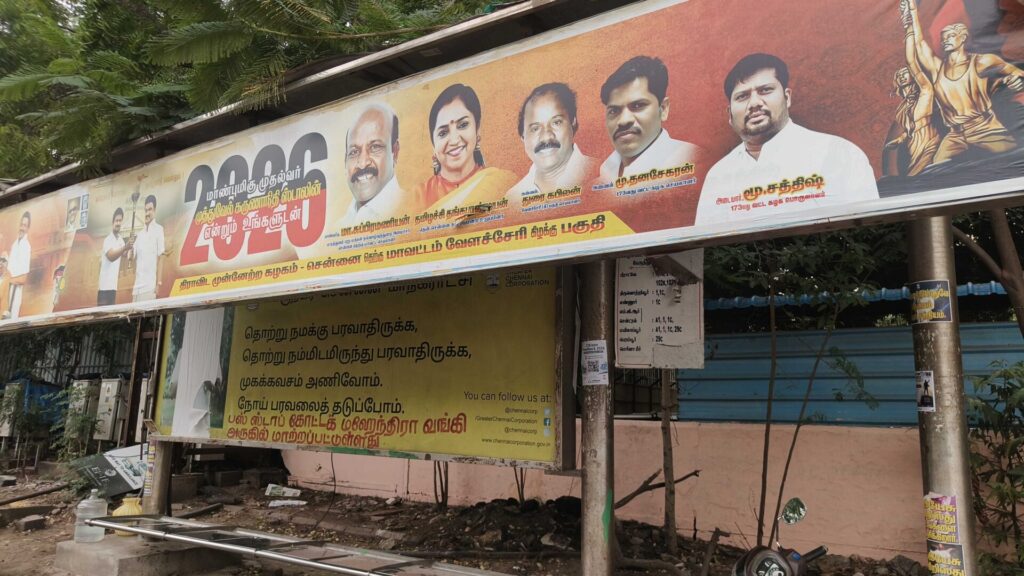
Like Amudhini and Maghizam, hundreds of commuters are left at the mercy of the city’s dilapidated bus shelters that lack uniformity and have poor infrastructure. “The only things changing are the ads,” says John*, a regular commuter. “During the run-up to the Assembly elections, these shelters featured the face of then-Chief Minister MK Stalin. Now, Chief Minister C Joseph Vijay’s face has taken its place.”
Bus shelter design and maintenance reflect a lack of focus on commuter usability and accessibility. “These shelters are designed to maximise ad space and are placed in such a way that the ad is visible even with people sitting down. While these shelters need to display route and bus arrival information, maps and so on, these are not as prominent as the ads,” says Santhosh Loganathan, urban research expert at Nagariyal.
Read more: Are Chennai’s bus stops and terminals truly accessible? A reality check
First, who maintains and funds bus shelters?
Several commuters and ward councillors told Citizen Matters that they were unsure which government body maintained bus shelters. Until 2014, bus shelters and services were being managed by the Metropolitan Transport Corporation (MTC), which was later taken over by the GCC’s Bus Route Roads (BRR) department, says Vaishnavi, a gender and urban policy expert.
Currently, Chennai has over 1416 bus shelters. There are three models of maintenance and funding for these shelters:
- Built by Members of Legislative Assemblies (MLA) or councillors with maintenance by a third party.
- Built and maintained by GCC.
- Built and maintained by an advertiser in space provided by GCC.
The BRR maintains 779 bus shelters built under schemes including MLA or councillors’ funds. Another 637 function on a Build-Operate-Transfer (BOT) basis, under a Public-Private Partnership (PPP) model. Through this arrangement, advertising agencies are contracted to construct and maintain the shelters for a period of five to ten years. Media reports have earlier quoted officials saying that this model was expected to address infrastructure issues and bring in engineering and technology resources from private companies.
How does the tender process work?
The trend of private players such as ad agencies claiming bus shelter space for advertising began in 2010, explain experts, adding that the firms then choose zones or wards with high visibility. Shelters have often been the domain of a select few agencies, including Skyrams Outdoor Advertisings India Private limited or Laqshya Media Ltd, say experts.
A 2024 tender document calling for bids for the renovation, operation, maintenance and transfer of 402 modern bus shelters from Zone I to 7 illustrates how the tender process works:
- A bidder can be a single business entity in India or a consortium of entities.
- Bidders must be from the media and advertising industry with experience in outdoor/out-of-home (OOH) media in India, with minimum five years.
- No entity can be a member of more than one bidder/consortium simultaneously.
The document highlights that this model was in response to the growing demand for commuter facilities. It notes that the total display area of an ad must be a maximum of 16 sq.m for a 2-pole and 22 sq.m for a 3-pole. Of this, at least 20% must be reserved for bus numbers and bus routes, government schemes, public awareness slogans, among others.
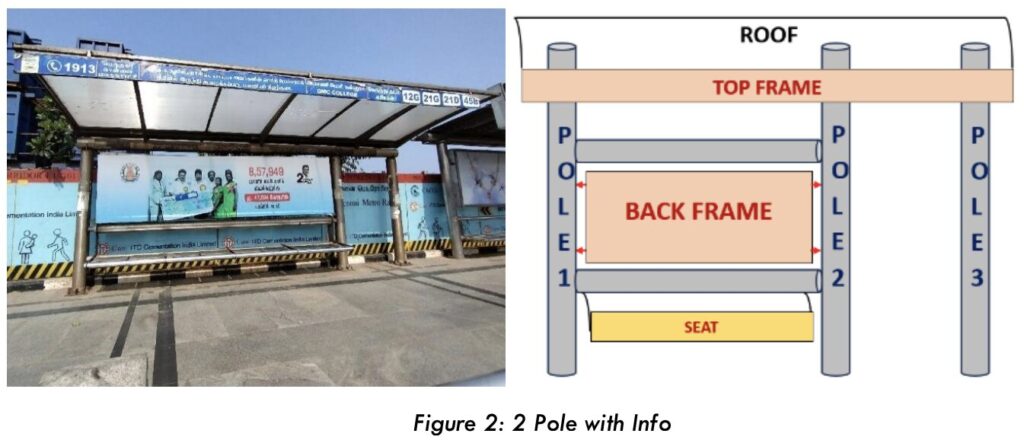
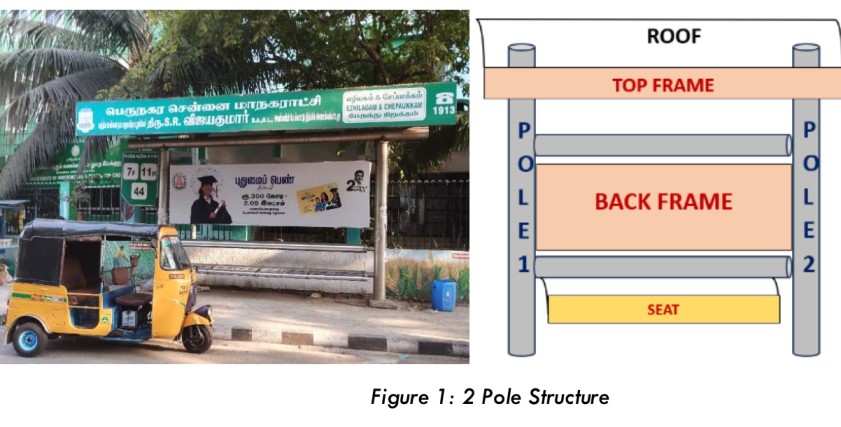
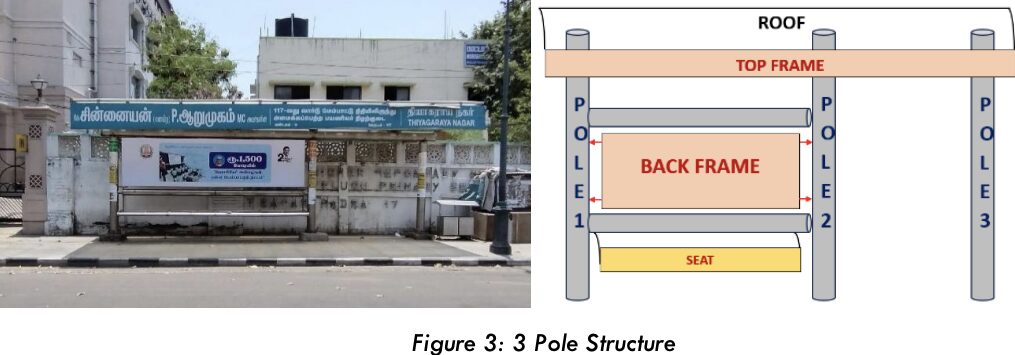
According to this tender document, the service provider must furnish a monthly report in compliance with Key Performance Indicators (KPI), and be assessed by an independent engineer. Any shortfall will draw a penalty or even termination.
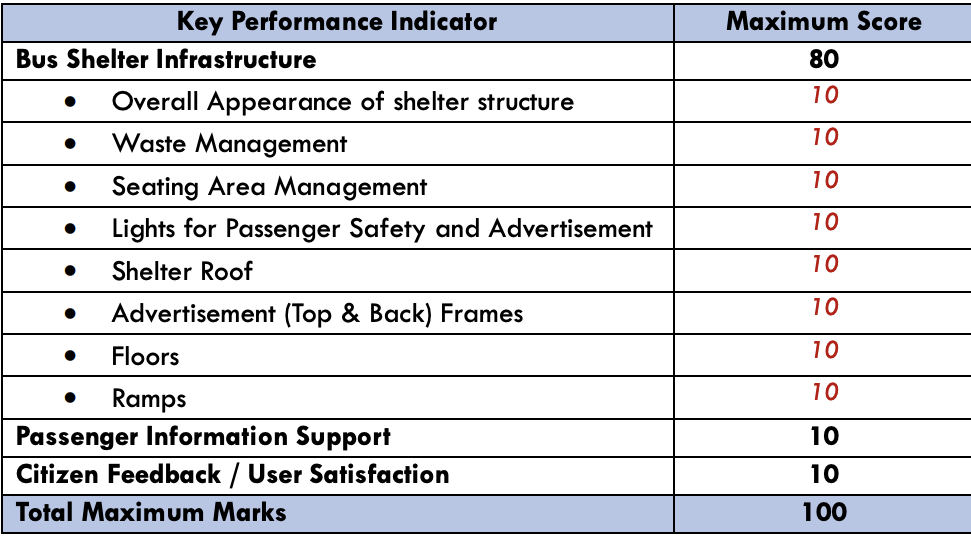
This tender was challenged in court by bidders for lower rates, and there is no public information on its update.
Guidelines on ads exist, but there’s lack of enforcement
Meanwhile, many shelters are yet to comply with the Tamil Nadu’s first Inclusive Urban Design Manual by GCC rolled out last year. The 141-page document — prepared by Gender and Policy lab (GPL) — focused on women’s safety and access to public spaces, but also detailed design. Of the 470 bus shelters audited, 25% on routes used by 30–40 lakh women per month, didn’t actually have shelters, revealed the survey by GPL.
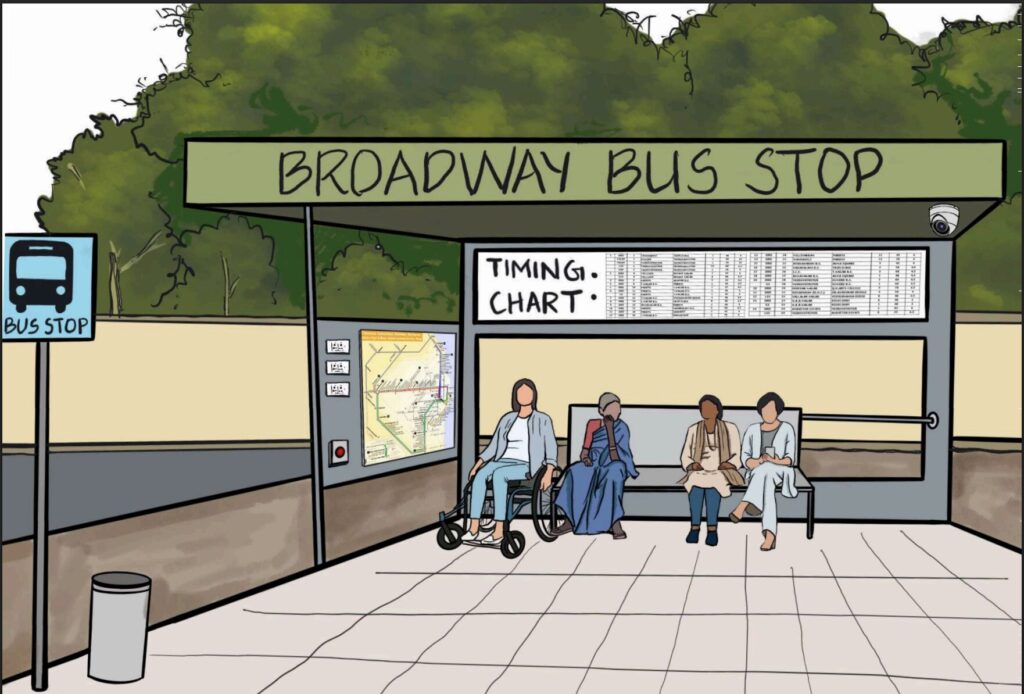
This mandate highlights that shelters must have 60% minimum transparency, where no surface — whether sides, front, top, or back— should be opaque from top to bottom, of which each surface area should be transparent. However, most ads do not follow these rules:
- For shelters near active spaces such as walkways, parks, beaches, etc, transparency must be 80%
- Elements such as signage, information boards, and small advertising panels can be used
- If there’s 2m walkway space behind the shelter, no advertisements should be placed.
- Stops must include multilingual static information boards.
Issues with ownership and maintenance
In areas like Avadi or Tambaram, corporation authorities are supposed to be in charge of maintenance but the jurisdiction is unclear. Vaishnavi Jayakumar from Disability Rights Alliance points out that this ambiguity on ownership of bus shelters outside GCC limits makes it harder for commuters to raise complaints about maintenance or location of shelters.
But on the ground, bus shelter design and placing seems arbitrary, she adds. For instance, at Kotturpuram, an inaccessible concrete shelter came up where the walls prevent users from seeing a bus coming to the stop. Next to Adyar’s Cancer Institute, she says a shelter was moved to an inconvenient location away from the usual bus stop, divorced from any user-centred logic. At Spurtank road, five shelters are placed on one road for just one bus route there.
Moreover, ad agencies and elected representatives prefer setting up bus shelters in areas with high visibility, say experts. Why do some areas have no bus shelters and some have several in a row? An official, who has worked with the GCC, says on condition of anonymity, that shelters are often placed wherever a councillor requested, in an area with high visibility to the public. “Analysing GCC’s budgets over five to seven years, we found we had not spent any capital money on new bus shelters but [did this].” This would lead to more bus shelters in some areas and none in others, adds the official.
Read More: Chennai’s bus shelters fall short on comfort and accessibility
Visibility over commuter safety and comfort
The geography also matters. In Adyar, Visalakshi Kabilan, councillor of ward 180, says, “Infrastructure construction has led to changes in bus routes, with commuters now waiting at temporary, ad hoc stops without shelter.”
But in North Chennai, the story is different. “Even when tenders are awarded to ad companies, North Chennai generates less revenue because ads naturally go to areas like Mount Road,” says B Vimala, the councillor of Ward 41, which is part of the RK Nagar assembly constituency. In 2023, she used her allocated funds to build a bus shelter in Royapuram and displayed information about government schemes on it.
In 2016, the advertising agency Trans Ads filed a petition in the Madras High Court challenging a bus shelter tender bid by the GCC. The agency argued that the eligibility criteria unfairly required steel fabrication experience, and that the bidding process violated a notice period. While the High Court quashed the petition, the GCC had noted that if only advertisers were selected during the process, they would choose areas with advertising potential, and neglect “economically-unviable areas” like Thiruvottiyur, Manali, Madhavaram and Tondiarpet.
However, this trend still continues; ad agencies remain major players and tenders continue to favour high-visibility areas. Jayaram Venkatesan, convenor of NGO Arappor Iyakkam points out that while North Chennai and interior areas are mostly dependent on corporation-owned bus shelters, there aren’t enough of them to meet commuter needs.
Skewed profits, corruption and discrepancies
While officials have previously argued that the PPP model ensures upkeep, commuters have flagged lack of adherence to design manuals. Tenders have been riddled with discrepancies and corruption, point out experts. In 2024, a news report found at least five of 24 areas which invited bids using councillors’ ward development funds already had sufficient shelters. Some councillors were not even aware of the civic body’s proposal. More recently, 3D-printed shelters across the city were demolished as they could not be uprooted due to infrastructure work like metro construction. These shelters, unlike stainless steel ones, cannot be shifted, but only demolished and built again leading to waste of public money.
In 2015, Arappor Iyakkam had flagged corruption in a bid for 400 steel bus shelters to be constructed under the BOT model. Three firms who were participating won but were registered under the same address, they pointed out. “It was handed over for 15 years at a very low cost, resulting in a heavy loss to the corporation while the companies stood to gain significantly. We showed how around ₹40 crores of black money was routed through these firms and were linked to former minister SP Velumani,” says Jayaram.
Now, the three firms in question are “experienced” players and continue to operate, he adds. Meanwhile, maintenance is minimal with no accountability for quality or upkeep.
The construction of bus shelters costs only ₹10–15 lakhs, says Jayaram, and these ad agencies recover their initial investment within 1–2 years, earning ₹1 lakh per month in ad revenue.“The company benefits disproportionately as it pays the corporation only ₹1.5 lakh per year while earning ₹12 lakh per year. That simply doesn’t make sense,” he says.
He recommends that instead of allowing privatisation, the GCC should manage the bus shelters directly. Meanwhile, if a tender process is used, the corporation could channel the money into resident welfare activities.
Other recommendations from experts, commuters, and ward councillors include:
- Build shelters that are uniform in design across Chennai, with focus on accessibility.
- Reduce ad space, prioritise usability and comply with Inclusive Design Manual.
- Introduce an app for commuters to raise concerns.
- Ensure interdepartmental coordination on routes, buses and shelters.
- Maintain a zone map (CUMTA) for citizens to know jurisdiction.
- Place QR codes in bus shelters or signboards giving information on zone/nearest police station/public toilets, etc.
- Have bus nameboards and display boards across shelters.
- In the case of PPP model, GCC must take a majority of the profits from ad companies.
Citizen Matters tried reaching out to the GCC bus routes and road superintendent and CUMTA and will update the article when we receive a response.
*Names changed to protect identity
Do you want to get information on local events in Bengaluru, Mumbai and Chennai, news updates, links to explainers, data and more? Join our WhatsApp broadcast channel, Citizen Matters – Civic updates for the Active Citizen.