Selomi’s text arrived at 7 am. “Let’s leave by 8.30. The traffic will be brutal otherwise.” We both live about 10 kilometres from the government office we had been going to every day for the last two weeks. The nearest metro station is four kilometres from our homes, which means forty minutes to reach it, twenty on the metro, and twenty-five on foot from Vidhana Soudha to the office. An hour and twenty minutes each way, assuming nothing goes wrong. In Bengaluru, something always does.
By the end of the second week, we had the routine down. Coffee in a flask. Munchies from home. Charged laptops, power banks, and online work queued up for the waiting. Over those two weeks, we met an octogenarian couple trying to reach the same bureaucrat. They had sat on the crumbling verandah for six hours before the sky turned overcast. They left before the rains came, resigned.
In Bengaluru, even a drizzle becomes a bureaucratic variable. One spell of rain and the city seizes, traffic compounds, floods gush in and whatever slim chance you had of getting somewhere on time dissolves entirely. We were there for a work-related permission, nothing too personal riding on it. For most others around us, the stakes were far higher: land disputes, welfare entitlements, documents that determined whether something in their lives could move forward at all. We had laptops to work on while we waited and enough flexibility in our days to absorb the delay. We were all in the same line, but we were not waiting equally.
The geography of the queue
The word, waiting, has come to describe something far larger than a government queue. According to the TomTom Traffic Index, Bengalureans lost the equivalent of nearly seven days a year sitting in traffic in 2025 alone. The figure sits alongside another: over the past decade, more than Rs 1.2 lakh crore has been committed in the name of decongesting Bengaluru. Yet the waiting has only deepened. This is not a paradox. It is a policy choice.
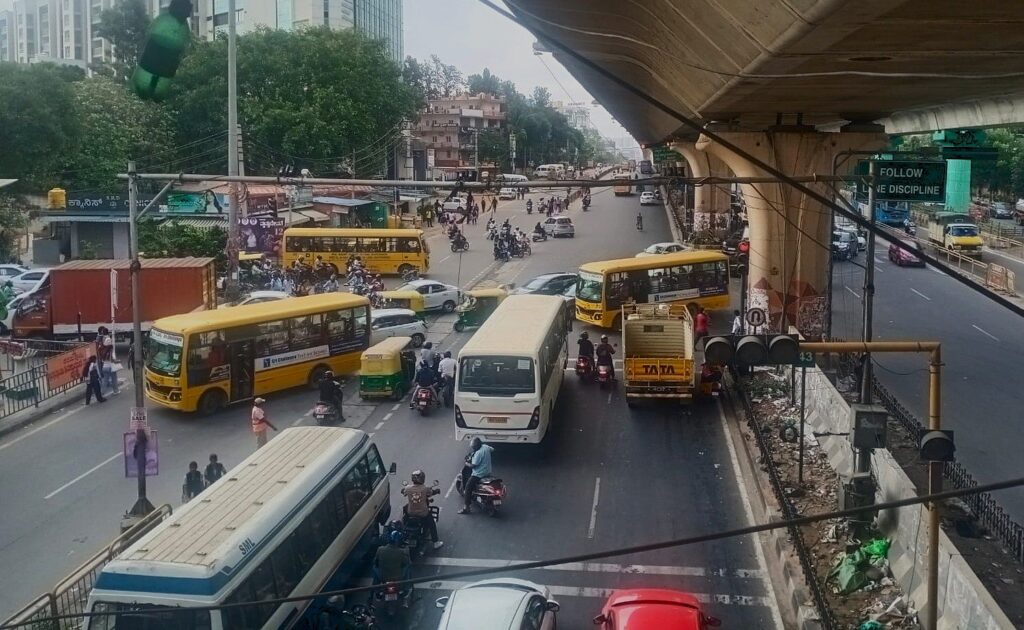
Bengaluru’s infrastructure imagination has remained, almost without exception, organised around the private car. The BMTC bus, which is the most affordable and widely used form of transport for the city’s working population, carries an estimated 33 to 43 lakh passengers every day, yet remains chronically underfunded in a city that now has over one crore registered vehicles. Buses are trapped in the same traffic they are supposed to relieve, with no dedicated lanes to move through. Metro expansion has meaningfully altered mobility for many, but poor last-mile connectivity means that even reaching a station becomes another episode of waiting. The result is that waiting in Bengaluru is not accidental or temporary. It is structural and reproduced by every crore spent on a quick-fix flyover.
Read more: Tunnel roads will not fix Bengaluru’s traffic problem: Here’s why
No priority for the commons
Experts have described the country as a “Queue Republic,” a place where access to the state is perpetually mediated through paperwork and bureaucratic uncertainty. The queue, in this reading, is a way of distributing access unevenly, of making people earn what should simply be available. Bengaluru has extended this logic into its streets. The Bengaluru Suburban Rail Project, first proposed in 1983, was formally approved only in 2020, budgeted at Rs 15,767 crore, with full operations expected only by 2029. The BMTC tells a similar story. The city has roughly 7,000 BMTC buses, against the 13,000 that the state’s own Comprehensive Mobility Plan identifies as necessary.
Meanwhile, the state continues to prioritise ‘spectacular’ vehicular tunnels worth Rs 17,698 crore and elevated corridors at Rs 13,200 crore. This reveals a consistent pattern: capital has been increasingly flowing toward infrastructure that serves a few, while the many who walk, cycle and take buses are left to negotiate whatever remains. The commons, accessible buses, walkable streets, open parks, and reliable public spaces erode quietly while the state celebrates the spectacular. Time is what gets extracted in the gap.
Not everyone waits equally in Bengaluru, and that is perhaps the most clarifying fact about the city’s mobility crisis. Those with flexible work hours or the financial ability to live near their offices experience the city on far different terms from those dependent on public transport and long commutes. The hours a commuter spends daily in transit, sometimes four hours in parts of the city, are hours not spent with family, not resting, not participating in community life, not doing anything except enduring the city. Commuting time of this scale becomes a hidden tax on working-class life, levied daily and silently. And this extraction has consequences beyond the personal.
The loss of civic and social time
A city where people spend enormous portions of their lives commuting, rerouting and waiting has less collective capacity for neighbourhood life, civic participation and care work. Congestion quietly consumes civic time. The hours lost in traffic are also hours taken from local organising, from friendships, from attending a school meeting or a neighbourhood assembly or a protest. A citizenry perpetually in transit becomes easier to fragment and harder to galvanise. Waiting, in this sense, is not just a personal inconvenience. It is a political condition.
None of this means Bengaluru’s problems are unsolvable. The priority has to shift from moving vehicles to moving people. A dramatically expanded BMTC fleet, adequately funded, backed by reliable schedules and dedicated bus lanes, would do more to reduce congestion than any elevated corridor, as buses move more people per unit of road space than private cars. These are not radical ideas. They are standard practice in cities that have successfully managed urban mobility, from Bogotá to Guangzhou.
Bengaluru’s buses carry lakhs of people daily on a fraction of the infrastructure investment that roads receive. Beyond buses, Bengaluru needs continuous, shaded and accessible footpaths that make walking possible and enjoyable; feeder systems that connect metro stations to the neighbourhoods and public spaces that do not require money to access. These are investments in time. In the aggregate, they return to people something that has been quietly taken from them: hours that become sleep, care, community, rest, love and choice. It is about what kind of city Bengaluru wants to be, and who it is built for.
A city must work for everyone
After two weeks of waiting, we were finally called in. Five minutes with the bureaucrat. When we stepped out into the afternoon, those five minutes felt disproportionately significant, which told us everything about what the waiting had done to our sense of proportion. The elderly couple were just arriving as we left. We exchanged a look of the kind that forms only on government office verandahs, a quiet acknowledgement that said, “May today be the day”. Nearly two hours later, we reached home. Most of the day had dissolved into different forms of delay: traffic, queues, commutes, verandahs and metro lines. Somewhere along the way, it had stopped feeling unusual, which is perhaps the most telling detail of it all. The waiting was no longer an interruption to life in the city. It had become the texture of it.
The right to the city has always been about access, to work, to services, to public space, to love and care. But in a place where time itself is so relentlessly consumed by the act of simply moving through it, the right to the city is increasingly also the right to time. Time to rest. Time to participate. Time to live somewhere other than the queue. Every infrastructure decision Bengaluru makes in the coming decade is also a decision about what kind of city it wants to be: one that moves faster for a few, or one that works better for everyone. A city that returns time to its people, rather than extracting it endlessly, is not utopian. It is simply a city that has got its priorities right.
The Government should implement one way street to reduce traffic congestion. Also do not allow too many intersections as this is one of the main causes for traffic congestion. In addition ensure there are no potholes as this can be implemented only with good quality roads. Do not allow road digging without ensuring restoration to good conditions after the repairs.Create good drainage for rainwater disposal. These are all straightforward solutions which needs genuine government intervention.
All of these are bandage solutions. Decades of research on other cities (Amsterdam, Tokyo, etc) show that only mass transit can solve congestion.
But guys, when given the choice of a quiet, fresh city, why are we forced to live in this constant noise and air pollution?
Private transport must remain under 20% of how people’s mobility. Else we’ll have traffic even with 50 lane highways. At some point, whole of India will become a 1000-lane highway and everybody will live in their cars. Fuck that future.
With disappointment I write this, as a daily commuter between Marathalli and Yelahanka, that I have to cross the painfully mis-managed and mis-behaved stretches of traffic. Let me divide the traumatic experience section wise –
1. Kadubeesanahalli Bus Stop (opposite Adobe) till DRDO (Kasturi Nagar) -> Reasons are long route private buses which park themselves senselessly. They are so arrogant that despite the traffic pile up behind them, they wouldn’t move an inch.
Another reason is the U-Turn at Kasturi Nagar and joining of service road, main road at the junction, and a perpendicular crossing of road coming from opposite direction, all causing absolute mayhem on the road. Vehicles go all over the place crossing every direction, which causes huge block. And this is a daily affair.
2. KRPuram Railway station –> Reason is the merger of vehicles from Marathahalli and Whitefield, leading to Metro station, where BMTC buses, private buses, autos and taxis park themselves anywhere they want, disregarding public nuisance that they cause. Next, right after the signal, BMTC, private buses, autos and taxis stand next to the bus stop (which is on the extreme left of the road, but BMTC doesn’t stop there and you will find all sorts of vehicles parked). Adding to that, you have a small road coming and joining this junction from the interiors of KR Puram.
3. TinFactory junction –> Reason is the merger of vehicles coming from Hosakote trying to go straight towards Hebbal and also left towards old Madras road, and also trying to stop at the petrol bunk right perpendicular to the bridge. This is made worse by the vehicles coming from KRPuram side and merging, with vehicles crossing to go towards Hebbal and Old Madras road. Add to this, there are private buses which stop wherever they want, sometimes in the middle of the road. BMTC buses too don’t stop at the designated stops, autos and taxis complete the mayhem.
4. Kalyan nagar Till Nagawara flyover –> Reason is only private buses, autos and BMTC buses stopping wherever they want for how much ever longer they want. The barricades by Metro, BWSSB add to the misery with their never ending works. The roads become bottlenecks. Today, I was stuck between Babusabpalya and Nagawara flyover for over 45min, just because the Nagawara flyover junction is misused by private buses and other misbehaved vehicles. The merger from a pocket road perpendicular to the junction, the service road and the narrowed main road causes serpentine block. This is a daily thing, on both sides of the road.
5. Veerannanapalya flyover till Kempapura –> Reason is, never ending works by Metro and BWSSB causing the road to be narrow and vehicles criss-crossing. Private buses and BMTC buses add to the agony. They just stand wherever they want.
These are just the junctions which I experience every day. Entire Bangalore is marred with such ill-planned and badly managed junctions, adding to the audacity of these private long route buses and autos.
Please help save lives on the road. We are wasting our precious time on the roads on a daily basis. There is no empathy towards the average citizen. If there is a VIP convoy to go, the entire stretch is cordoned off at the expense of the common public. Nobody seems to care.
It is not difficult to understand that neatly tarred roads, proper lane markings, proper sign boards, repairing drains, footpaths, completing civil works and most importantly give a stick to unruly people/defaulters/audacious behaviour on the road so hard they be scared next time. Traffic police Patrolling at important junctions will be huge advantage.
Hope the new CM will address the traffic issue urgently instead of playing to their cadres like other CM’s did with unnecessary topics. Address the common man’s problems first. Your loyalists will take care of themselves.
Bus routes should be redesigned and focus should be on introducing shorter routes… especially loops that connect to the main bus stop junctions on highways or metro stations. Long routes are prone to delays due to the traffic jams in the city.