In Varthur, east Bengaluru, residents watch in dismay as leachate from garbage trucks seeps into the Varthur Lake. “We need a local composting or bio-methanisation plant right here in the ward,” insists Jagdish Reddy, a resident. He points out that irregular waste collection and burning of leaf litter are not just polluting water bodies but also affecting air quality.
Across the city, the problems are varied, but the frustration is the same. In HSR Layout’s 5th sector, open drains reek, and roads flood with the slightest rain, says Jyothi G Prabhu. Meanwhile, Gunjur resident Chetan Gopal points out that the underground drainage system (UGD) remains unfinished in his neighbourhood, leaving lakes to bear the brunt of untreated sewage.
Different wards, different crises: poor solid waste management in one, while incomplete drainage in another. And when the causes differ, the solutions must too.
Our reporting on urban heat and worsening air quality has emphasised how climate challenges demand local answers. Now, Bengaluru is taking the step to draft Ward Level Climate Action Plans (WCAPs) to build local roadmaps for climate action, one ward at a time.
Background of WCAP
The Bengaluru Climate Action and Resilience Plan (BCAP) was launched in November 2023. Following this, in February 2024, a Climate Action Cell (CAC) was formed to facilitate the BCAP. One of its key proposals was to prepare local-level climate action plans. The Bruhat Bengaluru Mahanagara Palike (now Greater Bengaluru Authority) budget for 2025-26 proposed ward-level plans and earmarked ₹28 crore for the year, the budget report stated.
To develop WCAP reports for a few pilot wards, the CAC has established a working group with seven organisations:
- WRI India
- Socratus Foundation
- Jansahas
- WellLabs
- Sensing Local
- CSTEP
- Hasiru Dala.
Projects across categories
Citizen Matters interacted with the working group, and here’s what we learnt: the WCAPs were initially planned for 28 wards in BBMP’s last budget, and focused on climate action projects. Recognising the need for ward-specific roadmaps to set priorities across time horizons, the CAC formed the working group to bring together diverse expertise.
The plan is to develop WCAP reports for ten wards across five city corporations as pilot projects, which can be scaled up and replicated in other wards. The working group is preparing a list of such climate action projects. Given the short timeline, the team is focusing only on selected wards, the group members noted.
Each WCAP will outline short-, medium-, and long-term climate action projects for its ward. Proposed initiatives include rooftop solar installations in public buildings, green corridors and pocket parks, and blue-green school models.
These projects fall under three categories:
| Categories | Example |
| New interventions | Creation of sponge spaces, green corridors |
| Strengthening ongoing government work | Stormwater drain fixes |
| Enabling systems/processes | Information, education and communication activities and capacity building |
Some of these projects will also focus on encouraging citizen participation in climate action.
Read more: Bengaluru failed to beat the heat: Why ward-level action plans are urgent
Who will take up these projects?
The WCAP becomes a ready pipeline of implementable climate projects. The GBA, city corporations, and other government departments, such as the Bangalore Metropolitan Transport Corporation, can take up these projects. CSR funders, NGOs, and civil society groups can also execute some projects based on the needs of different wards identified in each WCAP.
The Climate Action Cell will support any organisation taking up a project by facilitating the process and leveraging the expertise of its knowledge partners.
How will WCAP ensure community needs shape the plan?
The process includes:
- sectoral assessments
- geospatial hazard assessments
- intensive field visits
- community consultations
- knowledge from groups already working in the ward
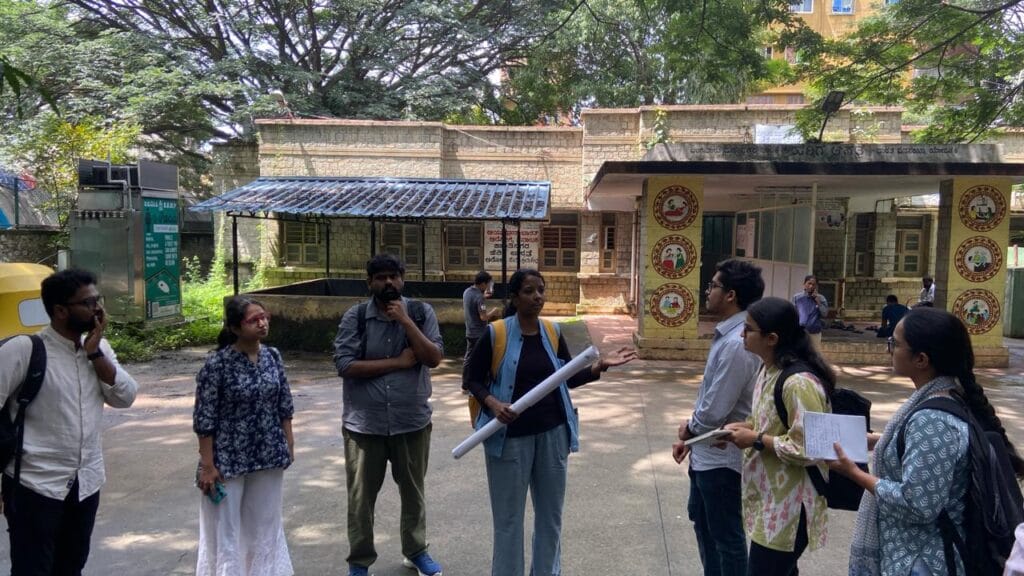
The WCAPs will employ a bottom-up approach to understand the needs of local communities, especially vulnerable groups, the members said. Interactions with residents and public consultations at the ward level will be a vital part of the process.
BCAP vs WCAP
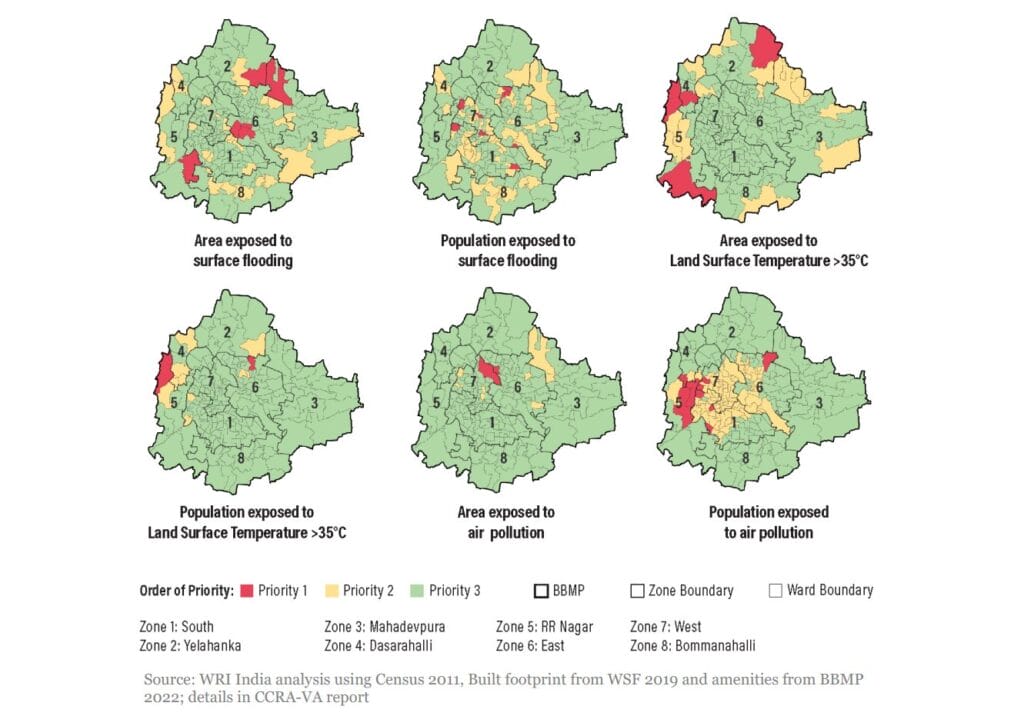
Unlike the BCAP, which outlines how Bengaluru should tackle emissions and climate risks at a city level using a global framework required under the C40 Cities network, WCAPs enable those actions to be carried out hyperlocally. The ward plans aim to be concise and accessible for citizens, officials, CSR partners, RWAs and others, and centre on practical action lists rather than technical modelling.
“WCAPs are the next step towards implementing BCAP, and this has been one of the main aspirations of CAC since its inception. The framework, scope, approach and objectives of both the plans are different,” says Praseeda Mukundan, Program Manager at WRI India.
The Climate Action Cell has also acknowledged gaps in BCAP—especially the difficulty in turning city-level recommendations into local projects. “The ward-level plan will fix that as it facilitates relevant and permissible local-level actions,” she adds.
Challenges in building a local plan
The working group and climate action cell fellows identify certain challenges in formulating ward-level plans. The lack of localised data is one. “Lack of disaggregated and consistent datasets at the ward level remains a significant hurdle,” says Bhargavi Nagendra, Programme Manager at Socratus Foundation. “Most of the data we have now is at the city level, and it is really challenging to develop a ward-level plan with such aggregated information.”
Jeevitha, Data Innovation fellow at GBA-CAC, agrees. She adds that having fellows from different backgrounds, like data, urban planning, and architecture, helps bring in shared knowledge.
Also, working group members say that repeated ward delimitation makes it difficult to fix boundaries for data analysis. With tight timelines, they want to finalise projects for selected wards by the end of January so proposals can feed into the next financial year’s budget of the GBA and municipal corporations.
Read more: PM2.5 pollution: Why Bengaluru urgently needs hyperlocal air quality monitoring
Overcoming the challenges
The working group brings together organisations with different strengths. “Organisations like CSTEP, WRI India, WellLabs bring in sectoral expertise; organisations such as Socratus, Jansahas bring in community engagement expertise, and organisations such as Hasiru Dala, Sensing Local have expertise in both,” says Praseeda. She added that they also consult other experts, like Biome Environmental Trust, when needed.
Ward-level data is limited, but several members have already worked closely in specific wards. That existing experience, along with studies and resources created by other groups, is helping the team fill the gaps.
The pilot plan in Shanti Nagar
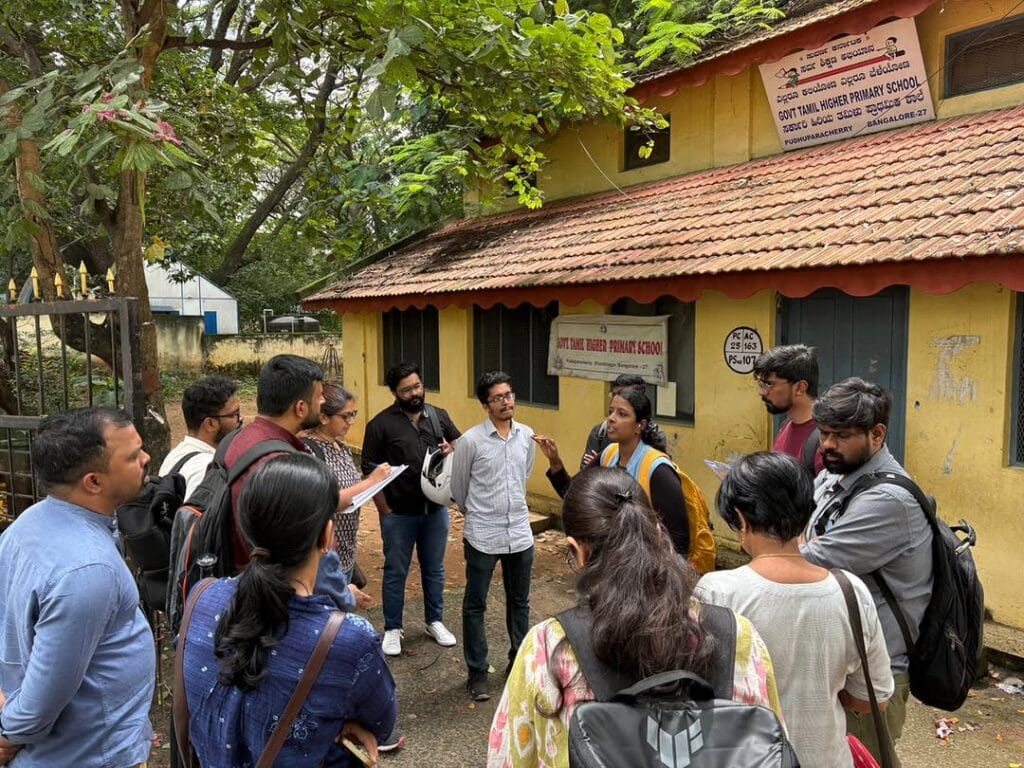
The climate action cell is now focusing on Shantinagar for the initial pilot of the WCAP.
Prasad, a Shanti Nagar resident, says that in many pockets in the ward, such as the Hindu burial ground, debris is dumped. These places can be cleared up and used to develop green cover in the ward. He noted that the groundwater level has significantly reduced, and recharge pits are needed. “Concretisation of tertiary stormwater drains is not allowing water to seep through,” he says, adding that periodic cleaning of drains is important.
Socratus Foundation has already worked in Shantinagar, and that knowledge is now feeding into the WCAP works. Bhargavi highlights the gaps in stormwater management that need urgent attention in the ward.
She also points out that the ward lacks a dedicated Dry Waste Collection Centre. “In terms of disaster management, there are a few localised hotspots where workers assemble. Greening and spaces to recreate and hydrate need to be looked into,” she says. The team has also identified pockets of public spaces that can be utilised better to implement nature-based solutions.
In a recent social media post, GBA-CAC informed that the citizen consultation for Shanti Nagar WCAP would begin soon and invited citizens to participate.
Will WCAP succeed?
Environmental activist Dattatraya Devare is concerned that the GBA has not taken any initiative to build awareness on WCAPs among the public. He also notes that the implementation of BCAP action plans is not yet recorded. ”Without any data on what has been achieved already, how will the cell facilitate newer actions?” he questioned. While the actions need to be implemented by other departments, the cell lacks the power to convert plans to actions, he remarks.
He also suggests citizen collaborations to facilitate ward-level actions. Working group members we spoke to confirmed that the WCAP will focus more on citizen engagement.
Residents like Jagdish believe that WCAPs are essential for solving the city’s problems. “Bengaluru’s challenges (garbage, flooding, air quality) are too diverse to solve with a one-size-fits-all plan,” he says. “What works in a densely populated core ward will not work in a peri-urban ward like Varthur, which is characterised by lakes, vacant plots, and rapid, often unregulated, growth.”
“The failure to stop illegal dumping and burning is a failure of hyperlocal enforcement,” Jagdish notes. He believes when WCAPs are driven by the Ward Committee and implemented by dedicated, empowered ward-level staff, it will create the necessary structural matrix to define responsibilities, set measurable targets, and hold local officials accountable.