In an earlier article, we highlighted how Bengaluru lags behind in utilisation of funds received under the National Clean Air Programme, and how that, coupled with the lack of an elected municipal body, threatens the prospect of climate action. In November 2023, BBMP launched the Bengaluru Climate Action and Resilience Plan (BCAP), with the objective of addressing climate issues in the city.
Following the launch of the BCAP, a climate action cell was established in February 2024 to coordinate the work of different departments towards climate action. Some of these plans are to be realised utilising NCAP funds, either exclusively or combining it with funds from the 15th Finance Commission (XV-FC) or other sources.
However there has been little progress in these plans so far, which points to a crucial implementation gap. Experts feel that there is a lot of scope for utilising the funds and an urgent need to prioritise certain measures.
BCAP and NCAP
As per the Bengaluru Climate Action and Resilience Plan (BCAP), the city requires at least 36 Continuous Ambient Air Quality Monitoring Stations (CAAQMS). In fact, according to Sarath Guttikunda, founder of UrbanEmissions.info, the city requires 41 CAAQMS. At present there are 10 CAAQMS and 13 manual stations. The city is short of 13 CAAQMS and the 13 manual stations should be transitioned to CAAQMS. One of the track-wise actions listed in the BCAP document refers to strengthening the air quality monitoring system using NCAP funds, but there is no evidence of any progress made in this regard so far.
Experts have also suggested hyperlocal and mobile AQ monitoring systems, though right now the city seems to be struggling even with adequate ambient air monitoring.
BCAP has listed several track-wise actions for each department, with a total of 40 different action items to be taken up across the departments of energy and building, transport, solid waste management, air quality, water management, urban planning and greening, and disaster management. Some of the actions plans include:
- Developing EV charging infrastructure
- Preparing a plan to convert solid waste management (SWM) fleet to Electric Vehicles
- Preparing a clean fuel transition plan for freight vehicles as 2040 as the horizon year
- Enforcing stringent regulation for vehicles carrying construction debris
- Developing low-emission (air pollutants) zones, installing water sprinklers to minimise dust
- Creating policies and mechanisms for airshed management to address trans-boundary air-pollution
- Developing mechanisms for data collection on Influenza like illness
- Integrating CAAQMS with forecasting systems to predict air pollution at ward/zone levels
- Intensifying surveillance and ward-mapping of open waste burning
- Various awareness building and community engagement programs.
Action status unknown
However, there is no clarity on where each of these plans are right now. The BCAP portal is an open platform, meant to inform the public about the functions and progress of the Climate Action Cell formed under the BCAP. But even after a year since it was launched, there are no action updates available.
In an interview with Preeti Gehlot, chairperson of the Climate Action Cell, we broached the topic of delay in utilisation of NCAP funds, to which she replied that the Cell was not concerned with expenditures under NCAP.
Read more: We have initiated the climate budgeting process this year: BCAC Chairperson Preeti Gehlot
According to sources from the climate action cell, clean air zones have been identified based on analysis of traffic and air quality and regulation, such as limiting the number of vehicles, will soon be enforced in those zones.
Apart from that, most of the other action plans listed under the BCAP are now only at the stage of floating tenders for contracts.
Implementation gaps
Meanwhile, the Karnataka state government recently approved the state clean air action plan, which is a part of NCAP. With NCAP funds stalled, one cannot help wonder how the city is going to implement its action plans. The funds that are lying idle must be utilised, but that needs a systematic plan too. Coordination among different departments, stricter implementation and capacity building need to be prioritised.
“The long-term success of the NCAP is closely linked to the commitment shown during its initial phases, particularly regarding governance and financial backing,” the document states, which is ironic considering the city’s progress so far.
Experts say that though there is a detailed plan of action for improving air quality under NCAP, the government has lagged sadly in implementation. “While plans are on paper, there is a lack of progress in implementation,” says Siddharth Sreenivas, head of sustainable mobility at ASAR social impact advisors.
Coordination is a huge challenge whenever multiple departments are involved in the execution of a plan. For instance, while the Climate Action Cell itself is under the BBMP, it has plans that call for direct involvement from BMTC. BMTC being under the transport department, questions arise on how the two will work together. Execution can only be improved if all the stakeholders, both within and outside the government, come together to ensure that the work is carried out in a timely, systematic manner.
Anirban Banerjee, from the policy development and outreach group in the Air Quality sector of the Center for Study of Science, Technology and Policy (CSTEP), suggests that the government should establish a rapid implementation committee comprising experts from relevant sectors, bureaucrats, and politicians. Clear Standard Operating Procedures for regulatory approvals should be defined.
Read more: Namma Metro construction taking a huge toll on air quality and public health
Prioritising action: Where should the funds go?
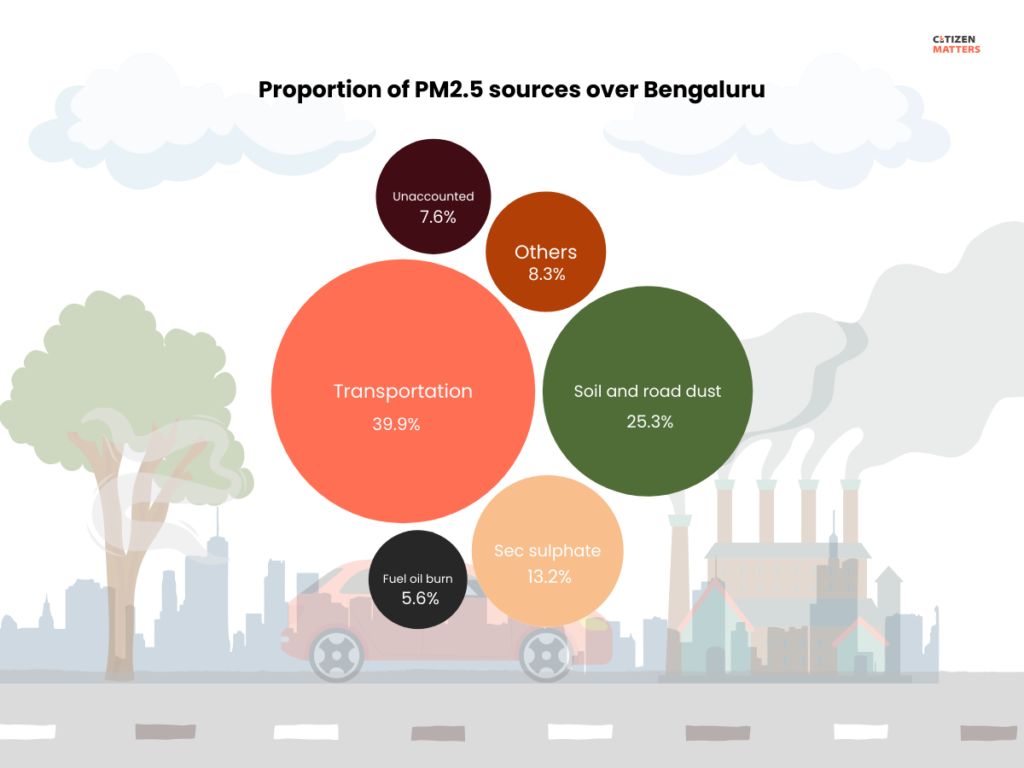
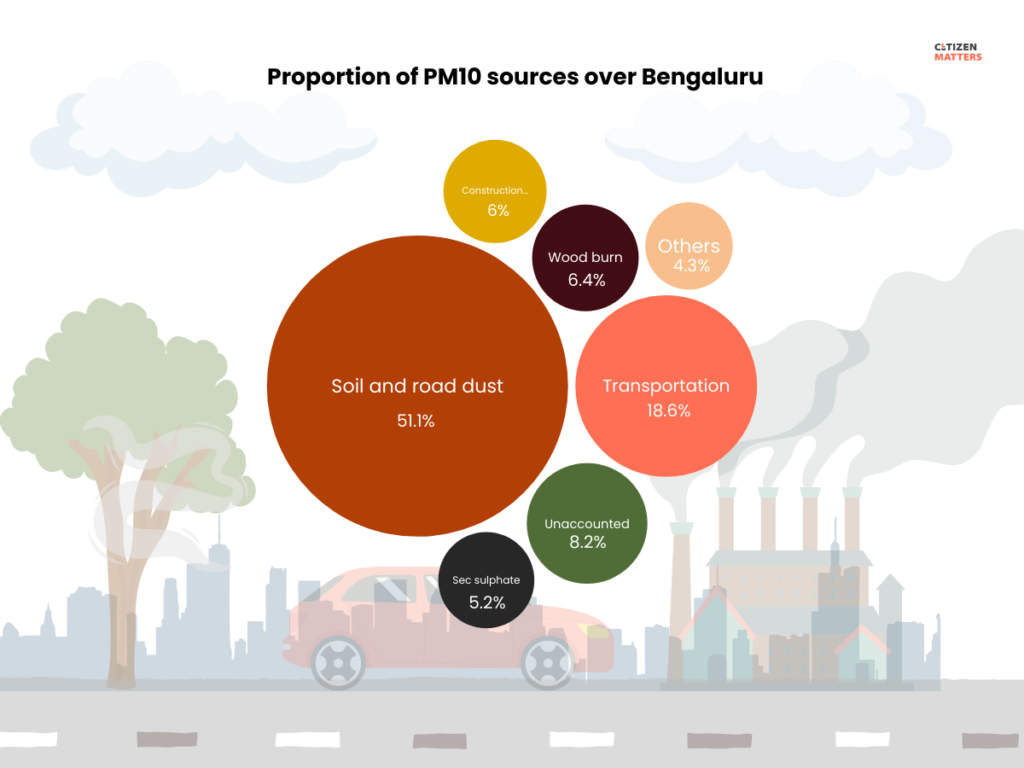
According to one source apportionment study, vehicular emission contributes to 39.9% of PM2.5 pollution and 18.6% of PM10 pollution. Thus, experts suggest focussing on controlling vehicular emissions as a key move towards air quality improvements. A significant chunk of the funds from the XV-FC under NCAP could be spent on that.
Siddharth says that the government has been successful in the replacement of the BMTC fleet. However, heavy vehicles are creating grave pollution in the city and that should be looked into.
The climate action cell is already looking at some softer solutions, but now is the time to also address harder objectives like decarbonisation, EV transition, transport infrastructure and improving non-motorised transport share. “There is a lot of scope to develop the non-motorised transport system,” Siddharth notes. Cycling accounts for only 15% of the modal share presently and walking 5%, based on data from the Namma Raste exhibition by BBMP.
Besides a city-centric approach, Karnataka should follow an airshed approach that will cover the transboundary sources of pollution, suggests Anirban.
While there is a need to prioritise measures to tackle the city’s air quality woes, the stalling of NCAP funds is a huge setback. The government should urgently utilise the existing funds effectively to implement measures to mitigate the city’s worsening air quality, so that the flow of funds may be resumed. The conduct of BBMP elections will also be critical in this regard.
The way forward:
- Establish a rapid implementation committee
- Strengthen stakeholder coordination and improve utilisation strategies
- Increase transparency of details on fund utilisation and action status
- Prioritise important measures such as to reduce vehicular emissions
- Conduct immediate BBMP elections to restore local governance and unlock stalled funds