Long before Mumbai’s relentless summer even began this year, the city was already simmering. In March, Mumbai was hit by a severe heatwave, with the temperature reaching a five-year high of 40° Celsius. As rapid urbanisation and a flurry of infrastructure projects replace dense tree cover with steel and mortar, heatwaves seem to have gone from being rare occurrences to an annual threat.
The Mumbai Metro Rail Corporation Limited (MMRCL) cut a whopping 3,093 trees in Aarey Colony to make way for Mumbai’s Aqua Line ( Metro 3). For environmentalist Stalin Dayanand, this is not just a temporary problem. “There is no attempt to provide land for afforestation inside Mumbai. Whatever greenery we are losing, it is a permanent loss,” he warns.
Loss of green cover in cities has been widely connected to rise in temperatures. According to the Mumbai Climate Action Plan (MCAP), Mumbai has experienced ten heatwaves and two extreme heatwaves between 1973 and 2020. During the same period, there has been an increase in temperature of 0.25°celsius per decade. At the same time, Mumbai’s tree cover has been steadily decreasing. A study shows that between 1991 and 2018, Mumbai lost 81% of its open spaces, and 40% of its green cover. Simultaneously there was a 66% increase in the built up area. This has contributed to the urban heat island effect (UHI) in Mumbai.
Stalin adds that the two projects which have led to maximum loss of trees are the Metro 3 and the Versova-Bhayandar Coastal Road. Across Mumbai, many more infrastructure and redevelopment ventures are robbing the city of its canopy.
Tree loss at Nehru Nagar, Kurla
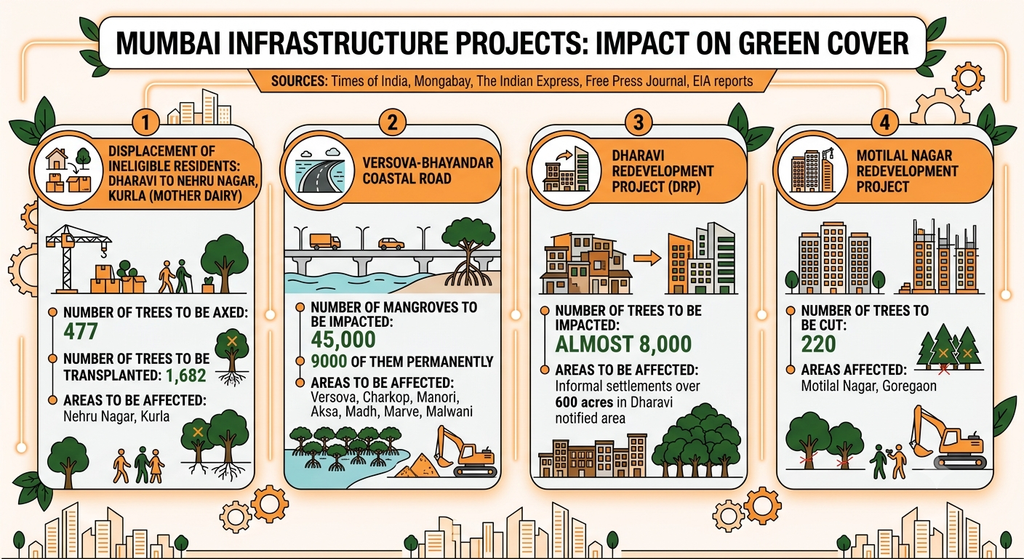
The Dharavi Redevelopment Project, led by Adani Navbharat Developers Private Limited, will displace a large number of residents from the informal settlements at Dharavi. Those ineligible for housing in Dharavi will be relocated. One of the sites for the relocation is the land at Nehru Nagar in Kurla, where formerly a dairy was located.
The plot, which has hundreds of trees, has been transferred to MMRDA and then to the Dharavi Redevelopment Project. Residents of Kurla have been protesting against the construction of housing in that plot. A local NGO Lok Chalwal has taken the lead in these protests.
Vidya Ingawale of Lok Chalwal, a citizens’ group, says it has been almost twelve years since the dairy closed and that there are 2,600 trees in a plot measuring 25 acres. “In 2023 a plan was floated by the government to convert the plot into a mini-BKC. Residents came together to protest against this asking for the trees to be protected since it is the only open green space in an already congested neighbourhood,” she adds.
The group wrote a letter to the Maharashtra CM pointing out that there are restrictions on commercial and residential development on the land according to the DCPR 2034. In 2023, they campaigned for the plot to be turned into a botanical garden and undertook various activities to educate people about the importance of retaining the open plot. Further, they gathered 10,000 signatures petitioning the government to turn the plot into a garden.
Read more: Beyond rains: Why Mumbai trees are falling and what needs to change
Vidya explains that in 2024 the land was allotted for the use of the Dharavi Redevelopment Project. Ten acres have been earmarked for the construction of Metro 2B, for which more than 800 trees have already been cut.
Though it seems inevitable that the trees will be axed for the Dharavi Redevelopment Project, Lok Chalwal is continuing their fight to save their trees. Members of Lok Chalwal are particularly concerned about the increasing concretisation in Kurla, and hope that these green lungs of Kurla can be saved.
Mumbai is losing its mangroves
The ₹18,000 crore Versova-Bhayandar Coastal Road is impacting 45,000 mangroves. This is the northern extension of the coastal road which extends currently up to Worli from Marine Lines.
In December 2025, the Bombay High Court gave the go-ahead for the cutting of the mangroves. Stalin’s NGO, Vanashakti had appealed to the Supreme Court against the Bombay HC order. But the Supreme Court dismissed the petition and allowed the chopping of the mangroves.
Activists have questioned why other alternatives have not been explored and if there was no way to avoid the loss of the mangroves. Experts are also questioning whether a project of this scale which will only benefit car owners is justified. In the wake of the BMC’s decision, groups like Save Mumbai Mangroves have come forward, organising protests and creating awareness. They have expressed their frustration over the BMC’s reluctance to listen to their concerns and initiate a dialogue with them.
This decision is also going to affect the livelihood of the fisherfolk living in Kandivali. Not only is the sea a source of fish, but so are the creeks and mangroves. Fishers fish in the Manori creek, but the construction of the road will make access difficult they say. While speaking to Citizen Matters for an earlier article, Dr. Girish Salgaonkar had told us that some varieties of crabs and certain fish are available nowhere but in the creeks. To reach the creek four to five fisherfolk have to drag boats through waist-deep mud. The cutting of the mangroves and construction of stilts for the Coastal Road will make this process more tedious.
Dhiraj Bhandari, another fisher from Charkop rues the fact that their entire way of life, which was tied to the cycles of nature, has been getting eroded over a period of time.
Read more: Mumbaikars are fighting for their mangroves. Here’s how you can join them
To make matters worse for Mumbai, the High Court has granted permission to the BMC to chop 1237 mangroves to construct a bridge over Malad Greek. This bridge will connect Madh island to Versova. The BMC claims that the alignment of the bridge will impact 2.5 hectares of mangroves. There will be a permanent loss of 0.5 hectares, and 2 hectares will be restored after construction.
Redevelopment at what cost?
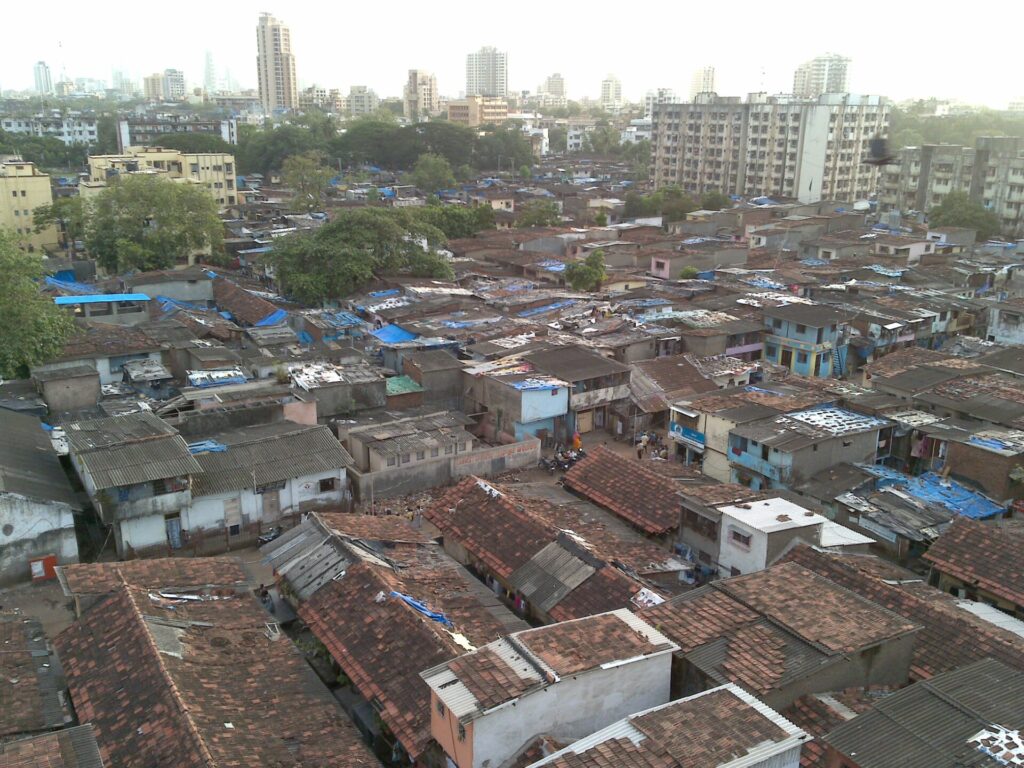
Redevelopment projects are increasingly on the rise in Mumbai. The unfortunate fallout of this is that trees are cut to make way for new buildings in many cases.
The Dharavi Redevelopment Project (DRP) is a huge project looming across Mumbai’s redevelopment landscape. Being executed by Navbharat Mega Developers Pvt Ltd, the project intends to turn the maze of informal settlements spread over nearly 600 acres into a township. Recently the developers have asked the BMC’s permission to remove 1693 trees from the site. There is a proposal to transplant 822 of these. Overall, almost 8,000 trees are likely to be impacted by the DRP.
Meanwhile, the Motilal Nagar Redevelopment project is being touted as India’s largest redevelopment project. Motilal Nagar is sprawled across nearly 143 acres in Goregaon. The master plan for the development of colonies 1, 2, and 3 in Motilal Nagar has been presented by MHADA. The Adani Group is the Construction and Development Agency for this project. Officials from the Garden Department have tagged 220 trees which fall in the project alignment. Out of these, 89 could be chopped and 121 will be transplanted.
Large scale and cluster redevelopment projects come at a dear price. There are two grounds at Motilal Nagar: Ambedkar Maidan and Annabhau Sathe Maidan. These open spaces, a rarity in Mumbai, are home to a variety of trees. 220 trees will be cut and some sections of the grounds will see construction.
Read more: What does it take to transplant a tree?
Larger buildings, fewer trees
Shriya Bhatia, an architect and urban planner says, “There is a new urban form which is emerging. In the previous urban form, even in large societies, there were smaller buildings, and spaced out.”
Under Regulation 33 (9) of the DCPR 2034, cluster redevelopment projects get a Floor Space Index (FSI) of 4.00. Shriya explains that this means the footprint of the building itself is larger, especially in a city like Mumbai where certain areas have height restrictions on buildings. This reduces the scope to save the existing trees, especially given that there is a lot of pressure to maximise FSI consumption. She also points out that there is car-centric development: chunks of the plot have to be reserved for parking areas, which are free of FSI.
Shriya believes that it is still possible to retain trees along roads, provided we tweak our approach to street design and infrastructure management. But the reality is that the juggernaut of infra projects is rolling ahead, flattening precious greenery in its wake.
The Supreme Court has already approved the felling of 95 trees in Film City for the construction of the Goregaon Mulund Link Road (GMLR). Instead of more concretisation Mumbai needs greening measures and more blue-green infrastructure. What is worse is that there is no space to plant trees under the mandatory afforestation by the BMC’s own admission. Thus the compensatory plantation will have to take place outside Mumbai for upcoming projects. Mumbaikars deserve better than this.