Fifteen lakh trees. A place in the Guinness Book of Records. The Bengaluru Development Authority (BDA) has been on overdrive, promoting its new project to plant 15 lakh trees in spaces created in its new layouts.
240 acres have been earmarked across BDA’s faraway layouts. The saplings are to be planted across lake and nala buffer zones, parks and public spaces in new neighbourhoods like Nadaprabhu Kempegowda Layout, Banashankari 6th Stage, and Dr Shivarama Karanth Layout, according to the BDA Chairman N A Haris.
While such massive tree plantation exercises are by themselves questionable, there is also the question of a body like BDA conducting these exercises and what it intends to achieve.
Missing the trees for saplings
Saplings take decades to grow into trees. After the backlash that fast-growing non-native species like Tabebuia and Gulmohar face due to issues with falling branches during heavy rains, there is a focus on planting only native trees like Pongamia, Neem, etc. While this is a much-welcome step, these trees also take years and decades to reach the same level of functioning as the older trees that they are compensating.
There is also the question of these saplings becoming trees. There is no data on what proportion of saplings survive over a year or five years. The saplings are expected to be planted in Miyawaki-style plantations, where trees will be planted in close proximity. Miyawakis, while being touted as a quick-fix system able to generate a “forest” in a short period of time, have been mired in controversy.
Researchers have noted that they sequester much less carbon than a grassland or shrub-forest in the same place. They have also flagged concerns about biodiversity – dense canopies were seen to block herbaceous growth, faster-growing trees crowded out slower-growing species, and thick leaf litter prevented natural regeneration. No new species were observed growing naturally in these forests.
While we are staring at an upcoming El Niño, and concerns over AI data centres’ water usage are rising, water remains an issue for these plantations. According to Prof. Abi Vanak, Director of the Centre for Policy Design at ATREE, Miyawaki trees need a lot of water to grow at a rapid pace, and under no circumstances should they be grown in semi-arid landscapes or in arid landscapes where water is a constraint. And multiple Miyawaki plantations with 15 lakh saplings? We need to ask where the water is coming from in a perennially water-stressed city.
According to Deokant Payasi, co-founder of Saytrees, a Bengaluru-based NGO partnering, a Bengaluru-based NGO partnering with the BDA on this planting drive, the water demand is not expected to compete with residential needs as the areas where the plantation is being planned are not densely populated. In some areas, they expect to use functioning borewells. But is groundwater a localised resource or belongs to the city at large? And where water tankers are the norm for the way groundwater is transported, is removing groundwater from an area for plantations in a water-stressed city a good idea?
Then there is the matter of long-term maintenance. While there are MoUs with NGOs for three years for specific areas, there is no mention of where money is coming from, except a vague hand-waving towards CSR. According to Ravindra TC, director of Indus Herbs, one of the partners of the plantation drive, the BDA will only provide the saplings and access to land, and they have to maintain the plants for three years by mulching, de-weeding the area, and watering them. In case of issues, the BDA has the right to terminate the agreement.
To read that again, if issues are seen and the maintenance is not up to the mark, BDA has the right to terminate the agreement, and everyone can then shake hands and heads and walk away disappointed, with little accountability beyond that. That is, of course, if anyone is still around checking in three years. The saplings and plantations will anyway have been forgotten by then.
Read more: The trees we forget: What a city loses when the canopy disappears
Not all places need trees
Most of these plantations are being done in areas that already have grassland and shrub vegetation. Near Kannalli Lake, which comes under NPKG Layout, the lake buffer areas had been cleared of existing vegetation, and saplings were planted four years ago. They have still not grown beyond a couple of metres.
Grassy areas which harboured much biodiversity like munias and weaver birds were partially cleared for that plantation drive in late 2022.
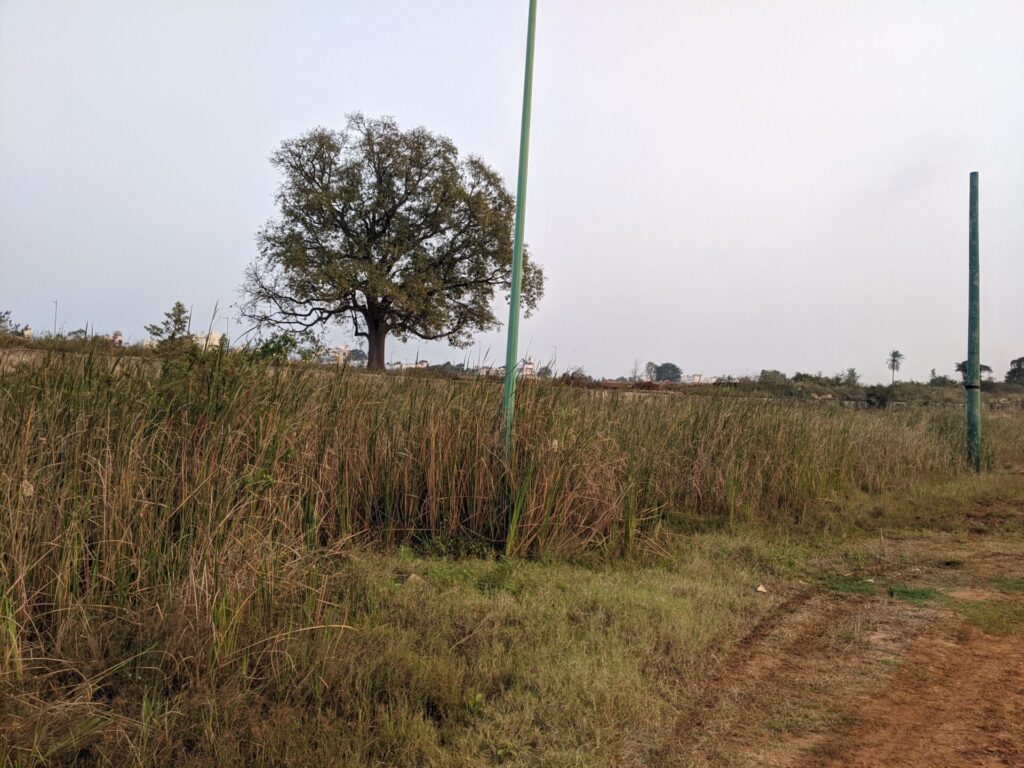
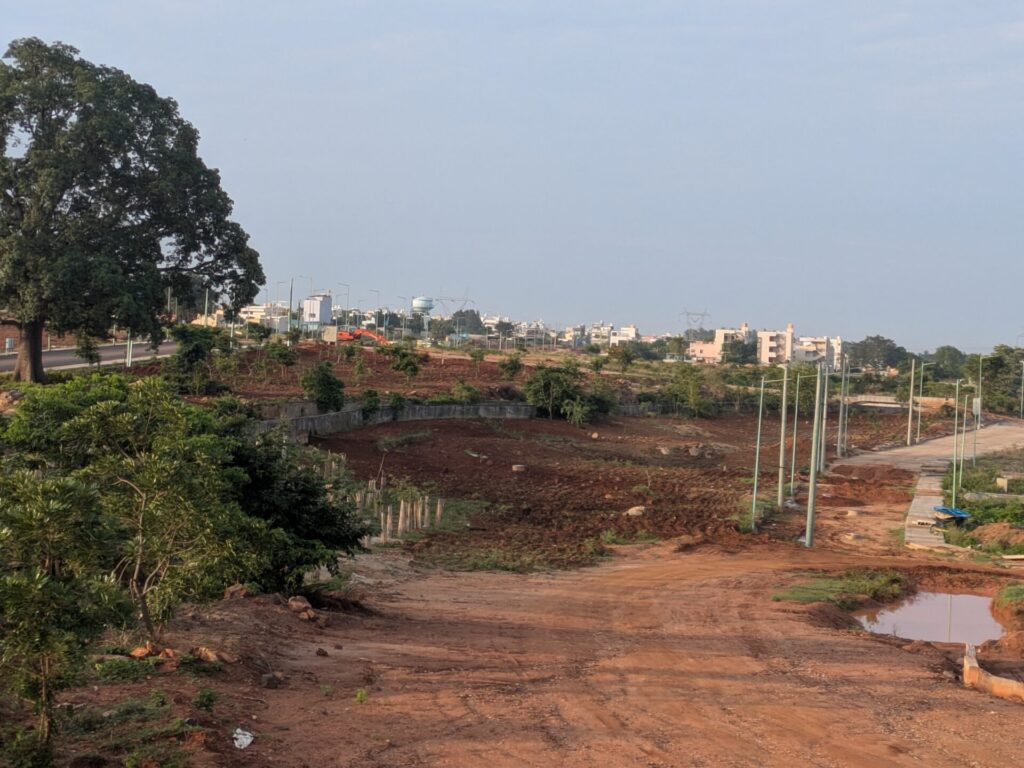
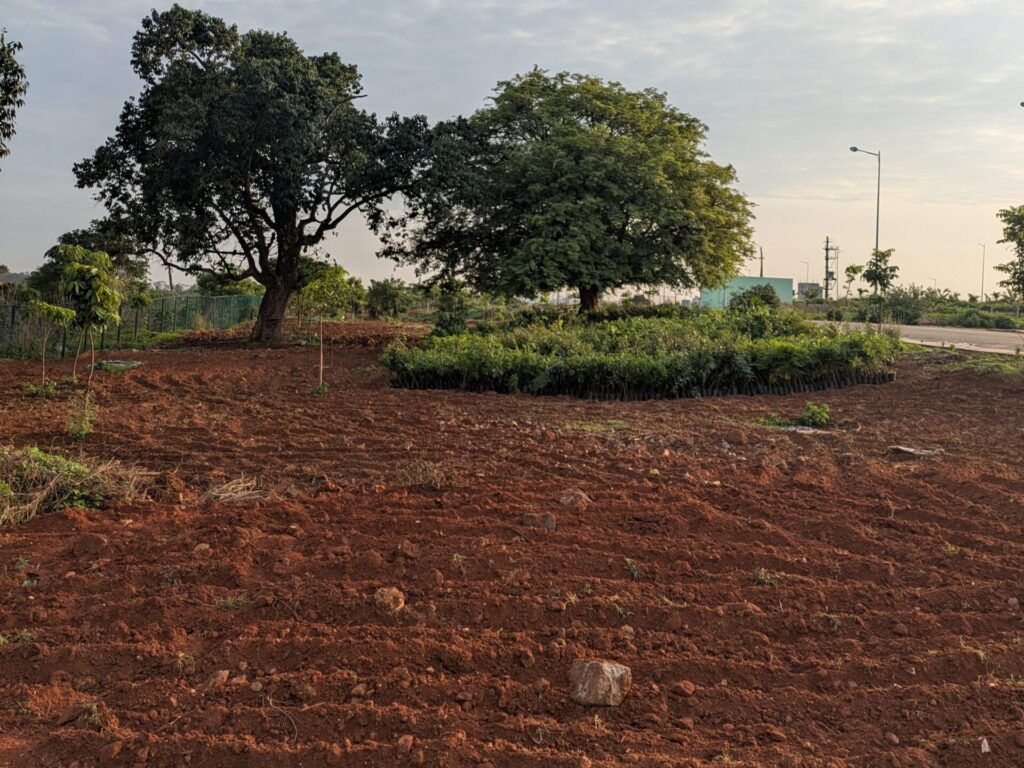
A few days back, the rest of the grasslands and shrubbery have also been cleared and saplings lie in wait to be planted. Experts have pointed out how such replacement of grass and shrub lands with trees does not help sequestration of carbon and is a bad idea in semi-arid landscapes.
Bengaluru is not the Western ghats. The city receives around 1000mm of rainfall each year which is not distributed evenly around the city. Shrub forests and grassy patches, which are called One Natural Ecosystems are prevalent across the city and harbour astounding biodiversity. While considering only tree dense areas as forests, these ONEs have been facing threats from real estate interests across Bengaluru, and the BDA has been the biggest of them.
Clearing them in the name of real estate and roads, and replacing parts of them with clusters of trees helps neither with carbon sequestration nor biodiversity, while only increasing the stress on a water-stressed city.
BDA has a tree problem
The main function for most city development authorities is planning for the city – studying and understanding the growth of the city, its needs in the future, and ensuring that the city grows in a planned way, in planned directions. One of the primary deliverables for these planning bodies is the city’s Master Plan.
Bengaluru’s own Development Authority, however, is little more than a real estate agency. The city does not have a functioning master plan; the last plan was withdrawn in June 2020. Meanwhile, the BDA counts as its achievements more and more layouts in far-flung parts of the city—the much-mired-in-litigation Arkavathy Layout, Shivarama Karanth Layout, Vishweshwaraiah Layout and the most recent Nadaprabhu Kempegowda Layout.
To make these far-flung layouts more attractive, the BDA also develops major roads. The controversial Peripheral Ring Road, now renamed as the Bengaluru Business Corridor (BBC), is one of them. A “Major Arterial Road”(MAR) was developed to connect Mysuru Road with Magadi Road ostensibly to solve the city’s traffic congestion.
As if these projects were not enough, there is now a brand new body called the Greater Bengaluru Development Authority which is now driving the controversial AI city in Bidadi. All these projects require land, lots and lots of it. And most of this land is agricultural or forest, and have trees.
The BBC or PRR needs 32,000 full-grown trees to be cut down. It also cuts through the Avalahalli State Forest devouring 600 trees inside what is ironically called a tree park.
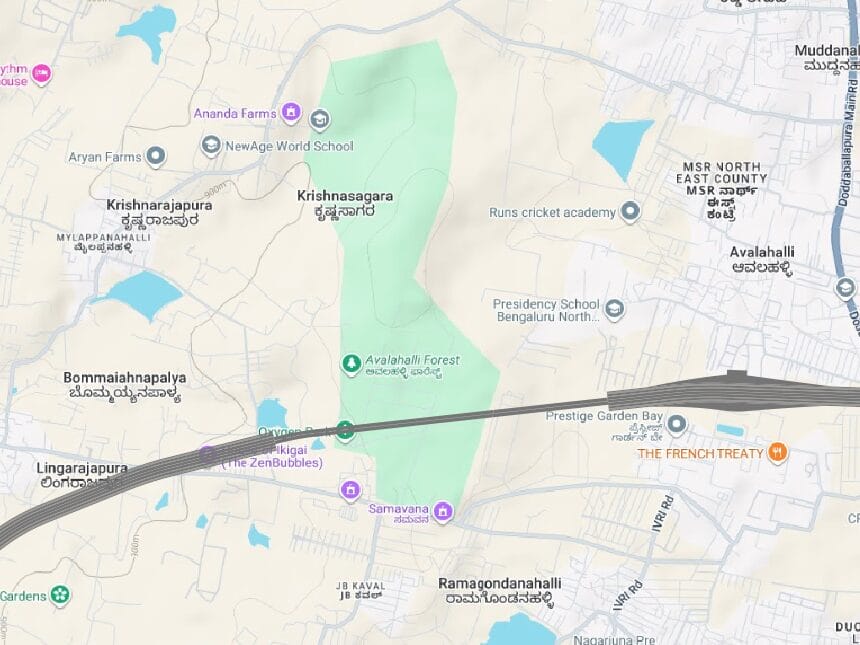
The MAR slices through the Sulikere reserve forest, barely 100 metres from its end, and required the massacre of hundreds of trees. A mild detour could easily have prevented this.
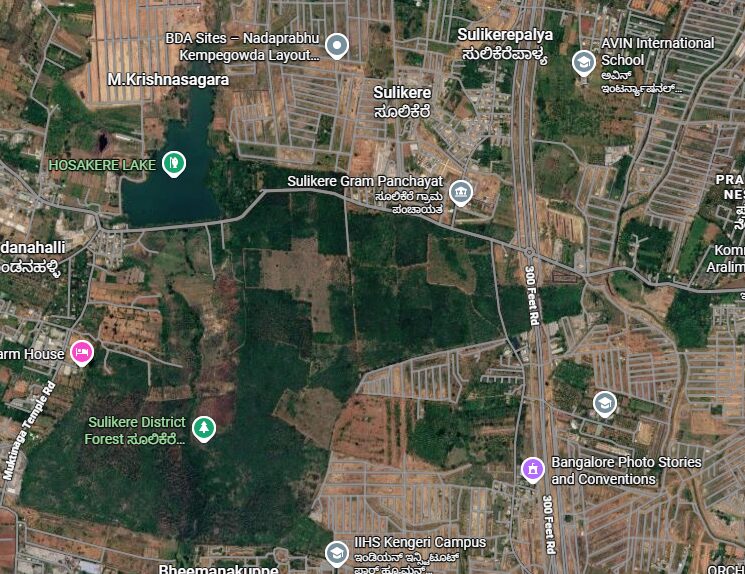
But the winner of this macabre contest is the Bidadi AI City which would involve a destruction of around 2 lakh trees as per media reports. There is no mention of how many trees were chopped, how many green areas cleared to create the brand new layouts of Arkavathy, Shivarama Karantha, Vishweshwaraiah and Nadaprabhu Kempegowda (NPKG). BDA has been resisting registering with RERA so the data is never put in the public domain.
But we need to remember that the BDA is only a real estate agency. And a real estate agency needs to create more properties to sell. With all these layouts done and ready to sell plots, BDA is now eyeing the villages farther west of the city towards the Big Banyan Tree for Phase 2 of NPKG Layout. 5755 acres are being earmarked with no mention of how many trees are going to be chopped for this.
The goal of a real estate agency is real estate as an investment, not housing. Most of the plots from these layouts are acquired for “investment” and do little to help a city struggling to find affordable housing.
This large scale tree plantation is nothing more than a Guinness record size, but still miniscule, band-aid on a fast-growing cancer called the BDA, which devours trees while expanding relentlessly. While citizens, NGOs and social media influencers come together to celebrate creating a record, the BDA juggernaut will roll on devouring everything on its path all around the city.
The BDA is a body that has eluded accountability for decades to continue doing what it does best. With no accountability, the tree plantation will likely end up a forgotten chapter, leaving behind a trail of bulldozed vegetation and neglected half-grown saplings. A greenwashing could have been acceptable over this.
It’s very sad to see such destruction of our garden city that it literally brings me to tears. How greed of money and power has brought to the extent of destructing anything that comes our way. They create tree forests just to destroy it. They do plantation drives after destroying 100yr old trees. They build white top cement road just to dig it up to build a flyover leading to the next big traffic choked junction. All these with people’s hard earned tax money while having the galls not to answer any citizens’ concerns. Being an IT professional I sometimes wish the whole IT frenzy crashes and burns just to see these politicians see there loot turn char in front of their eyes.
it is nothing but emblaze crores of tax payers money,with smelling corruption to deceive the people and government.
plant 50 crore native trees banyan peepal jamun Bela tamarind neem mango jackfruit sitaphal mulbery. conserve adopt lakes. oversaturated Bangalore is a horrible garbage barren concrete dusty hot desert. stop real estate and registration of new vehicles. plan growth outside bangalore tier 2 cities.
BDA just chop the trees and forms the layout without mercy just like a coward. Did they have any account of cutting trees, planting and planted grown up all these days. Let us hope this drive is not for publicity or to loot, only for survival of the mankind.
bda has never been above board in its multifarious activities in its past decades of existence. the present tree planting drive, hopefully will not be another milestone of their failures. success of the tree project in achieving the objective, hopefully, will be substantial if not 100 percent. with the present minister kbg holding bengaluru portfolio, with his excellent track record of his previous portfolio, revenue, will succeed in making the tree plantation drive substantially, if not fully successful. let us wait and watch and more importantly do monitoring task which citizen matters can ably do.
please save the plants
This article is a classic case of looking at the glass half full.
Deccan Herald has been covering this development objectively. If you want to castigate BDA, it is fine but don’t undermine the efforts of volunteers and NGOs.