Every year, as the north-eastern monsoon approaches, residents in Chennai are on high alert, fearing a deluge. The memories of the 2015 floods, the aftermath of Cyclone Michaung in 2023 and annual flooding continue to haunt citizens even as they head to vote this April.
The Chennai City Municipal Corporation Act, 1919 points out that the Greater Chennai Corporation (GCC) must provide and maintain a sufficient system of public drains throughout the city. Recently, the GCC claimed that 88% of stormwater drain (SWD) works have been finished and that ₹6,475 crore was spent over four years on this. This covers 1,235 km of lines across all corporation zones.
However, residents flag issues of incomplete SWDs in their areas and report persistent flooding yearly. Missing SWD links, poor canal maintenance and silt catch pit management, and inadequate design are also on this list.
In our third pre-poll conversation, we spoke to residents in Vyasarpadi and Perambur in north Chennai and Sunnambu Kolathur and Thalambur down south to discuss issues on flooding, infrastructure, and drainage in their neighbourhoods.
Our previous conversations were around urban planning and waste management.
Demands from citizens
- Integrated stormwater drain network linked to all waterbodies with zero-stagnation targets.
- Restoration of natural flow paths for canals.
- Transparent tracking of desilting schedules.
- Redesign of faulty stormwater drains to prevent flooding.
- Mandatory inter-departmental coordination before road cutting and resurfacing.
- Close monitoring of road works to ensure proper milling and restoration as per IRC guidelines,
- Removal of lake encroachments and maintenance of SWD canals.
- Implementation of underground sewage schemes in Chitlapakkam, Sembakkam, Madambakkam, Perungalathur, Peerkankaranai, and Tiruneermalai.
The above points were collated based on manifestos released by several resident groups, including FOMRRA, Perambur Neighbourhood Development Forum, a cluster of South Chennai RWAs, Tansi Nagar, and Chitlapakkam. The manifestos can be read on Opencity here.
Spotlight always on South Chennai
Residents allege that whenever the city is inundated following heavy showers and cyclonic storms, both media and government tend to focus on central and south Chennai. Meanwhile, Perambur, and low-lying portions of Vyasarpadi, and outskirts like Shollinganallur and Thalambur have remained largely out of the scope of urban planning policies and media coverage.
“During 2015, Chennai saw flooding across the city. But the media only focussed on the opening of Chembarabakkam lake gates and its impact in the south. However, in the same way, the gates of Keelkattalai lake were opened up in our area and water entered our homes and roads,” says J Sankar from Sunnambu Kolathur, “but there was no media coverage here.” With no SWDs or other infrastructure in place, Sunnambu Kolathur, Thalambur and Velachery reeled under neglect during the deluge.
Cut to 10 years later – infrastructure still lags in most areas. In south Chennai, from Padur to Okkiyam Maduvu, there are missing SWD links and canals, notes Swaminathan Srinivasan, a resident. “The open canal near Tsunami Canal has not been desilted for the last three years,” he says, adding that this leads to backflow and flooding.
Across north Chennai, flooding is a recurrent threat. During 2015 and even in 2023, residents say they had no information on emergency numbers, relief centres or contacts of concerned officials. “Most residents are not aware or provided information; but as a precaution, this information must be shared,” says Sakthivel from Vyasai Thozargal.
Pallikaranai marshland and Kodungaiyur wetland – both ecosensitive zones – have now become the city’s dumpyards. Dumping of garbage and changing the land has exacerbated the flooding in surrounding neighbourhoods, Sakthivel points out. Residents have demanded for these areas to be reclaimed on earlier occasions too.
Missing links, unclean canals, and other infra issues
While SWDs are meant to carry rainwater to the sea, cut and cover drains and canals across Chennai are clogged and in dire need of desiltation. In all our conversations, residents flagged sewage being let out into the stormwater drains and then into waterbodies. “Alapakkam lake and Korattur Lakes are full of sewage,” points out Raghukumar Choodamani, a resident of Perambur.
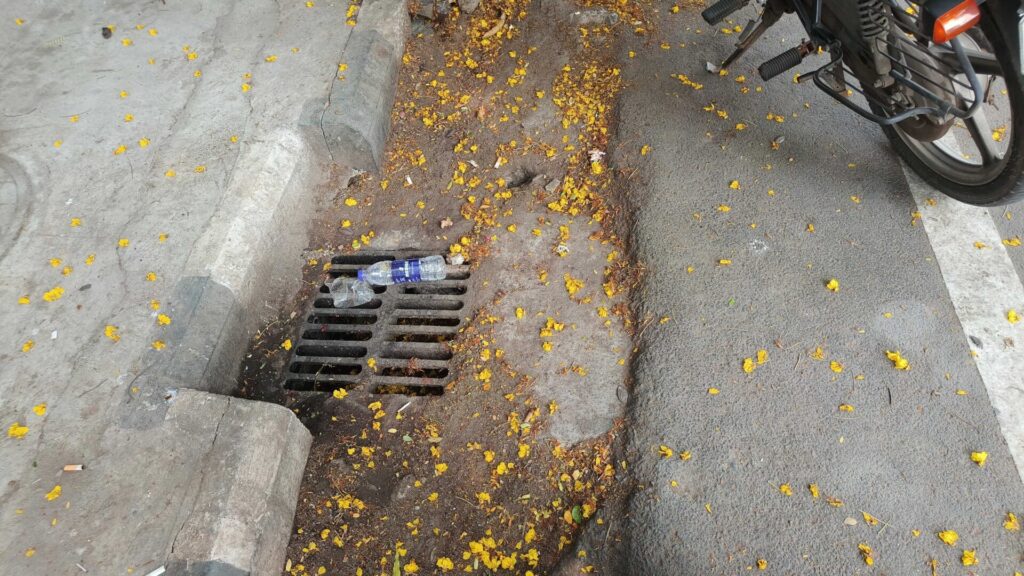
According to the GCC mandate, SWDs are designed to relieve water stagnation in the waterlogged areas. A few SOPs include:
- SWDs need to be built on roads of 7m width and above.
- The maximum drain size must be 600X750 mm and the drain top must be 6 inches above the road level.
- Inlet chambers and silt catch pits with rain water harvesting structures must be provided at 30m intervals to collect rain water and to increase the groundwater level.
While the website mentions that desilting of SWDs is carried out regularly, residents say they have not seen this happen on the ground.
Design issues persist. Contractors often do not comply with the GCC’s SOPs, SWDs are built against the natural gradient of the road and there is shoddy maintenance, says Raghukumar from Perambur. He also flags how, in the same area, workers were seen breaking the SWD manhole covers and desilting them manually in 2022.
Meanwhile, Vyasarpadi’s flooding is exacerbated by its impaired canal system, finds a 2025 study by Vyasai Thozargal and Chennai Climate Action Group. This system includes the Buckingham Canal to the east, the Captain Cotton Canal to the north, and the Otteri Nalla to the south. This network is designed to drain floodwater via the Buckingham Canal to Kosasthalaiyar River. However, rampant encroachments and tidal influence has affected flow of water from Captain Cotton Canal, while deposition of fly ash – the size of 492 standard football fields – clogs the Ennore Creek and Kosasthalaiyar.
Several poorly planned projects currently in progress will lead to future flooding, say residents. The redevelopment of Perambur station, under the Amrit Bharat Station Scheme, ignores the Ekangipuram Canal under the tracks, notes Raghukumar. As Ekangipuram canal was built as a flood carrier, the blocking of this canal is a concerning move.
Read more: Perambur Railway Station grapples with redevelopment chaos
As a long-term solution, Swaminathan says that SWDs need to have end-to-end connections across the city. “There are a lot of gaps with no proper connectivity, with complete connections in only a few areas. In its absence, the water flows out into open space and there is backflow.”
Read more: Chennai floods: Master Drainage Plan and better SWD design the way forward, says Dr Janakarajan
Lessons from citizen groups
In Sunnambu Kolathur, the 2025 rains did not cause inundation like previous years. The installation of 13 shutters on waterbodies have helped regulate release of surplus water, says Sankar.
Cut and cover drains from Narayanapuram to Pallikaranai marsh, and a retainer wall in Keelkattalai, have reduced water stagnation. Residents stress the need for shutters to be opened before the monsoon and closed after, with regular maintenance.
This was a result of repeated citizen demands, appealing to elected officials, and posting on social media, says Sankar. “Ahead of the lakes brimming, there can be precautions taken – regular cleaning of SWDs, canals, and reducing the levels and regular maintenance,” he recommends.
As residents set out to choose their Members of Legislative Assembly (MLAs), they urge them to bring scientific drainage plans to the city, with a focus on vulnerable areas. Flood mitigation policies and creating awareness among citizens about helpline numbers and relief aid are other demands. Citizens hope the state government interacts with residents to understand ground-level issues in neighbourhoods, and holds public consultations ahead of projects.
Other recommendations include:
- Include residents of north Chennai in policy
- Share information with residents like emergency contacts, relief centres, community food kitchens, in the event of heavy rain and flooding
- Maintain SWDs, desilt canals regularly
- Hold public consultations for projects
- Design SWDs scientifically, in compliance with statutory norms