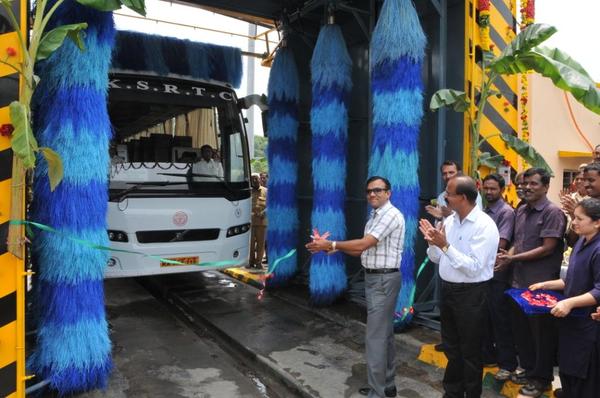
If buses could talk, they’d be squeaking clean!

KSRTC buses at the Shantinagar depot will now be cleaned by a new washing machine, one that has been built in-house.

On June 1st, the Karnataka State Road Transport Corporation (KSRTC) unveiled a new washing machine for its buses. Built in-house at the Bangalore Central Division (Shanthinagar) depot, KSRTC claims that the new machine is the first of its kind in India. The machine was inaugurated by KSRTC Managing Director, Rajender Kumar Kataria.

As per the press release shared by KSRTC, the new washing machine offers quite an upgrade on the earlier washing process.  

  • The new system comes fitted with six brushes on either side, for improved quality of washing. Only two brushes were used to wash the vehicles in the past. 

  • Soap oil is now sprayed automatically. This feature was not present earlier.  

  • The roof top of buses will be washed with an exclusive brush. This feature too, was not present in the earlier system. 

  • It takes only seven minutes to wash a vehicle.  

The machine has been installed in the Shanthinagar depot which operates 128 Volvo buses, on 121 schedules.

Leave a Reply

Your email address will not be published. Required fields are marked *

Similar Story

,

High transport costs, low support: The daily toll on commuters with disabilities

Disabled persons spend thousands monthly on commuting in Chennai and Bengaluru, as inaccessible transport and meagre pensions increase their woes.

TMN Deepak, a professor of social work who has a physical disability, commutes from Velachery to Loyola College in Chennai for work every day. He owns a wheelchair cum scooter that allows him to cover short distances comfortably, but he avoids public transport. “Instead, I have had to go for an automatic car, which has increased my overall spend, and I had to shell out an additional ₹2.5 lakh for modifications,” he says. Deepak's monthly petrol costs exceed ₹6,000. “I prefer not to use the bus because of inaccessibility,” he explains, highlighting how the lack of accessible public transport forces…

Similar Story

How OMR residents strive for better last-mile connectivity and improved public transport

Residents of Chennai’s OMR push for bus and metro links; FOMRRA’s survey highlights poor last-mile connectivity and urges MTC to expand services.

As commercial development along Old Mahabalipuram Road (OMR) has surged, reliable public transport has become essential. Yet, daily commuters, labourers, office workers, college and school students, and Resident Welfare Association (RWA) staff continue to grapple with limited access to Metropolitan Transport Corporation (MTC) buses. For many, reaching bus stops on the main road is a daunting task, especially since interior localities remain underserved and private operators like share autos rarely venture into these areas. The absence of adequate bus stops and the restricted MTC service forces residents into long, difficult journeys. The worst-affected by this lack of last-mile connectivity are…