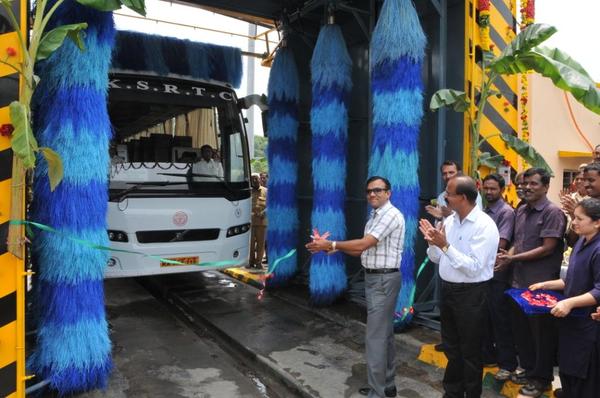
If buses could talk, they’d be squeaking clean!

KSRTC buses at the Shantinagar depot will now be cleaned by a new washing machine, one that has been built in-house.

On June 1st, the Karnataka State Road Transport Corporation (KSRTC) unveiled a new washing machine for its buses. Built in-house at the Bangalore Central Division (Shanthinagar) depot, KSRTC claims that the new machine is the first of its kind in India. The machine was inaugurated by KSRTC Managing Director, Rajender Kumar Kataria.

As per the press release shared by KSRTC, the new washing machine offers quite an upgrade on the earlier washing process.  

  • The new system comes fitted with six brushes on either side, for improved quality of washing. Only two brushes were used to wash the vehicles in the past. 

  • Soap oil is now sprayed automatically. This feature was not present earlier.  

  • The roof top of buses will be washed with an exclusive brush. This feature too, was not present in the earlier system. 

  • It takes only seven minutes to wash a vehicle.  

The machine has been installed in the Shanthinagar depot which operates 128 Volvo buses, on 121 schedules.

Leave a Reply

Your email address will not be published. Required fields are marked *

Similar Story

Riding the Chennai Metro is a breeze, but last-mile connectivity remains a worry

Chennai needs a unified transit system to ensure seamless travel for metro commuters on either side of the journey.

Stepping off the Thirumangalam metro at 6.45 pm, the train ride seemed effortless. It was cool, fast, and on time, taking just fifteen minutes from the office. Now comes the hard part. Standing at the station exit, finding a ride home is a struggle, as I switch between three apps to book an auto. The metro feeder bus only runs every 40 minutes and has just left. By the time I reach home, the "fast" metro trip has cost an extra half-hour and ₹120 in surge-priced rides, a last-mile problem the metro itself was built to solve. This is the…

Similar Story

A four-hour commute: The daily transport struggles of women from Chennai’s resettlement areas

Watch this video to understand how absence of last-mile connectivity and unreliable public transport in Chennai is failing those who need it the most.

Chennai has long had a tradition of public transport usage, with commuters having the choice of the suburban railway network, Metropolitan Transport Corporation (MTC) buses operating in the city and the Metro Rail for their daily transit. Despite the government introducing new services recently, especially electric buses, private vehicles numbers have soared and bus ridership has gone down considerably. Last mile connectivity issues, poor coverage in certain areas and the inability of the government to encourage residents to use public transport are major impediments. In fact, private vehicles make up 65 per cent of all motorised transport in the Chennai…