Citizens for Malleshwaram constituency formulates Climate Action manifesto

Citizens for Sankey presented the five-point climate action manifesto to Siddaramaiah of Congress and Dr. Ashwath Narayan, BJP, on March 28th.

In the wake of fierce citizen opposition to the Sankey Flyover and road widening project, the Citizens of Malleshwaram Constituency came together to create a ‘Climate Action Manifesto 2023-2024’ for their constituency. Citizens for Sankey presented this manifesto to Siddaramaiah of Congress and Dr. Ashwath Narayan, BJP, on March 28th.


Read more: 10 guarantees in Aam Aadmi Party’s Karnataka manifesto
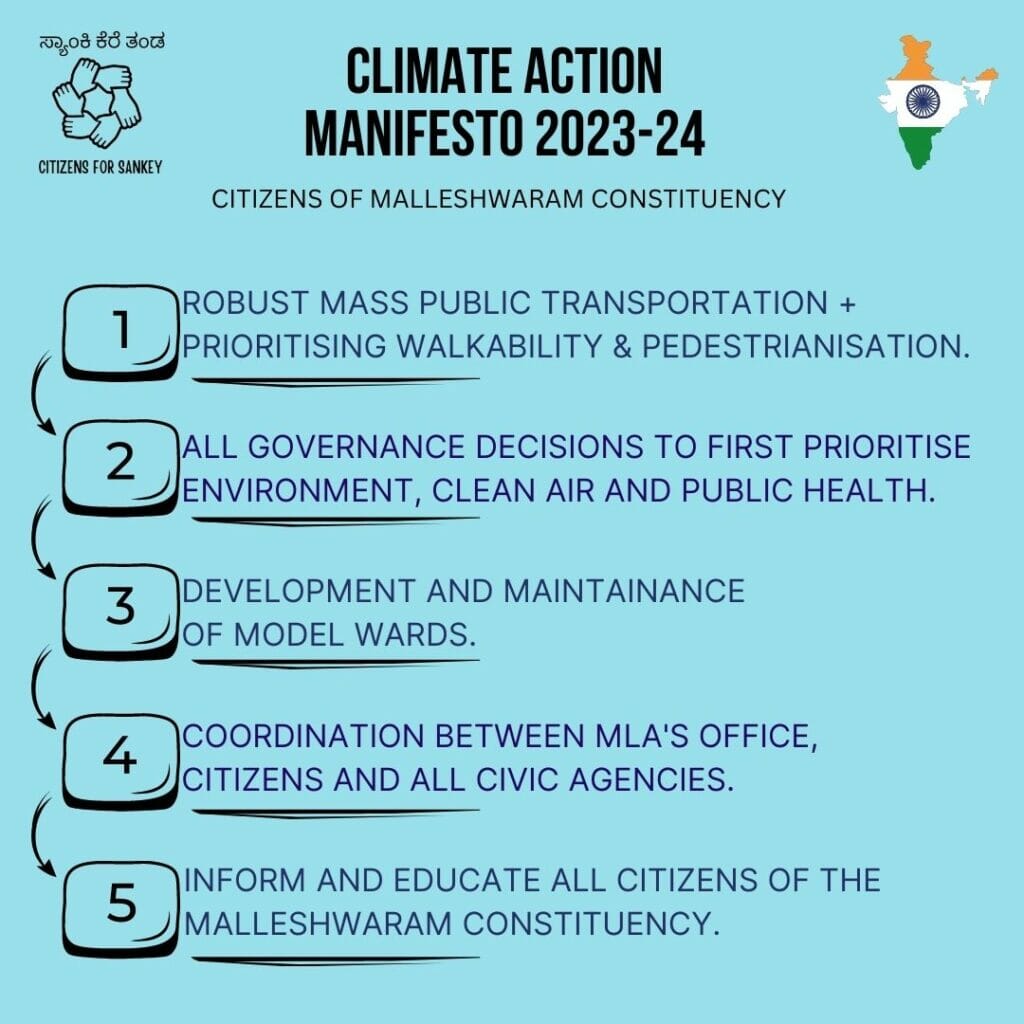

Summary of Malleshwaram's five point climate action manifesto.
Summary of the five-point climate action manifesto. Graphic courtesy: Citizens for Sankey

“To safeguard the future of our city, our elected representatives and civic bodies must coordinate closely with us citizens when making decisions, which impact us all. A repeat of this Sankey Flyover debacle is simply unacceptable. Mechanisms must be set in place to ensure smooth flow of information between all stakeholders, particularly citizens. More importantly, all governance decisions must prioritise the environment and public health,” says Preeti Sunderajan, Citizens for Sankey.

The five part Climate Action Manifesto largely focuses on robust mass public transportation and improving walkability. It requires all governance decisions to first prioritise environment, clean air and public health. The development and maintenance of model wards. Coordination between MLA, citizens and civic bodies. And programs to build awareness and educate all citizens of the constituency.
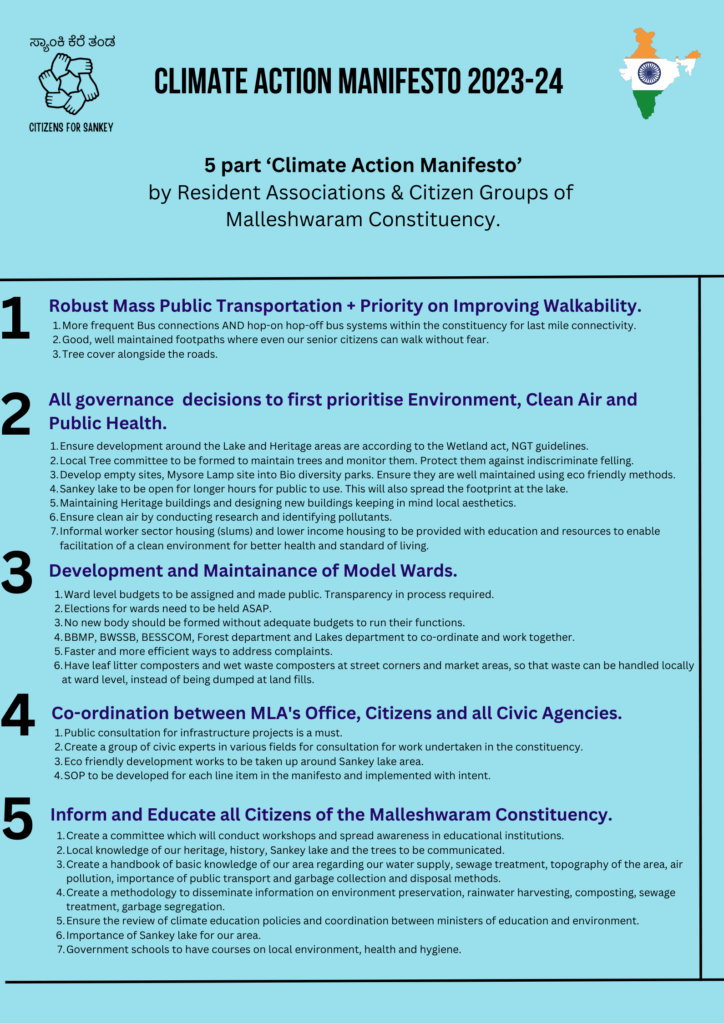
Detailed Malleshwaram Climate action manifesto.
Detailed Malleshwaram Climate action manifesto. Graphic courtesy: Citizens for Sankey

[Content courtesy Citizens for Sankey with minimal edits]

Also read:

Leave a Reply

Your email address will not be published. Required fields are marked *

Similar Story

Shaping Bengaluru: “Citizens can add real capacity through local knowledge, feedback”

We spoke to authors of the Janaagraha report, ‘Shaping Urban India’ to understand its recommendations in the context of Bengaluru.

“The road is broken, buses are overcrowded, traffic disrupts daily life, garbage piles up on the streets”—these are everyday complaints of citizens across Indian cities. In Bengaluru, these issues only seem to be worsening with passing time. Bengaluru’s built-up area grew by 85.19% between 2001 and 2020, resulting in commuters losing 168 hours (one week) annually to traffic congestion. As the city grows rapidly, governance systems, data frameworks, and citizen participation have failed to keep pace with its increasing complexity. What would it take to bridge this gap?  A report by Janaagraha, a non-profit working to improve the quality of…

Similar Story

India Civic Summit 2026: Spotlight on changemakers transforming cities

From waste management to urban forests, the Indian Civic Summit spotlights residents that are driving change in their cities

Cities are the heart of the Indian growth story. Vibrant. Crowded. Diverse. Multidimensional. And yet, as we look around us, we find that they are ridden with problems and face multiple threats to their ecology, habitats and human lives. The crises in our cities make it hard to imagine an urban future that is truly inclusive, sustainable and marked by high liveability standards. But as the oft-cited quote from anthropologist Margaret Mead goes, "Never doubt that a small group of thoughtful, committed, citizens can change the world. Indeed, it is the only thing that ever has."  That is perhaps the…