Citizens for Malleshwaram constituency formulates Climate Action manifesto

Citizens for Sankey presented the five-point climate action manifesto to Siddaramaiah of Congress and Dr. Ashwath Narayan, BJP, on March 28th.

In the wake of fierce citizen opposition to the Sankey Flyover and road widening project, the Citizens of Malleshwaram Constituency came together to create a ‘Climate Action Manifesto 2023-2024’ for their constituency. Citizens for Sankey presented this manifesto to Siddaramaiah of Congress and Dr. Ashwath Narayan, BJP, on March 28th.


Read more: 10 guarantees in Aam Aadmi Party’s Karnataka manifesto
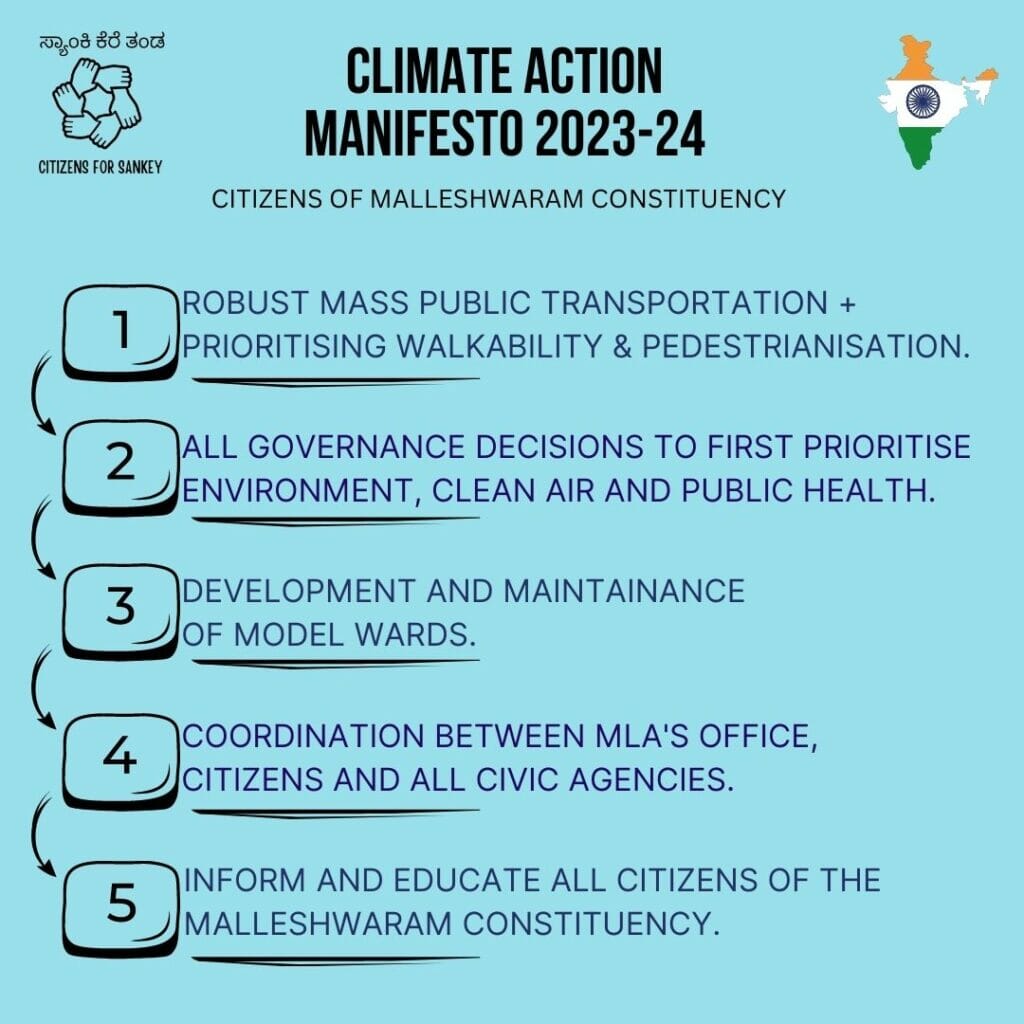

Summary of Malleshwaram's five point climate action manifesto.
Summary of the five-point climate action manifesto. Graphic courtesy: Citizens for Sankey

“To safeguard the future of our city, our elected representatives and civic bodies must coordinate closely with us citizens when making decisions, which impact us all. A repeat of this Sankey Flyover debacle is simply unacceptable. Mechanisms must be set in place to ensure smooth flow of information between all stakeholders, particularly citizens. More importantly, all governance decisions must prioritise the environment and public health,” says Preeti Sunderajan, Citizens for Sankey.

The five part Climate Action Manifesto largely focuses on robust mass public transportation and improving walkability. It requires all governance decisions to first prioritise environment, clean air and public health. The development and maintenance of model wards. Coordination between MLA, citizens and civic bodies. And programs to build awareness and educate all citizens of the constituency.
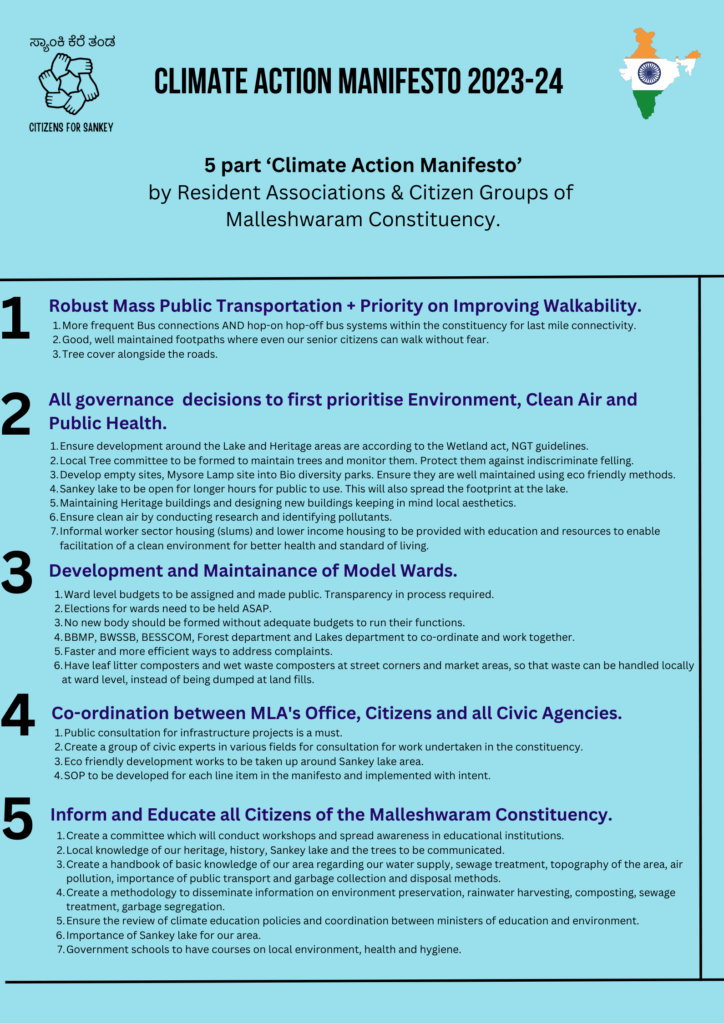
Detailed Malleshwaram Climate action manifesto.
Detailed Malleshwaram Climate action manifesto. Graphic courtesy: Citizens for Sankey

[Content courtesy Citizens for Sankey with minimal edits]

Also read:

Leave a Reply

Your email address will not be published. Required fields are marked *

Similar Story

Chennai has 835 parks, but overall green spaces have shrunk

Chennai's green spaces are shrinking with North Chennai having unequal access. Experts call for native planting, rainwater sponges and citizen action.

A flower-seller weaving mozhams of jasmine, men reading newspapers, and cackling children playing games — these are common sights across city parks. As Chennai saw temperatures cross 40°C this May, seekers of shade, couples stealing time together, and informal workers turned to parks for solace.​ Parks and open spaces are crucial for residents in congested areas, many of whom live without air conditioning. But open spaces in Chennai are shrinking. The Urban Regional Development Plans Formulation and Implementation (URDPFI) guidelines mandate 10 to 12 sq. m of open space per person, yet the Chennai Metropolitan Area has roughly just 0.65…

Similar Story

Beyond rains: Why Mumbai trees are falling and what needs to change

As tree collapses claim lives across Mumbai, experts point to BMC’s unscientific pruning, concretisation and lack of accountability.

“Ae Dil hai mushkil jeena yahan, Jara hatke, jara bachke, ye hai Bombay meri jaan!”  This song from the 1956 hit movie C.I.D has become most Mumbaikars’ anthem since the monsoon has started—replace the words “kahin building, kahin trame” with open manholes and falling trees. Residents have seen mayhem and mishaps due to lashing rains in the city. Within the first six days of July, the Colaba and Santacruz observatories have recorded 823.4 mm and 898.4 mm of rainfall, respectively. The Indian Meteorological Department (IMD) had initially issued an orange alert on July 3, which was changed to a red alert…