Should ‘Action Taken’ reports on government audits be made mandatory?

This webinar will provide insights into the role of the Comptroller and Auditor General of India (CAG), India's statutory watchdog agency.

An informed citizenry is the hallmark of a mature democracy. Hence, institutions or mechanisms that empower citizens, by providing feedback on the working of government, are essential pillars of democracy.

Citizen Matters has published a series of explainers by experts from the Comptroller and Auditor General of India (CAG), India’s statutory watchdog agency. It is responsible for the performance audit of government functions/departments.

CAG reports have covered a wide range of subjects: health, education, road safety, toll, guidance value of property, mining, construction workers’ welfare, etc. The articles focus on the performance of overall state finances with respect to State PSUs, Departments, Autonomous Bodies, etc. The receipt of grants from the Government has also been detailed.


Read more: BBMP pours 90 lakhs down the incomplete drain


All these reports have been tabled in the assembly and are in the public domain.

  • Which are the reports that are relevant to us, as active citizens of Bengaluru?
  • What can we learn from these reports?
  • What happens to CAG’s recommendations and how to track what happens on the ground through action taken reports?

To discuss this, Citizen Matters, Bengaluru chapter, is organising a webinar, titled ‘How to make governments accountable?’, on September 27th, Tuesday, at 5.30 pm. The webinar will be followed by a brief Q&A session open to participants.
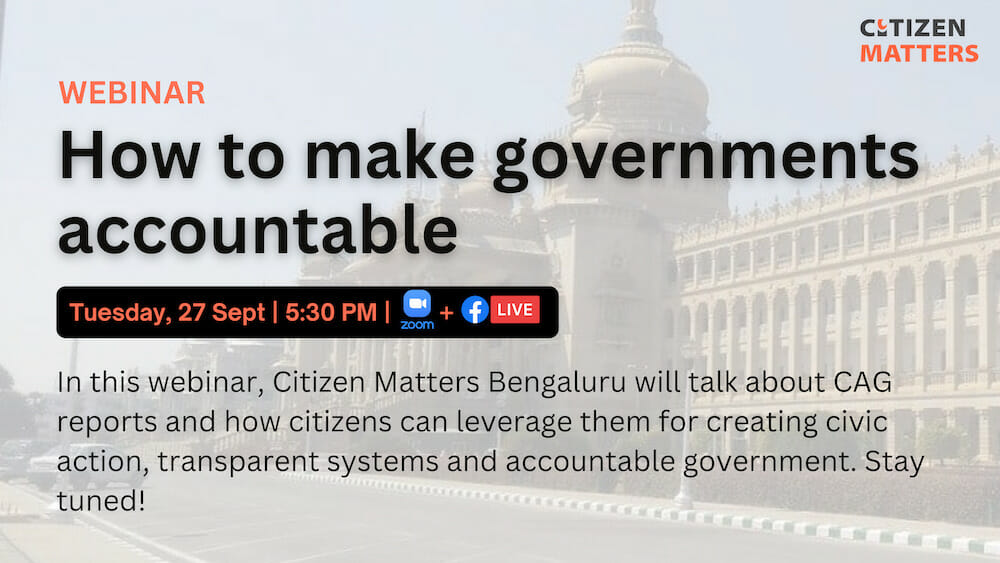
How to make governments accountable Citizen Matters Webinar poster
How to make governments accountable? A panel discussion. Pic: Citizen Matters

Read more: Bengaluru lacks buffer zones, raja kaluves, data and will to protect lakes: CAG


Event details

Event Title: How to make governments accountable

Date: September 27, 2022, Tuesday

Time: 5:30 pm

Register here: https://bit.ly/CMwebinarregister

(The webinar will be followed by a brief Q&A session open to participants.)

Speakers:

  • E P Nivedita – Nivedita is a civil servant in the Indian Audit and Accounts Service (IAAS) – Batch of 1993
  • Himanshu Upadhyaya – Assistant Professor at Azim Premji University
  • Anjali Saini – Member of Whitefield Rising
  • T R Gopalakrishnan – Consulting Editor, Citizen Matters – moderator

Also read

Comments:

  1. G R Gururaj says:

    Though rains & Storm Water Drain annual feature has become common and SWD impact has been brought out neatly by CAG in its Annual Report and has created havoc to general public.. the subject matter drains as the time passes

Leave a Reply

Your email address will not be published. Required fields are marked *

Similar Story

Citizens step up: How South Bengaluru volunteers solved SIR hurdles

From tracking down 2002 voter details to coordinating with overworked BLOs, community members in Bengaluru are stepping in where the system falls short.

While the Special Intensive Revision (SIR) process aims to clean up electoral rolls, the enumeration forms created innumerable hurdles for existing voters. From tracking down elusive 2002 voter details to coordinating with overworked Booth Level Officers (BLOs), citizens across Bengaluru faced a daunting task completing the registration process. Recognising these challenges in their own neighbourhoods, volunteers led by three active citizens—Poongothai, Aparna Shamanth, and Venkatachalam Subramaniam—took it upon themselves to help people in their community and beyond.   Mapping the confusion in Gottigere Poongothai lives in Gottigere, which falls under the Bengaluru South assembly constituency. Her community consists of around 400…

Similar Story

Bidadi GBIT project: Land acquisition process and compensation raises critical questions

As the goverment focuses on land acquisition for the 7,481-acre project, are farmers' rights and crucial social impact checks being compromised?

The Greater Bengaluru Integrated Township (GBIT) in Bidadi, first notified in March 2025, received its final notification in June 2026 under the Karnataka Urban Development Authorities Act (KUDA Act), 1987. The project is branded as India's first and largest AI City, featuring an AI-integrated township. The project will be implemented by the Greater Bengaluru Development Authority (GBDA) under the same act. Three villages, Kempainapalya, Vaderahalli, and Mandalahalli are notified in the Gazette under Section 19(1) of the KUDA Act for the implementation of a development scheme, deemed as public purpose. The development scheme is spread over a total of 7,481…