As Indian cities expand at an unprecedented pace, the consequences of rapid urbanisation are becoming increasingly visible: frequent flooding, water scarcity, heat stress, and the loss of natural ecosystems. Once-porous landscapes are now sealed with concrete, leaving rainwater with nowhere to go but into overburdened drainage systems. Even moderate rainfall events can now bring cities to a standstill.
In this context, nature-based solutions, such as sponge parks, offer a timely and practical response to India’s urban challenges.
What is a sponge park?
Sponge parks are engineered wetlands designed to absorb, store, filter and slowly release rainwater, mimicking the functions of the natural ecosystems that cities have lost to unchecked development. The term originates from China’s “Sponge City” concept but has gained global relevance as cities struggle to adapt to climate change and environmental degradation.
Sponge parks offer a wide array of ecological, social and infrastructural benefits. They help cities manage floods, recharge groundwater, reduce heat, and improve water and air quality. They also support biodiversity and offer community spaces, making them a cost-effective solution for climate resilience and urban livability.
For instance, China rolled out the sponge city model after testing it through a series of pilot projects. It now boasts one of the highest numbers of sponge cities, aiming to have 80% of urban areas absorb 70% of rainwater by 2030. Wuhan was one of the first cities to adopt this approach. Its Sponge City Programme focuses on reducing waterlogging and improving water quality by restoring urban water systems and building green and blue infrastructure to capture and store rainwater.
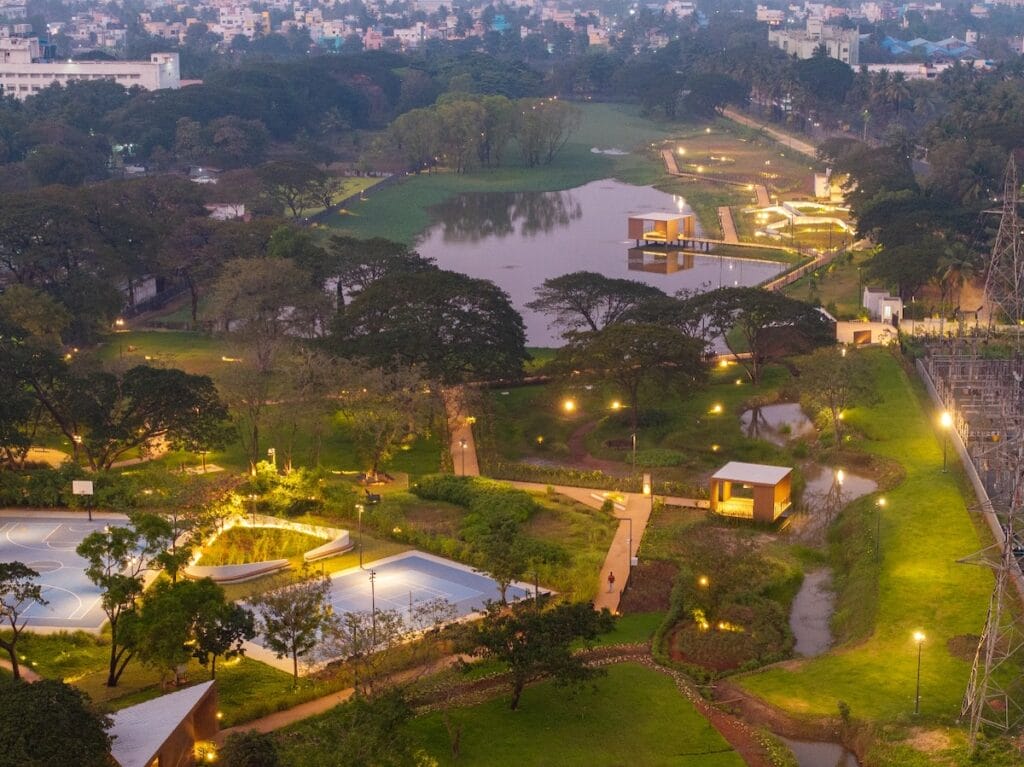
Similarly, Chennai’s first wetland sponge park, known as Dr M S Swaminathan Wetland Eco Park, was constructed and opened to the public in Porur in February of this year. Developed in collaboration with the Chennai Metropolitan Development Authority (CMDA) and Sponge Collaborative, the park was built on Open Space Reservation (OSR) land. This park aims to recharge groundwater in a densely urbanised area and reduce flooding by delaying the water flow into the public stormwater drain system. Other Indian cities like Kochi and Ahmedabad are also exploring the sponge city concept to mitigate urban floods.
Over the decades, urban land use has changed drastically. “This kind of constructed wetland and sponge parks would have had no meaning some 50 years ago,” notes Dr S Janakarajan, President of the South Asia Consortium for Interdisciplinary Water Resources Studies, Hyderabad, and former Professor at the Madras Institute of Development Studies.
He adds, “All the master plans so far have focused on giving a license for construction and infrastructural facilities, without considering that we are meddling with the natural hydrology of the city.”
Flooding cannot be seen in isolation; land use and water management are deeply interconnected and must be addressed together for any tangible, lasting solution. Sponge parks are designed with an understanding of this interconnection.
The basic principle behind sponge parks
“The principle is to work with locally adapted nature-based solutions and blue-green infrastructure as effective alternatives to conventional grey infrastructure (composed of concrete). Alongside flood mitigation, these parks also support biodiversity, improve air quality, cool urban temperatures, and provide recreational spaces for communities,” explains Manushi Ashok Jain, Co-Founder and Director of Sponge Collaborative.
However, it is not a quick-fix product that can simply be replicated without understanding local hydrology and geology. It is fundamentally a planning approach, one that protects and enhances blue-green systems through thoughtful urban planning.
Sponge parks help in
- Holding rainwater temporarily during storms
- Slowing its flow into the public drainage system
- Allowing it to percolate into the ground to recharge aquifers
- Filtering pollutants through soil and native plantation systems
Manushi stresses that it is important to design sponge parks as a multifunctional and integrated infrastructure. This means that they will not only perform hydrological functions, but also create habitats for native flora and fauna, enhance blue-green networks, and support much-needed vibrant, inclusive social spaces in our cities.
Read more: Stormwater drains upgrade: What GCC is doing to prevent flooding in Chennai
How are sponge parks built?
Though designs vary by site, sponge parks typically include:
- Shallow basins or depressions to collect and retain rainwater
- Permeable soil layers that allow infiltration
- Native vegetation to support water absorption and biodiversity
- Inlet and outlet channels to control water flow
- Public spaces designed with a low environmental impact
“Ideally, we should first do a sub-soil survey by digging the selected part of the land down to a depth of 30–40 metres. The nature of the soil plays a key role in identifying if the land is suitable for constructed wetland/sponge parks, etc.,” says Dr Janakarajan. For instance, sandy, sandy loam or red sandy soils are the most suitable, while clay sub-soil structure and rocky conditions should be avoided. The extent of the area selected for setting up the sponge parks should then be filled with natural filtration materials such as gravel and native plantation.
Read more: Chennai floods: Master Drainage Plan and better SWD design the way forward, says Dr Janakarajan
What to keep in mind while planning for sponge parks
The sponge park model is highly relevant to Indian cities, where frequent flooding stems from disappearing wetlands, poor drainage, and excessive concretisation. However, there are a few pointers to keep in mind while planning sponge parks
- Use natural materials like soil and plants instead of concrete to help rainwater soak into the ground.
- It is always more effective if sponge parks are connected with wetlands, temple tanks, and ponds, to manage water across the whole city.
- Ensure regular maintenance through activities such as desilting, plant care, and litter removal, which are essential to keep sponge parks functional and prevent clogging.
- Acknowledge the resource and capacity constraints faced by civic bodies and build partnerships to strengthen manpower, funding, and technical support.
- Engage local communities, including Residents’ Welfare Associations (RWAs), in the planning, maintenance, and monitoring of sponge parks to ensure long-term success and public ownership.