Aruna runs a tiffin stall on the footpath along Hosur Road, close to the National Institute of Mental Health and Neurosciences (NIMHANS). Her setup is temporary—just a foldable cot to lay out her dishes, partially shielded by a blue tarpaulin. The stove and dosa tawa sit exposed to the elements. “When the sun is out, the heat becomes unbearable, and when it rains, we can’t make dosas at all. That directly affects our earnings,” she says. Every day, she spends nearly two hours setting up and packing down this makeshift stall, even though the tarpaulin sheets offer little protection from heat or rain.
Like Aruna, countless street vendors, pourakarmikas, gig workers, and homeless individuals are already highly vulnerable to heat stress. The absence of shelters further increases their risk of prolonged exposure to extreme heat. “Shade by itself doesn’t discriminate, and making it accessible to all is what we must strive for,” say Ankritya Diggavi and Sagar Kandal, designers of the Neralu heat shelter model.
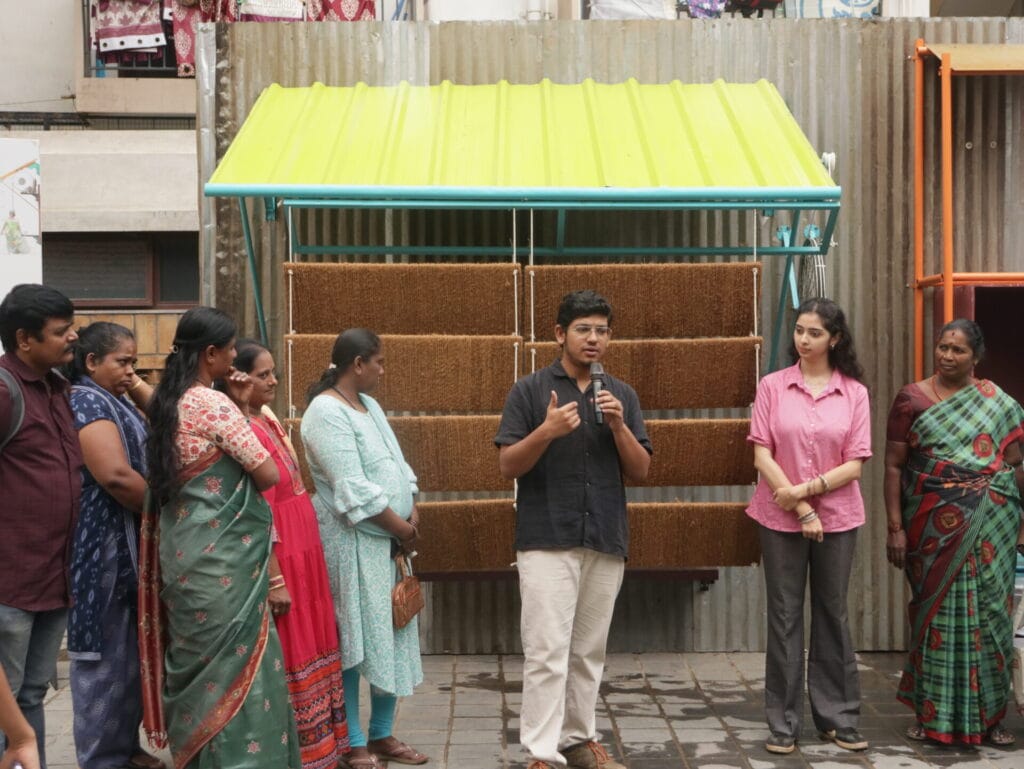
The design of the heat shelter
In Kannada, ‘Neralu’ means shade, and the Neralu heat shelter model is designed to provide accessible shade for everyone. Interestingly, its design draws inspiration from the improvised shelters created by vulnerable communities to protect themselves from the heat. “These communities, with whatever is available to them, like tarpaulin sheets, billboards, etc., construct makeshift shelters. They support these materials on a compound wall, and that’s exactly what we wanted to do,” Sagar said.
The roof is constructed using readily available materials such as bamboo, tarpaulin, metal sheets from scrapyards, or clay tiles, and is foldable. The front side of the shelter is made from a deck of wooden planks covered with jute, repurposed from discarded jute bags, forming the core of the Neralu shelter.
A pulley system with a wheel enables the entire setup to collapse easily. The shelter also consists of a foldable wooden plank, a utility space for storing water, and shelves for users to keep their belongings. This working prototype was last year’s winning entry in a heat shelter design contest by ATREE.
Read more: Heat stories: The daily grind of outdoor workers under the scorching sun
A design for the vulnerable communities
The designers say that installing the shelters on compound walls of private buildings could be of great help, as it can provide shade to people who work under the sun for long hours, near these places. For street vendors like Aruna, this could be an ideal model for their stalls. “The tarpaulin sheets I use get damaged by extreme heat and rainfall. Something like this could be really helpful, and I can also get some shade,” Aruna said.
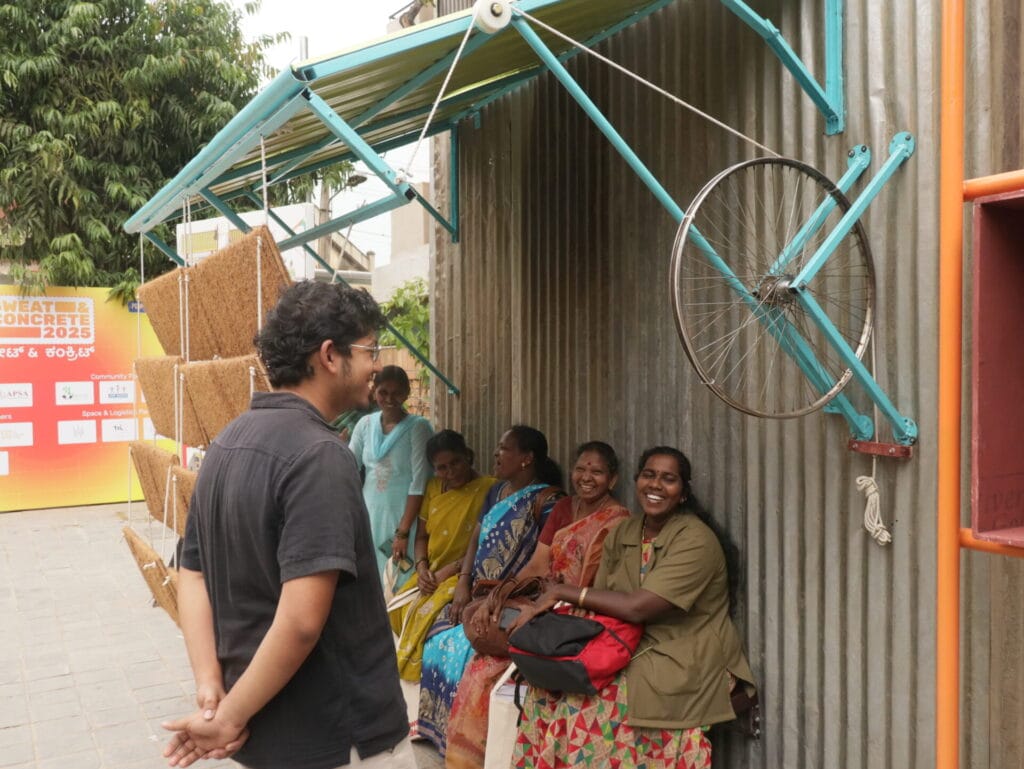
A feasible and inclusive model
“It is crucial to consider how space is used, and in the case of the Neralu heat shelter, its collapsible design is a key feature,” Kanishk Kabiraj, Strategy Director at Purpose, said. The model is designed to be inclusive, ensuring that even stray animals are not excluded. “It also presents an opportunity for private institutions that have suitable walls, where the shelter can be mounted. Since it is attached to a wall rather than placed on the ground, it may eliminate the need for permission,” added Sonali, Associate Strategy Director at Purpose.
Also, this allows communities such as resident welfare associations (RWAs), housing societies and apartment owners to step in and provide shaded spaces for vulnerable communities. “If a shelter is installed in an apartment complex, it can create space for delivery partners and others to rest for a while,” said Sonali.
“Areas with a large number of informal settlements and slums have fewer trees and more concrete and greater density of population,” said Sonali. “These communities are often marginalised by the way cities are planned, leaving them without access to ventilated, cooler spaces. That’s why shelters like this are essential.”
You can check out the Neralu heat shelter model in the video below:
The working model was exhibited at the Sweat and Concrete exhibition by People First Cities Initiative and other partners. The event highlighted the impact of heat stress on informal workers and explored community-centric solutions. The architects listened to the questions and suggestions of various stakeholders to improve the model based on their needs.
A conversation starter for better policies
For the designers, this prototype serves mainly as a conversation starter. “Government policies must be inclusive of the needs of vulnerable communities, as providing shade through models like these is only a temporary solution,” Ankritya noted.
Sonali added that most of the heat action plans (HAPs) lack a vulnerability assessment. “We try to create more spaces for people to come together and talk about how intersectional our solutions should be. Only then will policy recommendations become more specific, relevant, and grounded in real experiences,” Sonali said.
According to the designers, this is just one of many heat shelter prototypes. However, the greater priority is ensuring that urban planning prevents heat stress for all citizens, especially marginalised communities.
The People First Cities Initiative by Purpose works through strategic campaigns to make climate action more inclusive and equitable. In support of Sagar and Ankritya’s vision, they promote the Neralu heat shelter through events that bring the model to life.
Read more: A guide to beat the heat: How smart design can make your home cooler
Way forward
Kanishk and Sonali envision a multi-faceted approach to scale up shelters that cater to the vulnerable communities. They noted examples from Chennai where Zomato set up resting points for gig workers; similarly, private companies can step in to install shelters for the gig workers and other informal sector workers who employ a large workforce. They also stress the need for local government and municipal bodies to think beyond disaster management and consider long-term infrastructural changes tailored to heat resilience.
“Leadership at the highest level should commit to providing basic infrastructure to the gig workers and informal workforce,” Kanishk said. Following this, a feasibility assessment could be conducted to understand the available methods and feasible solutions. If not Neralu, it could be other designs that could be a better solution, depending on the context.
Another key element in scaling is fostering more spaces for conversations and discussions. Communities, designers, researchers, and policymakers can come together to co-create ideas. Only then, they argue, will policy recommendations become more intersectional, grounded, and impactful.
On the other hand, the Neralu designers say that public places like educational institutions and apartment complexes can install such shelters that could provide relief to the workers.