Following the disastrous deluge that hit Mumbai on July 26, 2005 and claimed 419 lives, the state introduced several measures to prevent such flooding in the future in Mumbai. The Chitale Committee, which was commissioned to find solutions for flooding in Mumbai recommended a series of measures, such as improving Mumbai’s hydrological planning to help the city’s rivers find their way into the sea and prevent them from overflowing into the city and endangering lives during the heavy Mumbai monsoons.
While this exercise mostly called for rejuvenating the rivers, one of the first moves by the authorities involved building retaining walls along all the four rivers of Mumbai, namely Mithi, Oshiwara, Poisar and Dahisar. These walls were meant to prevent encroachments on the rivers, dumping of debris in their waters, as also to help train and channel the waters in the right direction. Over 70% of the retaining walls along the rivers has been built and the process continues even today.
But while the city has already spent crores on the construction of these walls, hoping for them to provide an effective solution to the flooding that paralyses Mumbai every monsoons, residents staying along these walls say that their plight during the rains has not changed. Their houses continue to be vulnerable to flooding and while the flood risk has been “delayed”, it continues to threaten their lives and livelihoods.
Read more: Mumbai floods intensify despite reports and recommendations
As the river turns red…
Thirty three year-old Suraj Tayde, who has been living along the Dahisar river at Sanjay Nagar since his birth, continues to spend sleepless nights every monsoon. The river has cast a major influence on almost every aspect of his life: his house, livelihood and personal finance.
Suraj’s house is hardly 7 feet away from the 4-feet high retaining wall alongside the Dahisar river. Every time the Indian Meteorological Bureau (IMD) warns of heavy downpour, he chooses to skip work to monitor the water levels through a football-shaped hole on the retaining wall.
On this particular rainy day that I visited him, Suraj had not opened his shop where he sells radium stickers, preferring instead to stay back to keep a watch, lest the rainwaters enter his house and spoil their humble belongings. His wife, a nurse by profession, had also chosen to skip work to take care of their one and a half year old daughter, cranky after a dose of vaccination.
Pointing to the river through the hole in the wall, he said, “If you notice, the river water is black right now. This is because of the sewage flowing in it. You need to be on alert and take note of the moment when the water turns reddish — that means soil from the Sanjay Gandhi National Park has entered the waters, a sure shot sign of imminent flooding.” This is when they have to immediately start moving things up, and move out of the house towards the main roads to escape the waters.
“Yes, building the retaining wall around the river has definitely delayed flooding for us,” says Suraj, “but we have to be as alert as ever before because the threat is still very much alive.” Last year, the flood water entering his house damaged his fridge and he had to get a new one. His wife’s mobile display was also damaged, requiring replacement. Mattresses and grocery stocks are regularly spoiled by the rain water.
Suraj has fixed tiles on his house walls up to almost three feet, to prevent damage from flood waters. “I chose to renovate our house for the sake of my child,” he says.
Monsoon rituals
A little ahead along the river, on the other side of the arterial Swami Vivekanand Road, lies Ambawadi, a low-lying area, where the settlements of Pragati Nagar face similar woes. For people like Arshad Parmar, whose house in the area has an upper deck, an annual ritual at the onset of the monsoon involves shifting household electrical appliances like fridge, television set, washing machine upstairs to prevent damage during the rains.
Being close to the river, Arshad monitors the water levels and even gets down to shutting off the electricity connections to prevent electrocution or shocks during the floods. He recalls rescuing an old lady stuck upstairs during floods, who suffered electric shocks due to the tin sheet roof. They had to use bamboo sticks to rescue her.
Three months back, the legislators’ funds were utilised to raise up the entire low-lying area near the Dahisar river’s retaining wall to prevent flooding. But that has far from instilled confidence among residents about respite from floods. Motilal Kohil, whose house is closest to the retaining wall, says that his house floor level feels lower than the surrounding raised ground, aggravating chances of river water entering his house.
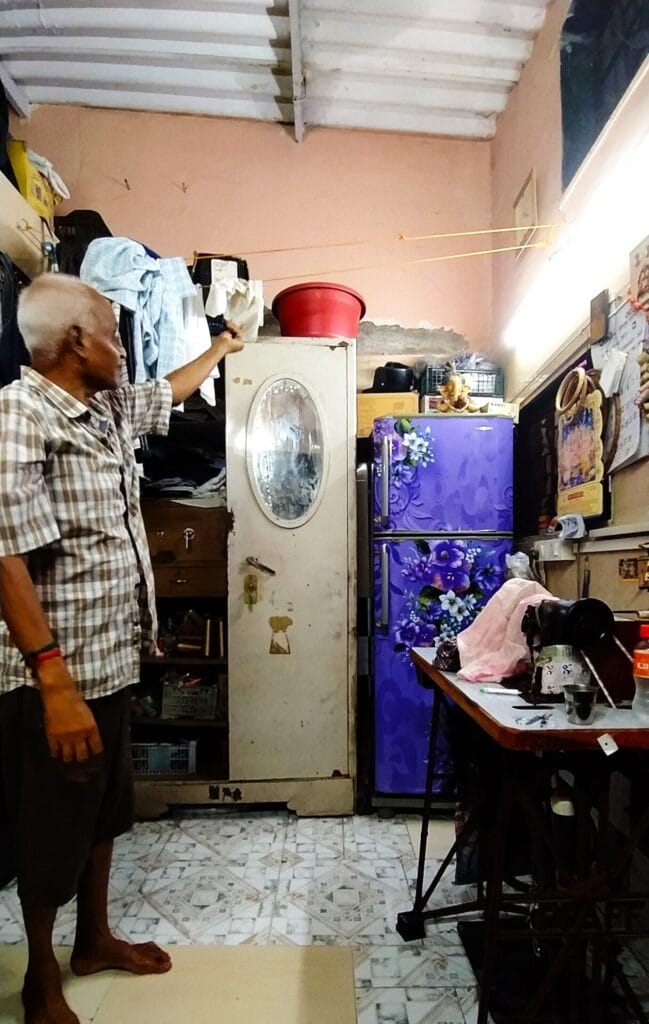
Some distance away, embroidery tailor Ramesh Waghela struggles to save his sewing machines and raw material, such as spools of thread, from the water. Come June and he starts keeping stuff atop his cupboard and fridge. He wanted to raise his house higher but was unable to do so due to objections from the landlord. As a pagree tenant, who needs his landlord’s permissions before undertaking any repairs to his house and also has to bear the costs, there’s not much he can do.
“The scariest part is when the waters start flowing back from the drains and into my bathrooms, that’s the red alert telling us to move out of our homes. The retaining walls have only given us a bit more time till the waters enter our houses, but have not been able to stop it. Our tryst with monsoon flooding continues to date,” says Waghela.
Affecting lives and livelihoods
For all residents in the area, retaining walls notwithstanding, life changes drastically with the rains. Major decisions are guided by thoughts of contingencies during floods. Ramesh’s neighbour Tanubai Gore insists that her son take up a job in the same neighbourhood. “Since, my back pain makes it difficult to lift things, I need him to be available a phone call away, for immediate evacuation if needed,” says Tanubai.
“Each time it floods, we are not able to cook for three or four days at a stretch, because at times our gas stove itself is floating in the water. Even after the waters recede, cleaning the house and getting the muck off vessels and other objects is very difficult,” she says.
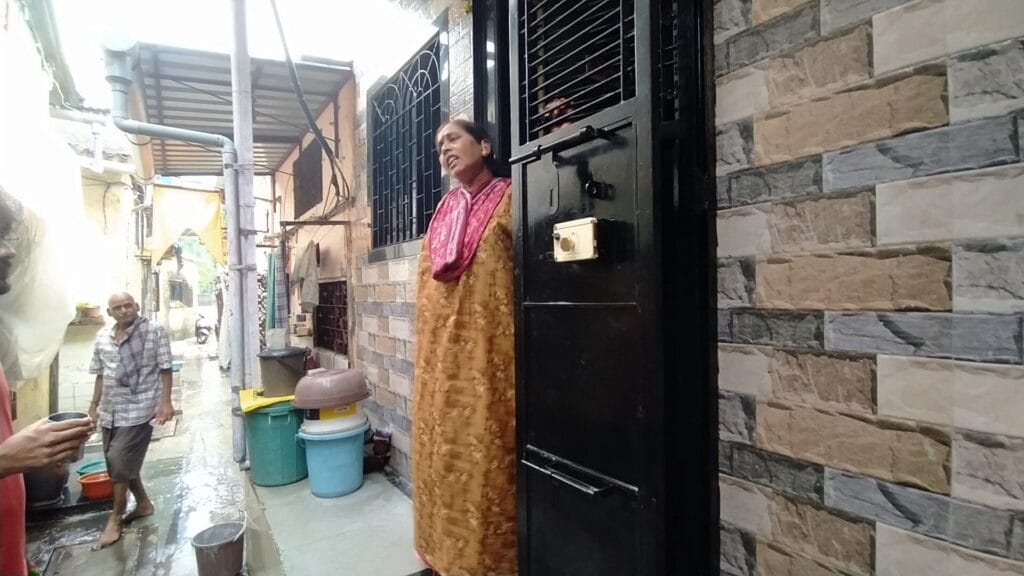
The commercial shops along DN Dube Road, which runs parallel to the Dahisar river, have also raised the level of their shops to prevent river waters from entering.
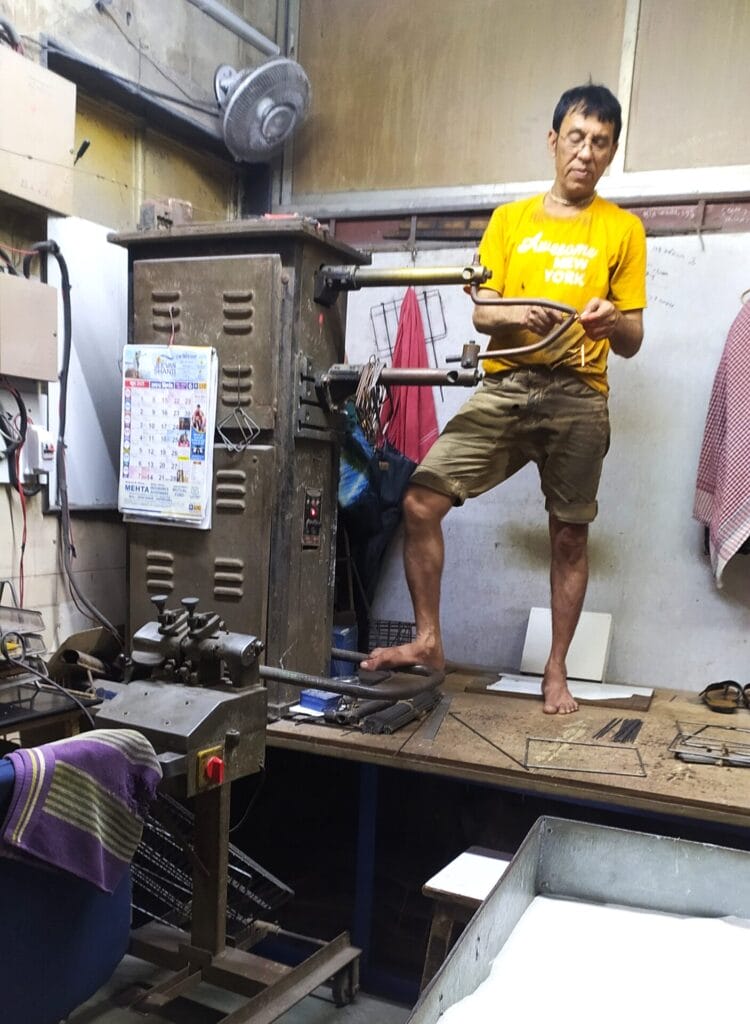
Those operating from commercial units on the Kanal Industrial Estate have devised their own strategies. Rohit Gandhi of Venus Corporation has shifted his Spot Welding machine to a 3-ft higher stand and has also kept his electrical installations at a higher level to prevent damage.
Entrepreneur Rajiv Kothari chose to shift his entire air-conditioning production unit out of the area to avoid losses due to annual floods.
Relocation, the only way out?
All those who stay close to the river shift to the neighbourhood Patidar community marriage hall, or temples, during the floods. The worst affected are senior citizens who need help moving out.
The neighbourhood too is quite familiar with the monsoons drill and turns up to offer tea, biscuits and even food during such times. “But, how long can they keep being generous and how long can we keep accepting help like this?” asks Tanubai. In times of flood, social workers also provide ration and aid, but the long queues for it are intimidating and deter many.
So, is there no way out of this? “I have seen this river since my birth and our only hope for respite from floods is rehabilitation,” observes Suraj, “Many of the people here, who had houses closer to the river, have been shifted out to areas like Jogeshwari, Malad and even Mira Road. We have filed our application for slum rehabilitation but post-COVID, the government seems to have gone silent on that.”
While uncertainty looms over their rehabilitation, what is clear is that retaining walls have failed to provide any sort of immunity against floods to the most vulnerable populations. Why that is so, and what the way forward appears to be under the circumstances, is what we shall explore in the concluding part of the story.
Also read:
- Photo essay: A look at urban settlements along the Mithi river
- Surviving the monsoon: Life in Mumbai’s coastal settlements
- As monsoon intensifies, fear grips citizens living on the banks of Poisar river