Mumbai, India’s financial capital, is admired for its fast-paced life and diverse culture, attracting many people from all over the country. However, the daily life of an average Mumbaikar revolves around managing work along with the stress of crowded trains and traffic-filled roads.
Mumbai, with over 22 million people, is getting extensive 14-line, 360-kilometer network. It is expected to increase the use of public transport, reversing a three-decade decline. The Aqua Line alone is predicted to attract 85% of commuters from using roads. It aims to ease traffic and crowded trains, with authorities promising safety, comfort, and better connections across the city.
By 2030, the Metro system is set to cover a distance nearly equal to the city’s old suburban rail and carry 11 million passengers, surpassing the current 8 million on the railways.
Navi Mumbai Metro
The first Metro line of Navi Mumbai started in the end of November this year after a nine-year delay. Instructing the City and Industrial Development Corporation (CIDCO) authorities, chief minister Eknath Shinde directed to start the Navi Mumbai Metro Belapur-Pendhar Line 1 without an official public ceremony.
Initially laid in May 2011 by former chief minister Prithviraj Chavan, the project faced multiple delays, with its original deadline of 2014 being extended several times due to contractor negligence compounded by the impact of the pandemic.
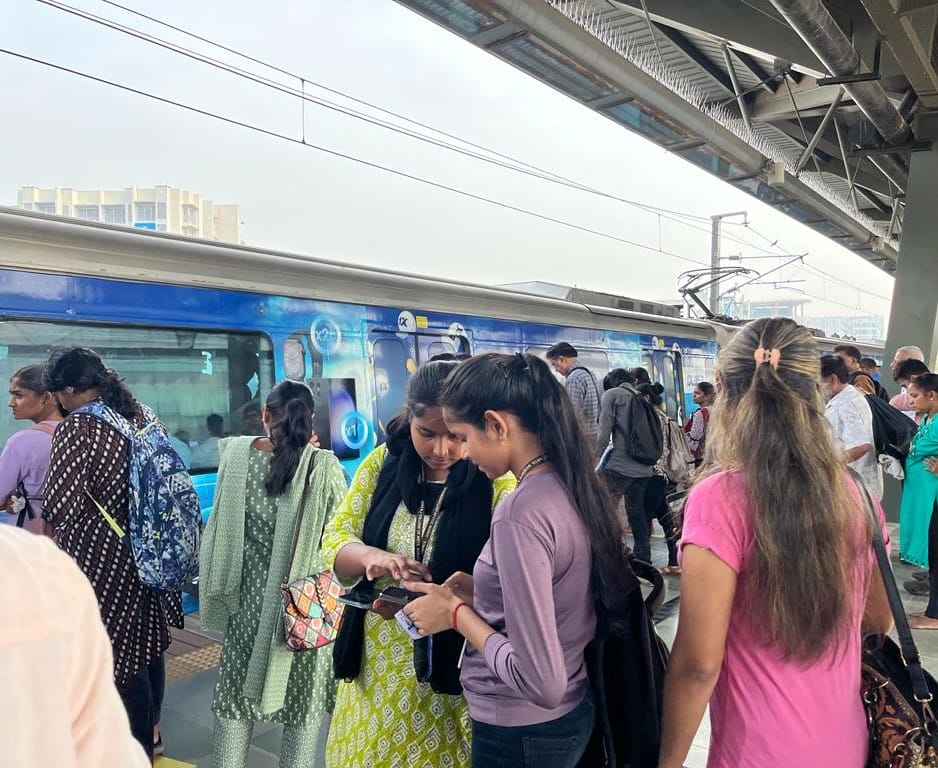
However, just days after its launch, the Navi Mumbai Metro Line 1 witnessed remarkable success, attracting over 100,000 commuters. It generated revenue of nearly Rs 39 lakh. This success of Line 1 in Navi Mumbai Metro has propelled the CIDCO to expedite the completion of the remaining lines.
Consultants are in the process of finalising the detailed project report for Lines 2, 3, and 4, which will be linked to the Navi Mumbai International Airport. The overall construction cost for all four lines is projected to exceed Rs 11,000 crore.
Read more: Increasing AC trains is cool, but reducing non-AC trains not done, say passengers
Mumbai Metro’s ambitious Aqua line
If all goes as planned, the entire 33.5 km network of Mumbai’s first underground Metro Aqua Line 3 is expected to start by 2024 connecting Colaba to Bandra and SEEPZ Village.
While significant work on Phase 1, spanning from Aarey to Bandra Kurla Complex (BKC), is expected to be completed by December, it will undergo extensive trials and testing before becoming accessible to the public, likely in early 2024. Concurrently, work on Phase 2, connecting BKC to Colaba, is going on in full swing and is expected to be operational in 2024. That would mark the opening of the entire 33.5-kilometer stretch of Metro’s Aqua line.
Preparations for Phase 1’s commencement involve nine trains, with plans for additional train sets arriving periodically. Mumbai Metro Rail Corporation Limited (MMRCL) officials noted, “Overall, 86 % of the Aqua Line’s work (encompassing both phases) has been completed.”
Previous stories:
Has the Mumbai Metro helped reduce traffic at all?
Since the start of the Mumbai metro Line 1 – between Versova and Ghatkopar through Andheri – in 2014, it has widely been considered a success. It crossed a passenger count of 25 crore people within the first 100 days, faster than any other line in the country. Before the pandemic in 2020, it had surpassed its daily ridership goal of 4.2 lakh in six years.
An updated comprehensive transport study pending, the number of private vehicles in Mumbai has only increased, sales accelerating every year. Compared to the pre-pandemic year of 2019, the first six months of 2022 saw a 28 % increase in car registrations; taking the total number to over 12 lakh. With two-wheelers, buses and trucks added, the total nears 43 lakh.
Link : https://citizenmatters.in/mumbai-metro-ridership-impact-on-cars-traffic-41689
Mumbai metro update: Now a two-year wait for the next line
Running parallel to the Western railway line and Western Express Highway (WEH) at 80 km per hour, the six-car trains with a capacity of 2,280 passengers will easily be the faster and more comfortable option for travel. Their connection to the metro Line 1 running between Andheri to Ghatkopar also opens the east-west corridor to commuters. It is no surprise then that the Mumbai Metropolitan Region Development Authority (MMRDA) expects the ridership to grow tenfold; from a daily maximum of 30,000 to 3 lakh. By 2031, it is hoped the ridership will double to over 6 lakh for both lines each.
Link : https://citizenmatters.in/mumbai-metro-update-now-a-2-year-wait-for-the-next-line-44816
Mumbai Metro progress update: What’s on the cards?
The two yellow and red lines were first proposed and approved in 2015. Construction started in 2016 with a deadline of 2019, and yet, only Phase 1 of the lines is operational today, cutting the journey short to Dahanukarwadi, Kandivali on Line 2A and Aarey, Goregaon on Line 7. The remainder will launch as Phase 2 in five-six months. August 15th is a tentative date.
Link : https://citizenmatters.in/mumbai-metro-progress-update-whats-on-the-cards-31189