The Metropolitan Transport Corporation (MTC) serves as the backbone of Chennai’s urban mobility, carrying millions of residents every day and accounting for over 70% of the city’s public transport share. As the transport utility expands its fleet with new buses and renovates shelters across Greater Chennai Corporation (GCC) limits, evaluating the accessibility of this mode of public transit becomes important, especially around access points near the city’s informal settlements.
To what extent does the MTC bus shelter network provide accessible and adequate service to slum settlements? And, where should improvements be prioritised? That forms the basis of this study, which was inspired by a problem statement given during a Chennai OpenCity datajam on public transport.
Datasets, tools and methodology
The analysis used geospatial, audit and bus shelter datasets: the GCC zone map, the slum boundaries map, bus shelter points, and draws from bus stop audit data on OpenCity. References include People Near Transit by ITDP India and the Comprehensive Mobility Plan (CMP) by CUMTA. QGIS is the GIS software utilised in this analysis.
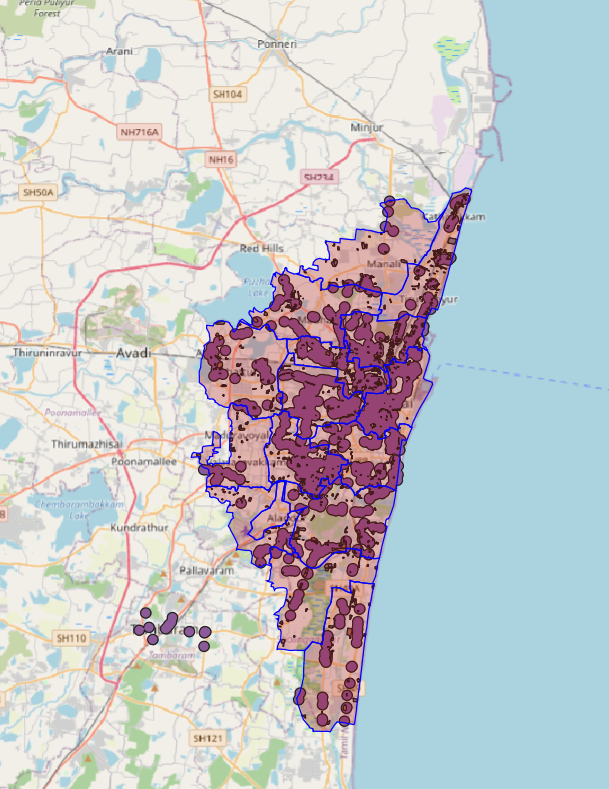
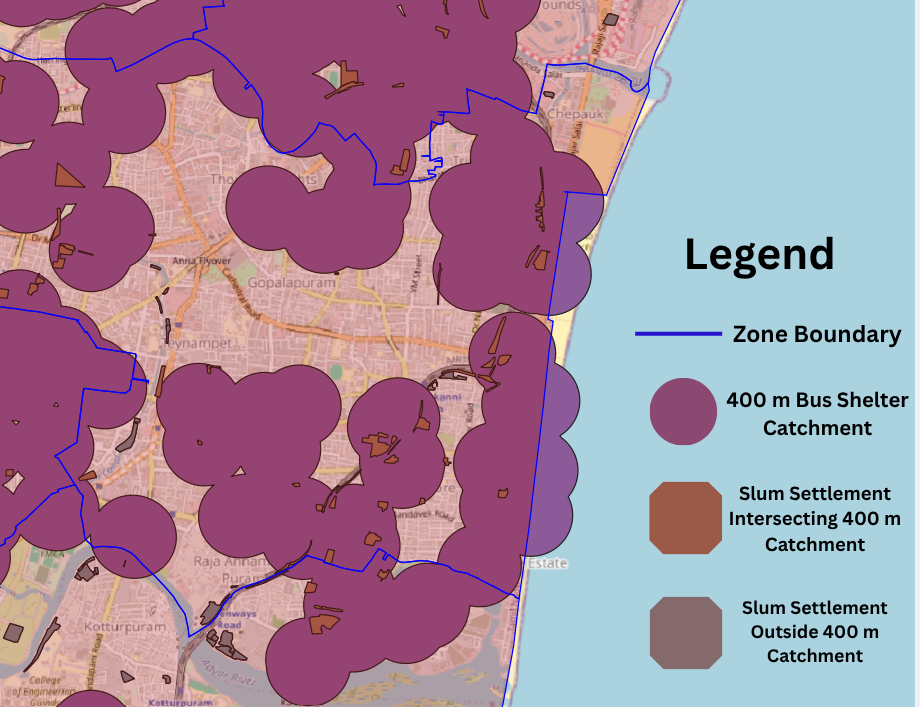
Accessibility. To identify settlements with access to an MTC shelter within 400 metres, we created a spatial catchment of that distance around each bus shelter. We then classified slum settlements based on whether they fell within or outside these catchment areas. This mapping included a total of around 800 bus shelters and 887 slum settlements.
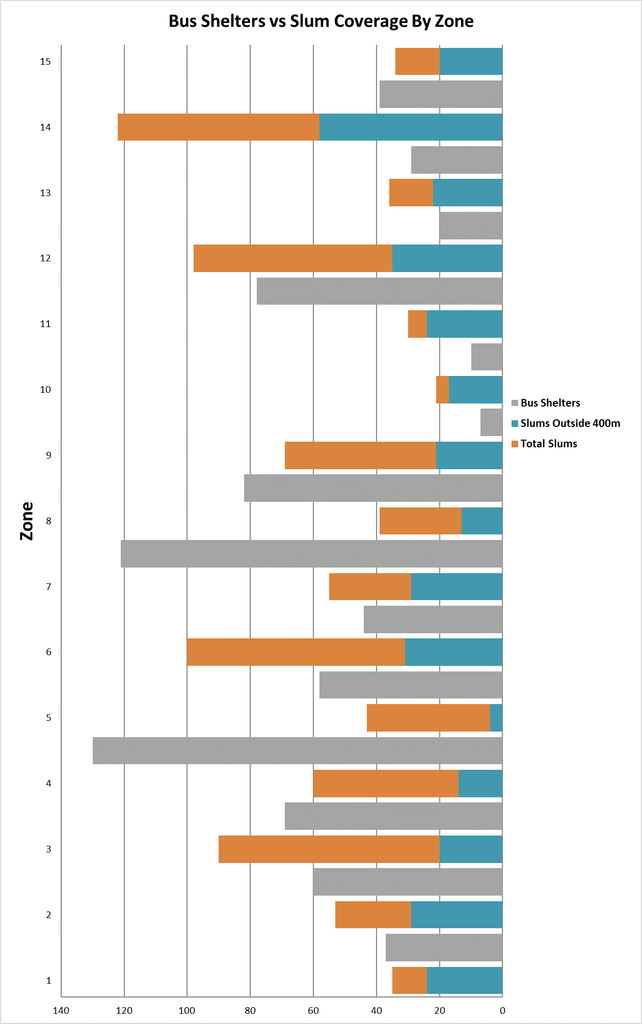
Zone-wise coverage: Zones were assessed using two equally weighted indicators: the proportion of slum settlements covered within a 400-metre catchment, and the number of bus shelters available per slum settlement. Both were normalised to a common scale and weighted 50:50 to generate a composite score, with higher scores indicating better shelter coverage and availability.
Quality: The audit records and the shelter dataset did not share a common name or ID field, so each audited bus stop was matched to its nearest bus shelter based on GPS coordinates. A match was only considered if the audited location was within 50 metres of a mapped shelter. Of 210 audited bus stops, 75 were successfully matched to a shelter within 400 metres of a slum settlement.
Limitation: A 400-metre straight-line catchment is only a proxy for accessibility. Using the actual road and pedestrian network would give a more realistic assessment, especially where roads, waterways or other physical constraints make the walking route significantly longer.
Here are the key findings of the study:
Accessibility of bus shelters
Around 41% of slum settlements fall outside the 400-metre catchment area. Assuming residents of these settlements belong to low- or middle-income households, they may not be able to afford private transit options. So, bus transit offers a sustainable way for mobility to employment, education, and essential services. Because a sizeable portion of these settlements lie beyond the 400-metre radius, expanding transit points and building new bus shelters is important to improve access.
Zone-wise coverage
| Zone | Zone Name | Number of Bus Shelters | Number of Slums | Number of Slums Outside 400m |
|---|---|---|---|---|
| 1 | MANALI | 14 | 35 | 24 |
| 2 | MADHAVARAM | 37 | 53 | 29 |
| 3 | TONDIARPET | 60 | 90 | 20 |
| 4 | TEYNAMPET | 69 | 60 | 14 |
| 5 | ROYAPURAM | 130 | 43 | 4 |
| 6 | THIRU-VIKA-NAGAR | 58 | 100 | 31 |
| 7 | AMBATTUR | 44 | 55 | 29 |
| 8 | ANNA NAGAR | 121 | 39 | 13 |
| 9 | KODAMBAKKAM | 82 | 69 | 21 |
| 10 | VALASARVAKKAM | 7 | 21 | 17 |
| 11 | ALANDUR | 10 | 30 | 24 |
| 12 | ADYAR | 78 | 98 | 35 |
| 13 | PERUNKUDI | 20 | 36 | 22 |
| 14 | THIRUVOTTRIYUR | 29 | 122 | 58 |
| 15 | SHOZHANGANALLUR | 39 | 34 | 20 |
| Zone | Zone Name | Slum settlements covered by a 400 m catchment (%) | Bus Shelters per Slum |
|---|---|---|---|
| 1 | MANALI | 31.43 | 0.4 |
| 2 | MADHAVARAM | 45.28 | 0.7 |
| 3 | TONDIARPET | 77.78 | 0.67 |
| 4 | TEYNAMPET | 76.67 | 1.15 |
| 5 | ROYAPURAM | 90.7 | 3.02 |
| 6 | THIRU-VIKA-NAGAR | 69 | 0.58 |
| 7 | AMBATTUR | 47.27 | 0.8 |
| 8 | ANNA NAGAR | 66.67 | 3.1 |
| 9 | KODAMBAKKAM | 69.57 | 1.19 |
| 10 | VALASARVAKKAM | 19.05 | 0.33 |
| 11 | ALANDUR | 20 | 0.33 |
| 12 | ADYAR | 64.29 | 0.8 |
| 13 | PERUNKUDI | 38.89 | 0.56 |
| 14 | THIRUVOTTRIYUR | 52.46 | 0.24 |
| 15 | SHOZHANGANALLUR | 41.18 | 1.15 |
The final score
| Zone | Zone Name | Final Composite Score |
|---|---|---|
| 10 | VALASARVAKKAM | 3.85 |
| 11 | ALANDUR | 7.69 |
| 1 | MANALI | 19.23 |
| 14 | THIRUVOTTRIYUR | 23.08 |
| 13 | PERUNKUDI | 26.92 |
| 2 | MADHAVARAM | 42.3 |
| 15 | SHOZHANGANALLUR | 51.34 |
| 6 | THIRU-VIKA-NAGAR | 53.85 |
| 7 | AMBATTUR | 53.85 |
| 12 | ADYAR | 57.69 |
| 3 | TONDIARPET | 69.23 |
| 4 | TEYNAMPET | 80.77 |
| 8 | ANNA NAGAR | 80.77 |
| 9 | KODAMBAKKAM | 80.77 |
| 5 | ROYAPURAM | 96.15 |
Read more: A four-hour commute: The daily transport struggles of women from Chennai’s resettlement areas
The composite scores reveal that Valasaravakkam, Alandur and Manali have relatively fewer bus shelters per slum as well as low catchment percentages within a 400-metre buffer.
Moreover, slum settlements in Tondiarpet and Thiruvottriyur have good coverage within 400 metres, but they fall into the bottom group when it comes to the number of shelters available per settlement. So, the bus network reaches these areas, but there are not enough shelters to serve the residents properly.
However, the opposite is true for Ambattur and Shollinganallur. These areas have plenty of shelters per settlement, but fewer settlements actually fall within the 400-metre radius. This means that while there are enough shelters overall, they are not located where the unserved settlements need them most.
Quality of bus shelters
A safe shelter that people, especially women, can feel comfortable accessing goes a long way towards higher use of public transport. The CMP highlights 22% of female respondents reporting harassment in public spaces, including transport modes. Only one bus stop (Meenakshi College on Arcot Road, Kodambakkam) in our scope has a functioning CCTV camera, while 11 others surveyed were poorly lit and isolated.
Further, 72% of bus stops lack adequate seating. Only two stops offer drinking water (MKB Nagar and KMC Hospital) and two feature public toilets (Brindha Theatre and Thiruvanmiyur Depot toward Gandhi Nagar) within eyesight, while 16 have digital boards with real-time arrival information.
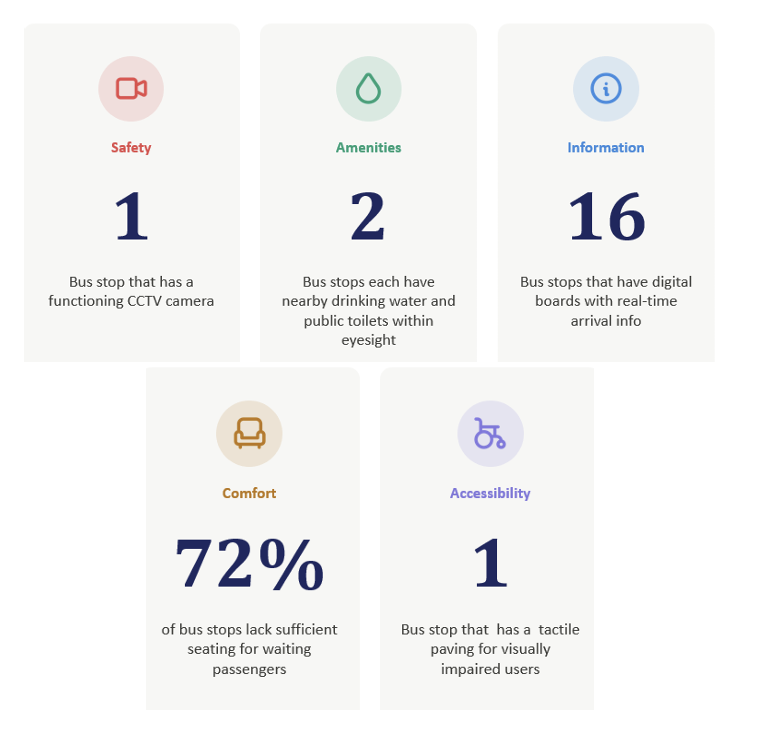
Accessibility for persons with disabilities is another concern. Only 17% of bus stops within this catchment have a ramp for wheelchair access, and of these only half are in usable condition. Only one bus stop has tactile paving for visually impaired users making the access near impossible for these people residing in the slum settlements. Many of these bus stops are difficult to access, even for able-bodied people. Around 75% of stops have some form of encroachment, such as vendors or parked vehicles, and lack safe pedestrian crossings.
This highlights a broader systemic issue where roads are not planned with people in mind. Road space allocation is prioritised over the needs of pedestrians, which results in significant safety risks across the city and state.
According to data from the Ministry of Road Transport and Highways, Tamil Nadu accounted for the highest number of reported pedestrian fatalities in 2024. While the facilities mentioned earlier are provided inside all metro stations, the environment changes as soon as commuters step outside onto the street. A uniform experience can encourage commuters to use public transit across their entire journey.
Recommendations and the way forward
- Prioritise the lowest-scoring zones: Valasaravakkam, Alandur and Manali should get adequate attention while planning new fleet routes and constructing bus shelters.
- Plan placement of shelters: Zones such as Tondiarpet and Thiruvottiyur need more shelters within the existing network, while underserved settlements in Ambattur and Sholinganallur must get more shelters.
- Address safety, accessibility and encroachment. Remedial measures such as CCTV, lighting, seating, usable ramps, tactile paving and clear pedestrian crossings are desirable, along with enforcement against encroachment and parking.
- Ensure new investment reaches underserved areas. Despite an 18% population increase near bus stops since 2011 (according to the CMP), a stagnant fleet has forced commuters to use personal vehicles. The MTC’s procurement of over 2,000 low-floor buses and a ₹500 crore depot upgrade offer an opportunity: directing these investments to underserved areas can ensure a safe, inclusive, and accessible transit system.
- Strengthen future analysis. Future scope involves utilising the actual road and pedestrian network to measure walking distance and travel time, and add population density by zone, so that priorities reflect the potential population served.