Saidapet, one of Chennai’s most historic and politically significant constituencies, enters the 2026 elections with a mix of legacy importance and persistent civic frustration. Once represented by leaders like M Karunanidhi, the constituency today reflects the pressures of dense urban living—ranging from river-adjacent flooding risks to infrastructure strain.
Saidapet Assembly Constituency is part of the Chennai South parliamentary seat. It includes key areas such as Guindy, Kotturpuram, Nandanam, and Jafferkhanpet.
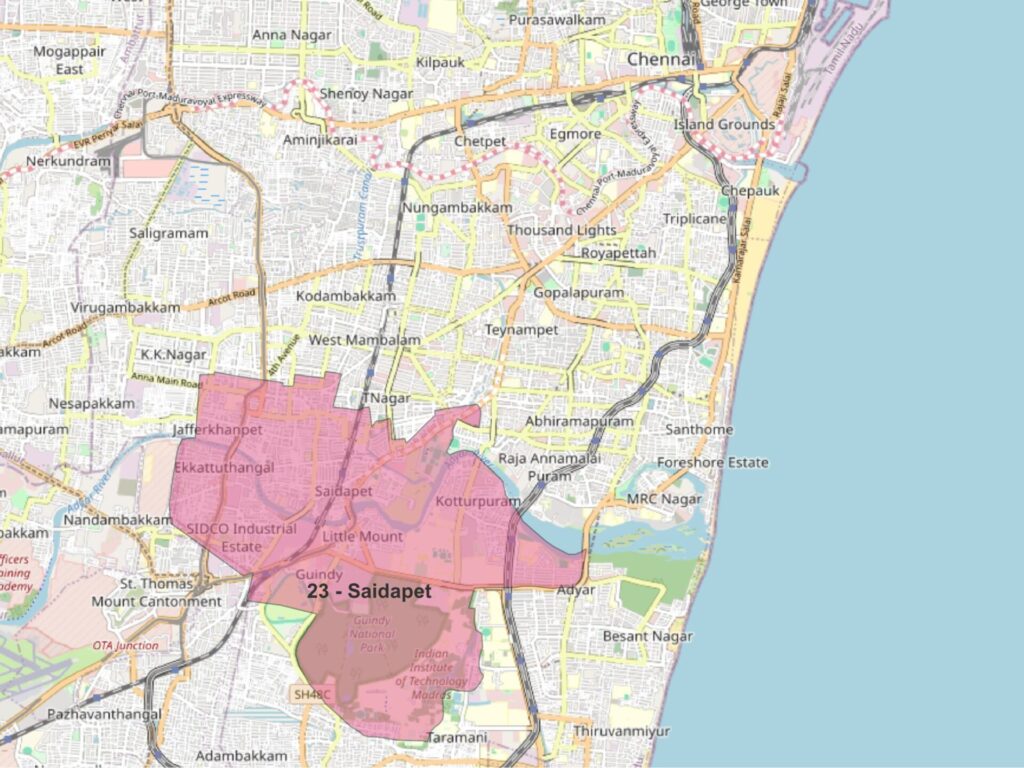
Map showing the Saidapet Assembly constituency. Pic courtesy: OpenCity.in.
Political Representation
Saidapet is a general constituency.
Candidates for 2026 polls
After the SIR, Saidapet has over 2 lakh voters. Around 15 candidates are contesting for Saidapet, with Dravida Munnetra Kazhagam, Naam Tamilar Katchi and Amma Makkal Munnettra Kazagam in the fray. The current Health Minister Ma Subramanian, who has held the constituency since 2016, is hoping to make a comeback. If voted back, he said he will focus on healthcare and resettlement. NTK is fielding candidate Srividya G.
Meanwhile, the Tamilaga Vettri Kazhagam (TVK) is fielding M Arul Prakasam who said, if elected, he would focus on issuance of land titles, and creating a drug-free Saidapet. A campaign-related law and order incident was reported where the candidate’s convoy was attacked.
Top candidates
| 2026 | Candidate | Sex | Party | Age | Link to Affidavit |
| 1 | SUBRAMANIAN MA | Male | DMK | 66 | Download Here |
| 2 | ARUL PRAKASAM M | Male | TVK | 44 | Download Here |
| 3 | SRIVIDYA G | Female | NTK | 46 | Download Here |
All candidate details can be found on the portal of the ECI here.
2021 polling snapshot
- Total number of voters: 2,69,884
- Male voters: 1,32,819
- Female voters:1,37,065
- Others: –
- Polling percentage:1,59,169 (59.4%)
Source: Election Commission of India
Previous results: 2021
| 2021 | Candidate | Sex | Party | Age | Votes polled (Share of vote %) |
| 1 | MA Subramaniam | Male | DMK | 61 | 80194(50.02%) |
| 2 | Saidai Duraisamy | Male | AIADMK | 69 | 50786(31.68%) |
| 3 | Snehapriya | Female | MNM | 29 | 13454 (8.39%) |
Source: Election Commission of India
Previous results: 2016
| 2016 | Candidate | Sex | Party | Age | Votes polled (Share of vote %) |
| 1 | Ma Subramaniam | Male | DMK | 56 | 79279(48.2%) |
| 2 | C Ponnayian | Male | AIADMK | 74 | 63024(38.3%) |
| 3 | V Kalidas | Male | BJP | 51 | 6000(3.7%) |
Incumbent MLA: Ma Subramanian
Ma. Subramanian is a senior DMK leader and the current Minister for Health and Family Welfare of Tamil Nadu (since May 2021). A seasoned politician, he previously served as the 47th Mayor of Chennai (2006–2011) and is a two-term MLA representing the Saidapet constituency. He joined the DMK in 1976 and also serves as the party’s Youth Wing Deputy General Secretary.
MLA profile
Age: 66 years
Educational qualification: Holds a BA degree from University of Madras and LLB from Bangalore University.
Contact details:
- Phone – 7550299999 / 9176700000
- Email – masubramaniandmkcs@gmail.com
Criminal records:
- charges related to Forgery for purpose of cheating (IPC Section-468)
- charges related to Cheating and dishonestly inducing delivery of property (IPC Section-420)
- charges related to Punishment of criminal conspiracy (IPC Section-120B)\
Social media presence:
- Facebook: Subramanian.ma
- X: Subramanian_ma
- Instagram: @ma_subramanian
Source: myNeta
MLA in the media
Ma Subramanian highlighted key development works executed in the constituency, including the installation of high-mast lights under the Tamil Nadu Urban Development Fund, and the construction of a new Chennai Primary School building on Bazaar Road.
He also pointed to welfare initiatives such as a Rs 40 lakh workers’ rest facility in Ward 142 and distribution of 216 ryotwari pattas to residents across 21 streets under the Gramanatham category.Infrastructure upgrades, including additional classroom blocks and improved lighting, were also cited. Subramanian further referred to the ongoing 3.2 km elevated corridor project from Saidapet to Teynampet, being executed.
Key citizen demands
Chronic flooding, ageing drainage systems, and relentless traffic congestion continue to disrupt daily life, especially in internal pockets. Voters in Saidapet have expressed dissatisfaction over the rising availability of ganja among youngsters, irregular functioning of Tasmac outlets, and persistent civic issues such as poor drainage, traffic congestion and inadequate public amenities, even as several infrastructure projects progress in the constituency.
The residents living along the Adyar river and canal complained of an increasing mosquito menace due to untreated sewage inflow. Citizens seek relief from unregulated parking and street hawkers causing traffic congestion.