The KEB Junction on 27th Main Road in HSR Layout highlights a typical urban planning failure. The junction prioritises vehicle movement over pedestrians. Resident Sachin Pandith, along with the HSR Community Task Force, has been working to address these issues and make the area safer.
According to Sachin, residents have been engaging with officials and filing complaints for more than five years, yet nothing has changed. Encroached footpaths, unclear signage, and unsafe pedestrian crossings have created a hostile environment for walkers. In addition, the poorly located bus stop leaves little space for buses to halt, often turning the stretch into a traffic bottleneck.
The HSR KEB junction is just one example. Across the city, many public spaces fail to serve their purpose. Encroached footpaths, poorly maintained parks, and unsafe market areas make them inaccessible to people. Spaces that could be developed as blue-green infrastructure, such as the edges of kaluves, remain unused. Traditional public spaces such as kattes are also losing their charm and role in community life.
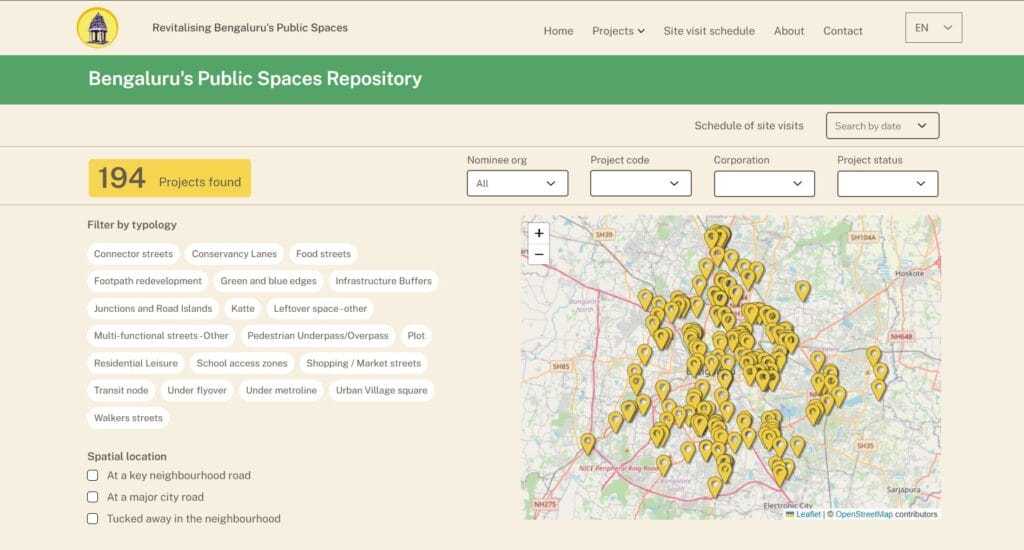
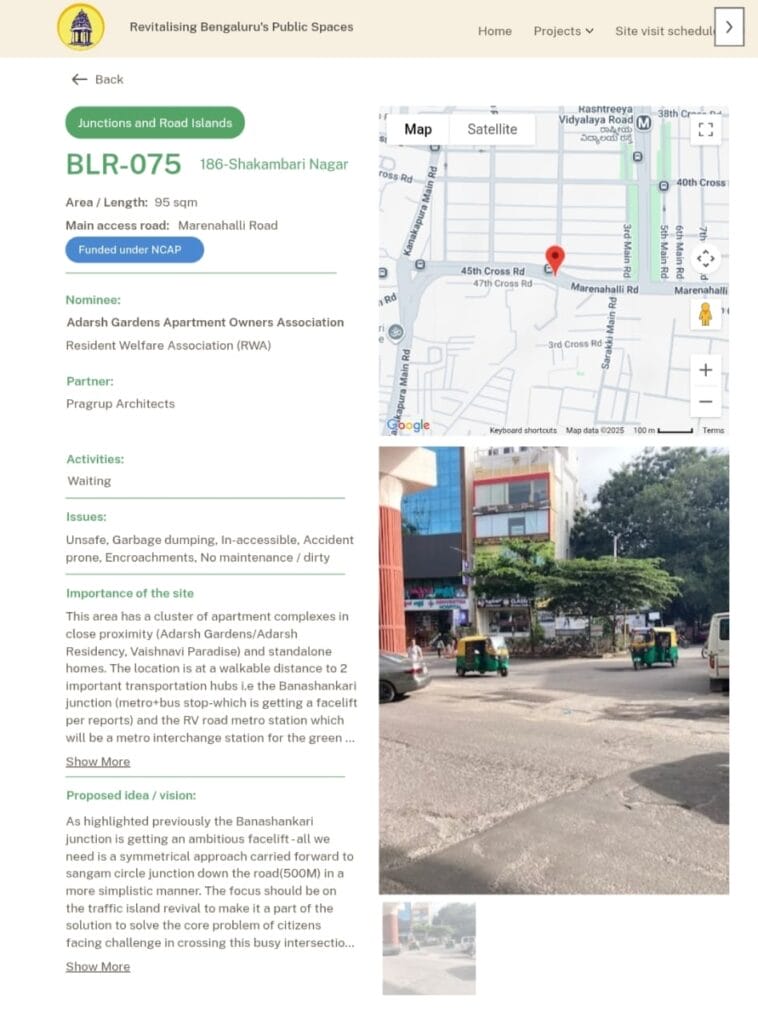
What were once just citizen observations of these lapses have now been compiled into a dedicated repository. Through citizen participation, this initiative, called ‘Revitalising Public Spaces’, has identified 194 sites that need urgent attention and upgrades. It gives people the chance to get involved and reclaim their neighbourhoods by helping plan improvements to these spaces.
A transparent repository
Bengaluru citizens, Resident Welfare Associations (RWAs), community organisations, educational institutions and NGOs nominated the spaces included in the repository. Out of 234 nominations, 194 were selected.
A total of 27 projects have been funded under Administrator Grants, ACS, and the National Clean Air Programme (NCAP), with ₹53.60 crore allocated so far. These areas will undergo major infrastructure improvements like repairing footpaths, redesigning junctions, rebuilding damaged kattes, creating permeable pavements, and planting trees along blue-green edges.
Currently, the team is verifying the sites to check feasibility, confirm land ownership, and plan the development accordingly. “As the funds start coming in, we will implement the project,” says Hemalatha, Superintending Engineer for Planning and Coordination at the Greater Bengaluru Authority (GBA).
Hemalatha adds that the repository website was designed to be transparent, acknowledging that not all nominated spaces can be taken up immediately. “Projects will be prioritised based on how the funds flow. The idea was to ensure that the inputs received are not wasted and that the entire process remains transparent.”
Who is involved
While citizen participation is key, the GBA initiative is supported by
- Sensing Local: An ‘urban living lab’ focusing on improving the urban environment.
- Institute of Urban Designers: An association of urban design professionals, academicians and practitioners
- Sustainable Mobility Network: Coalition of organisations working to bring sustainability at the centre of transport and mobility planning in India.
- Bengaluru Ward Samithi Balaga: A citizen coalition to strengthen and institutionalise the ward committees.
“The team also has 14 members from ten organisations, including Biome Trust, MOD Foundation, WELL Labs, and WRI India, among others, in its working committee,” says Ankit Bhargava, Co-founder at Sensing Local.
Read more: Bengaluru’s footpath crisis: What would it take to improve journeys on foot?
Promoting departmental coordination
The KEB junction that has been a major concern for HSR Layout residents, including Sachin, is among the 194 spaces. Volunteers from the Community Task Force accompanied Sensing Local during the site verification. “We have shared our concerns, ideas and vision for the junction,” says Sachin, adding that even small fixes are hard because departments pass responsibility. “Something as basic as a bus stop sign becomes a back-and-forth between departments.” Sachin believes this programme will unite efforts.
“We are working to build an SOP for each type of public space. Eliminating the ad-hoc fixes, this SOP will fix the ecosystem around such infrastructure projects,” Ankit says. The studies and metrics that need to be evaluated will be included in the SOP. “For example, if you redesign a food street, how do you do it without pushing vendors out or creating parking problems?” This, he said, requires basic groundwork, which the SOP will facilitate.
Why citizen involvement is important
Further, the SOP will make citizen participation compulsory. “Since communities were involved in the nomination, they have to be part of the process and bring all the stakeholders together. That’s how ownership comes in,” Ankit points out.
What residents will do:
- Identify the spaces and their problems.
- Participate in site visits and audits.
- Discuss a shared vision to improve the space.
- Suggest funding opportunities.
- Track and monitor progress.
- Join smaller tasks like clean-ups.
- Ensure ownership of the spaces.
- Follow up on development activities.
“People have dealt with the problems at these sites for five years or more. It only makes sense to include them at every step,” Ankit adds. “So many people want their neighbourhood to be a little better.” The programme allows both small and large ideas to take shape—from conserving a katte to redesigning spaces under flyovers. For many, this is their first civic engagement. “If communities see this as a space to speak up and participate, there’s nothing like it,” says Ankit.
Sachin also feels that the problems in different localities are varied, and while experts know about fixing them, only local communities will have the lived experience. “And that’s why we ensured that residents participated in the site visit to identify issues.
“There was good citizen participation in the nomination process, and we plan to continue with it,” Hemalatha says.
Collaborating for change
Shanish VN, Project Officer at Evangelical Social Action Forum (ESAF), a non-profit organisation working on urban development, says, “For a collaborative programme like this, community involvement is very important.” ESAF has nominated 10 spaces under the Revitalising Public Spaces programme.
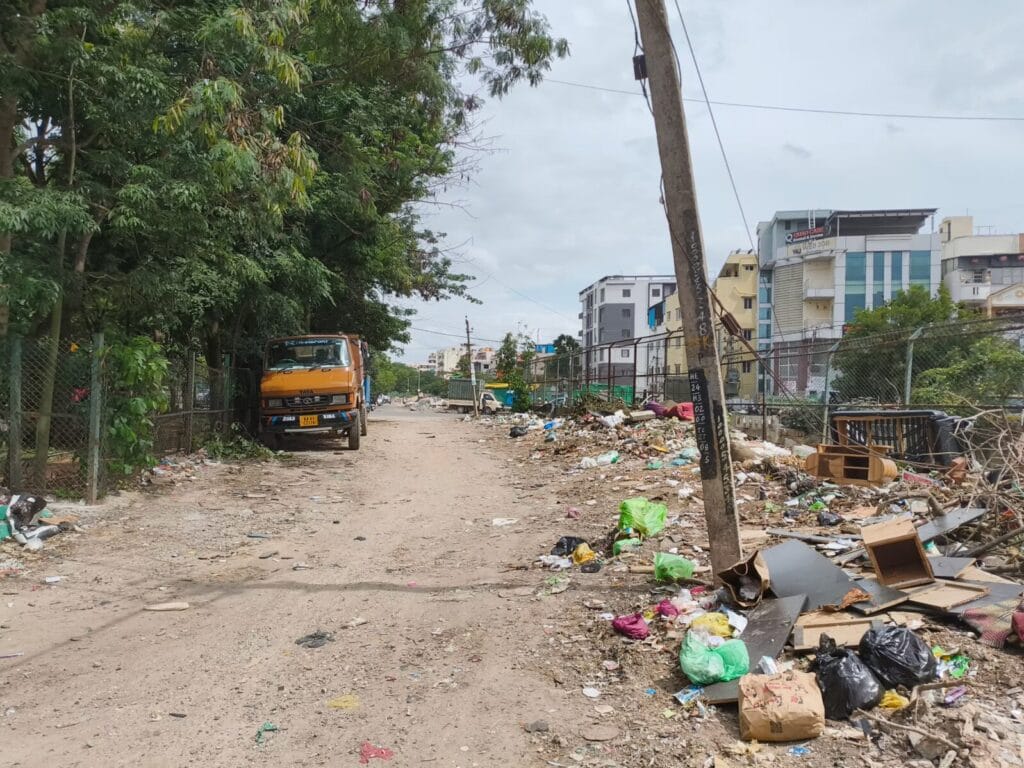
Prasanna Kumar, HBR Layout resident and Karnataka Vice-President of the Confederation of Residents Welfare Associations (CoRWA), worked on two nominated spaces — a neglected park and an unsafe roadside stretch. “Commercial vehicles are parked on all sides of the park, making it inaccessible and unsafe. Today, even walking for half an hour becomes stressful because the surroundings are hostile,” he says. On the stretch near 80 Feet Road, he adds, “That road became an alienated place; no vehicles, only garbage, dead animals, and dumping, and now frequented by people smoking and using drugs”.
Following persistent citizen efforts, GBA conducted a clean-up. “However, we need a permanent solution,” Prasanna adds. He joined detailed site verification with the Sensing Local team to ensure all the problems were documented. Emphasising citizen participation, he says, “Authorities take complaints seriously only when citizens are willing to step forward, attend meetings, and collectively own the problem.”
Future plans
Going forward, all the sites will be verified and turned into projects that can be taken up by the city corporations or CSR works. Sharp and precise information on priority intervention will be formulated. “A calculator will become a part of the already existing website, which will allow community members to estimate the budget requirements for each of the projects,” says Ankit. A public exhibition is also being planned at the end for February 6th and 7th, 2026. This public event aims to open up this programme to invite philanthropies and CSR funds for future projects as well.
Read more: Bengaluru: A comprehensive solution for decongesting the Hosur-Sarjapura Road junction
“As an organisation that advocates for more inclusive and green spaces, we wanted to connect communities with the programme. The outcome of this is multifold; the communities’ perception of public spaces changes through interactions, they get more engaged and the spaces get developed,” Shanish notes.
You can explore the digital repository and support the projects in your neighbourhoods through volunteering, funding, designing and more.
How can communities contribute to such infrastructure projects?
- Identify everyday problems and safety risks based on lived experience.
- Nominate public spaces and document what is not working.
- Take part in site visits and surveys with project teams.
- Share local knowledge on vendors, users, peak hours, and access needs.
- Help bring together residents, shopkeepers, vendors, and officials.
- Support small actions like clean-up drives and temporary fixes.
- Monitor work on the ground and flag gaps or delays.
- Stay involved after the project to help maintain the space.