In June 2025, Tamil Nadu’s Chief Minister referred to the demolition of ‘Madrasi Camp’ in Delhi as a “humanitarian crisis,” calling for basic amenities, transport support, and dignified resettlement. Yet, across Chennai and Tamil Nadu, evictions and resettlement continue. These actions often deprive marginalised urban communities of their dignity, rights, and safety due to the lack of a strong policy.
One recent example that illustrates these contradictions is the forced eviction of families from Anakaputhur to the remote and poorly connected site of Keeraipakkam, where women and children struggle to access work and school. This reflects a wider, ongoing pattern of displacing communities to isolated areas without adequate support.
A pattern of displacement
Research by the Information and Resource Centre for the Deprived Urban Communities (IRCDUC), a Chennai-based NGO, shows that over 70,000 families have been evicted in Chennai since the 1990s. Of these, 22,234 were displaced after the December 2015 floods. In the past three years alone, another 9,724 families across Tamil Nadu have been evicted, primarily under the guise of slum clearance, infrastructure projects, and environmental restoration.
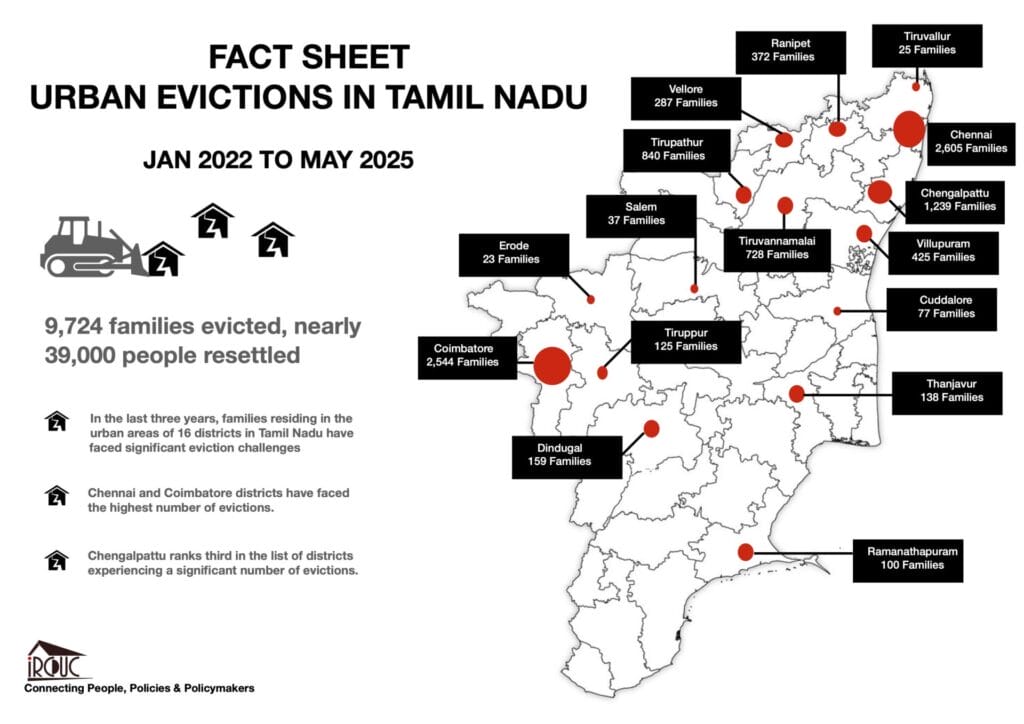
These families are often relocated to peripheral areas, reinforcing socio-spatial segregation rather than offering equitable development.
In June 2025, IRCDUC’s report Revisiting Urban Resettlement and Rehabilitation (R&R) in Tamil Nadu called attention to implementation gaps and recommended a more inclusive and just R&R system.
Policy shifts: From in-situ upgradation to peripheral resettlement
Tamil Nadu once prioritised in-situ upgradation. From 1952, the focus was on improving settlements instead of clearing them. However, from the 1990s, this shifted to mass resettlement on city fringes.
A 2005 study by the Tamil Nadu Urban Habitat Development Board (TNUHDB) found that resettlement was ten times more expensive than upgrading. Yet, the state continues to favour relocation, often citing land shortages.
Under the Rajiv Awas Yojana (2013–2022), cities were meant to map vacant land to support in-situ solutions. Chennai did not follow through, reflecting weak political will.
Instead, the state constructed 11 large resettlement sites in the Chennai Metropolitan Area, with 82,435 housing units. About 67,500 of these have been allotted to 2.69 lakh people from low-income and informal settlements.
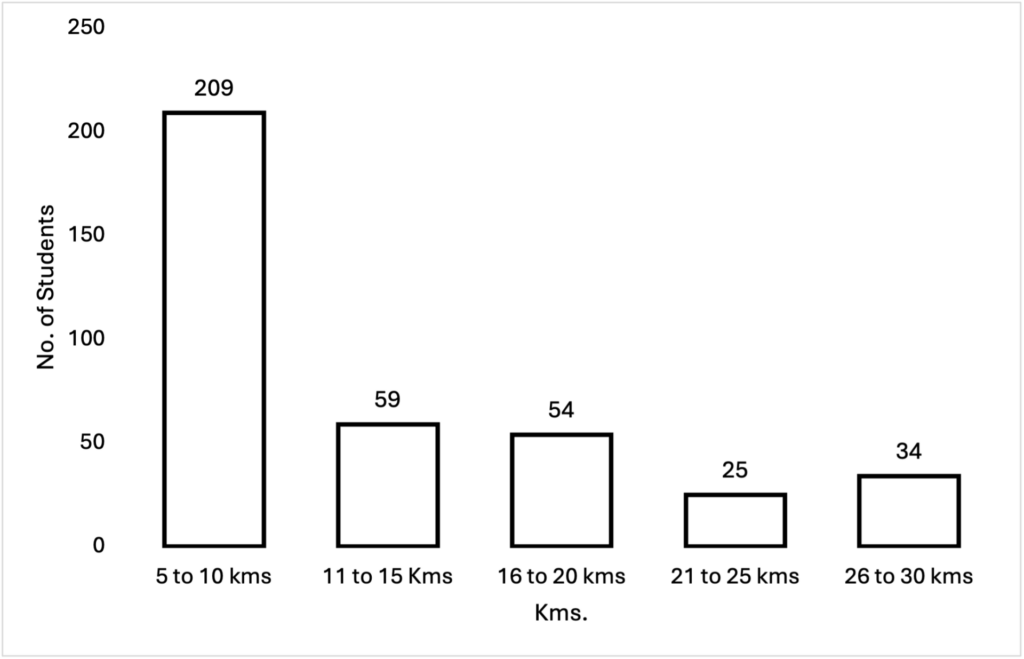
These remote locations overlook the fact that most residents of informal settlements rely on nearby jobs, 78.47% walk to work (as mentioned in the Second Master Plan), making relocation a direct threat to their livelihoods. Resettlement has also disrupted access to education, healthcare, and basic services, while severing social networks that communities rely on. Evictions during the school year have made matters worse, with some children now travelling 40 to 50 kilometres each day to attend school.
While these numbers seem significant, the shift from in situ to peripheral resettlement has only deepened people’s vulnerability.
These hardships remain invisible in the absence of proper assessments and planning prior to displacement.
Read more: Chennai’s decades-long policy failure to address housing issues of the urban poor
Largely ignored social impact assessments
Without reliable data and structured planning, the human costs of eviction are neither documented nor addressed, making the need for comprehensive Social Impact Assessments (SIAs) more urgent than ever.
Between 2015 and 2025, only 5 out of 95 evicted settlements in Chennai underwent SIAs. These assessments are critical for understanding the socio-economic effects of displacement and planning mitigation strategies.
With 95% of settlements excluded, the TNUHDB lacked essential data to support those affected. As a result, many housing sites do not have schools, transport links, or livelihood support.
Post-resettlement impact assessments, funded by the Chennai Rivers Restoration Trust (CRRT), have focused only on families relocated under CRRT projects, leaving others out. This selective monitoring worsens systemic neglect.
Discriminatory practices in R&R implementation
Access to housing and compensation is often determined by politics, people’s ability to protest, or media attention rather than clear policy.
For instance, families from the Adyar River in Chennai were given free housing at the Navalur site, but others from Kancheepuram, resettled in the same block, had to pay.
In 2024, families evicted from Retteri and Villivakkam received no housing, while those from Annai Sathya Nagar were resettled nearby. In 2025, over 300 homeless families received a one-time payment of ₹25,000 and still await housing.
Women-headed households, persons with disabilities, and SC/ST communities face the harshest outcomes. Two women-headed families resettled in Perumbakkam paid ₹74,000 each but now face eviction due to arrears, despite ongoing appeals to the authorities.
Resettlement sites built on flood-prone/hazardous zones
Many resettlement sites are in flood-prone, hazardous, or industrial areas. For example, 6,877 homes near Ennore Thermal Plant were built on land reclassified from hazardous to residential use, despite pollution concerns. The framework lacks binding land selection criteria to avoid such environmental risks.
Poor location choices lead to long commutes, ghettoisation, and increased risks for vulnerable groups. Even near the IT corridor in Perumbakkam or Semmenchery, residents struggle with job mismatches and lost livelihoods.
Read more: School, interrupted: The toll of mid-academic year evictions on children in Chennai
Inconsistent frameworks and a lack of coordination
Tamil Nadu lacks a unified, enforceable R&R policy. TNUHDB’s 2023 framework was created without public consultation process and remains an internal document. Other departments follow their own guidelines.
While international projects must follow safeguards like SIAs and Resettlement Action Plans (RAPs), state-funded or court-ordered evictions often bypass them.
The framework also sets a cut-off date of January 1 2018, excluding many families from benefits. The framework also ignores court-ordered evictions, although the Madras High Court (2014) clarified that the mode of resettlement lies with the government.
Therefore, it is suggested that the existing R&R framework should be strengthened to avoid discriminatory practices and ensure universal application of the safeguards beyond projects or funding or citing court orders.
Strengthening the R&R Policy: Key recommendations
- Make the framework binding and universal across all departments, projects, and funding sources.
- Prioritise in-situ or nearby resettlement within a 5-kilometre radius; replace vague terms like “reasonable distance.”
- Withdraw the 2018 cut-off date, which disqualifies many families unfairly.
- Publish clear SOPs for all types of evictions, including court-mandated ones.
- Conduct robust SIAs and RAPs before evictions, with data on education, health, and livelihoods.
- Clarify R&R committee roles and make them transparent.
- Ban evictions during school terms and examinations.
- Guarantee a basic support package for every family: housing, transport, subsistence, and education access.
- Avoid hazardous locations and mandate inclusive, safe, and gender-responsive design.
- Ensure public consultation with affected communities, civil society, and workers’ groups.
Tamil Nadu’s current approach to eviction and resettlement remains fragmented and unjust. Without a rights-based, enforceable policy, the most vulnerable will continue to suffer without protection or dignity.
A just city demands more. Strengthening the R&R framework is not optional; it is a moral and constitutional imperative.