Over the past few years, maths teacher Usha found her classroom sweltering during her usual 12.50–1.50 pm period, on the second floor of Perunthalaivar Kamarajar Government Girls Higher Secondary School. “It was so difficult to take class during the peak hours,” she says. But this year, she mentions that it feels slightly bearable, and attributes this to the shade of the trees, the wind blowing through the building, and the latest addition — solar-reflective paint on the roof.
Data from a state government and UNEP Cooling pilot project at the Ambattur school shows that reflective coating brought the classroom’s internal temperatures down by three to four degrees, from around 31–32°C to 26–28°C (mapped on a wet-bulb thermometer), according to news reports. Around 3,206 sq m of roof area across six academic blocks of the Ambattur school were covered with paint at a Solar Reflective Index of 101, as part of a pilot project by the state government and UNEP Cooling. “We wash the roof, prime it, and put three coats of this paint, which is estimated to last for three years. It costs ₹60 to paint one square foot,” says a forest department official, who preferred to be anonymous.
The cool roof initiative – envisioned by the former Additional Chief Secretary in the Department of Environment, Climate Change, and Forest, Supriya Sahu – is being rolled out in 55 schools in Chennai, say education department officials. So far, 10 schools have been equipped with the SRI paint, they say.
The cool roof project is in collaboration with the UNEP Cool Coalition, Tamil Nadu Green Climate Company (TNGCC), United Nations Environment Programme (UNEP), Swiss Agency for Development and Cooperation (SDC), technical partner Auroville Consulting, and is funded by the BeCool project.
Battling heatwaves with passive cooling methods
Tamil Nadu recognised heatwaves as a state-specific disaster in 2024. This August, the Ministry of Home Affairs officially included heatwaves in the list of notified natural calamities as well. With Chennai experiencing heat wave-like conditions in May, El Niño (climate patterns in the Pacific Ocean that can affect weather) and climate change, solutions are the need of the hour.
Read More: Brace for super cyclones, heatwaves, empower citizens to be prepared: Professor Ramachandran
Across Chennai, temperatures have been rising, with May temperatures soaring to 37–39 °C and warm nights around 24–26 °C with 70–80% humidity, according to a government study titled Mainstreaming Passive Cooling in Green Schools. From Ennore to Thiruvanmiyur, government school teachers told Citizen Matters that they noticed hotter summers this year and these temperatures impeded students’ productivity and play during the afternoon periods.
In areas like Ambattur, neighbourhoods witness frequent power cuts, spikes in air pollution, traffic, and heat owing to its proximity to more than 2,000 industries, says Meena, a social science teacher at the Ambattur school. “In government schools like this, we cannot afford air conditioning, and we have only two fans for a large classroom,” she adds.
Before the passive cooling initiative, the Ambattur school experienced high roof-related heat, with indoor temperatures reaching 31–32°C and ceiling surface temperatures of 33–35°C during peak school hours, according to the government study.
What is passive cooling?
Passive cooling is an architectural approach that involves cooling a building without using electricity or any active energy input. white paints reflect sunlight back into the atmosphere and are designed to reflect up to 80% of incident radiation, decreasing heat absorption by building surfaces, says the Tamil Nadu Cool Roof Standard Operating Procedure (SOP).
Envisaging a green school
This cool roof initiative is part of the larger Green Schools programme, now being rolled out in 300 schools in Tamil Nadu. Around `20 lakh has been earmarked for each government school to equip them with infrastructure under the overall Green School Scheme, according to a government order.

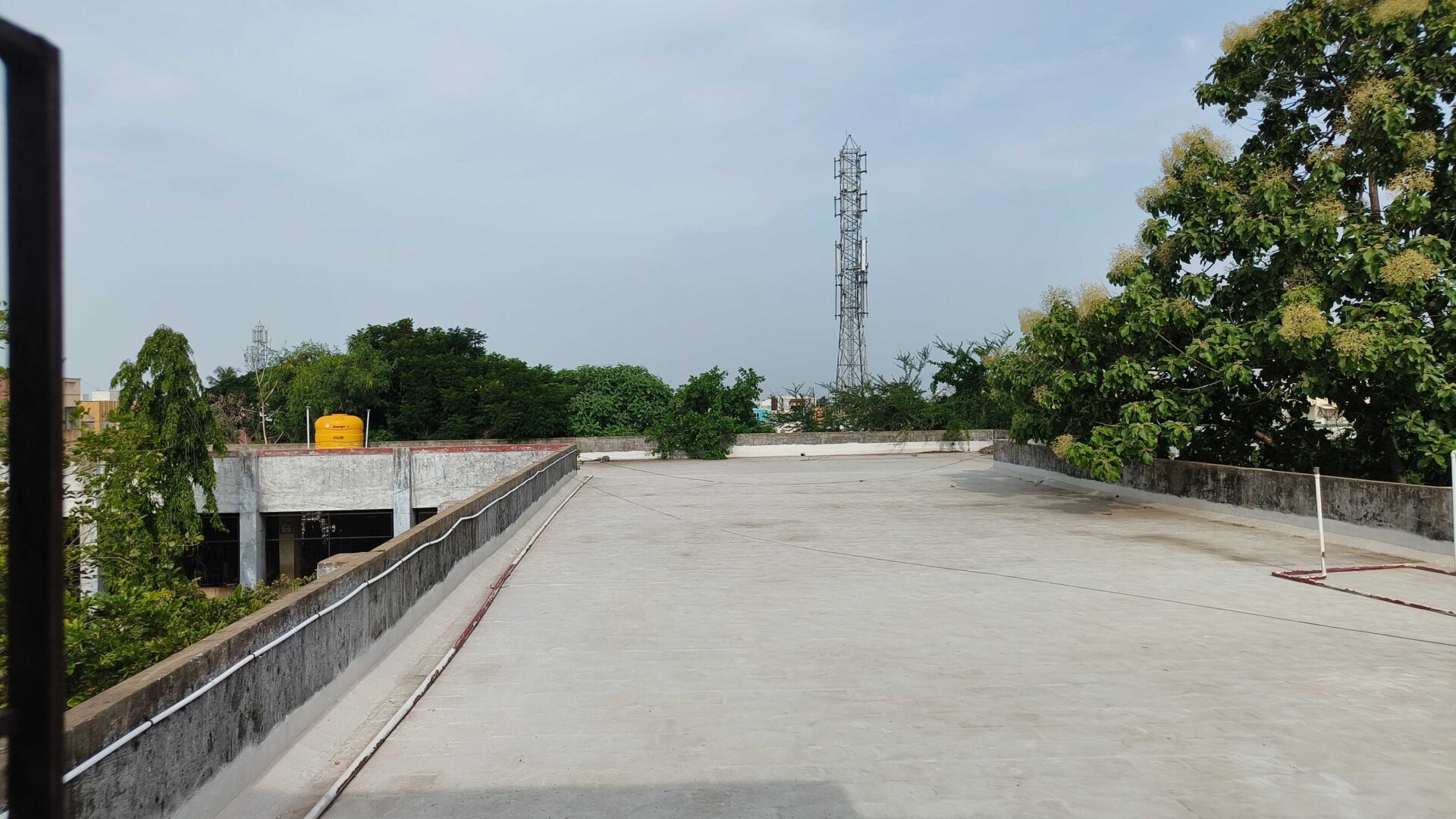
Beyond cool roofs, other passive cooling methods are included, which integrate rooftop solar panels, rainwater harvesting, drip irrigation, waste segregation, along with garden spaces, to build climate-resilient school infrastructure, based on the requirements of individual schools. Other methods include photovoltaic systems, herbal gardens, and borewells.
“We also give training to students and teachers on how to take care of the cool roof, and create awareness about these methods,” says an official. The green spaces developed on campuses are also expected to improve the school environment and provide the students opportunities to engage with nature.
According to education department officials, these methods will help bring down temperatures by four degrees, and this will result in a 30-40% monthly reduction in electricity bills. An analysis of electricity expenditure across 49 schools in the State, under the Green Schools project, showed an average 46% reduction in grid electricity use after rooftop solar installation, found news reports. Here, monthly consumption dropped from 607.7 kWh to 328 kWh per school. If extended to all government schools, the study estimates that electricity savings may offset up to 91% of the current power consumption of government schools.
So far, the elements of this project are being rolled out in a phased manner across schools. “At a building level, other changes that can be identified are the number of windows and insulation, and architectural plans,” say officials.
How do cool roofs work?
In wards with high heat that had low green cover, and more buildings, passive cooling methods (such as cool roofing) could reduce indoor temperatures by 2–5°C, improving comfort and reducing energy bills, a government study highlighted.
In June, the Tamil Nadu government issued a Standard Operating Procedure (SOP) for cool roof coatings. This cool roof is a passive cooling measure that reflects solar radiation and reduces heat absorption by building surfaces, highlights the SOP circulated by the Tamil Nadu government highlights. They mention the steps required to apply for a cool roof:
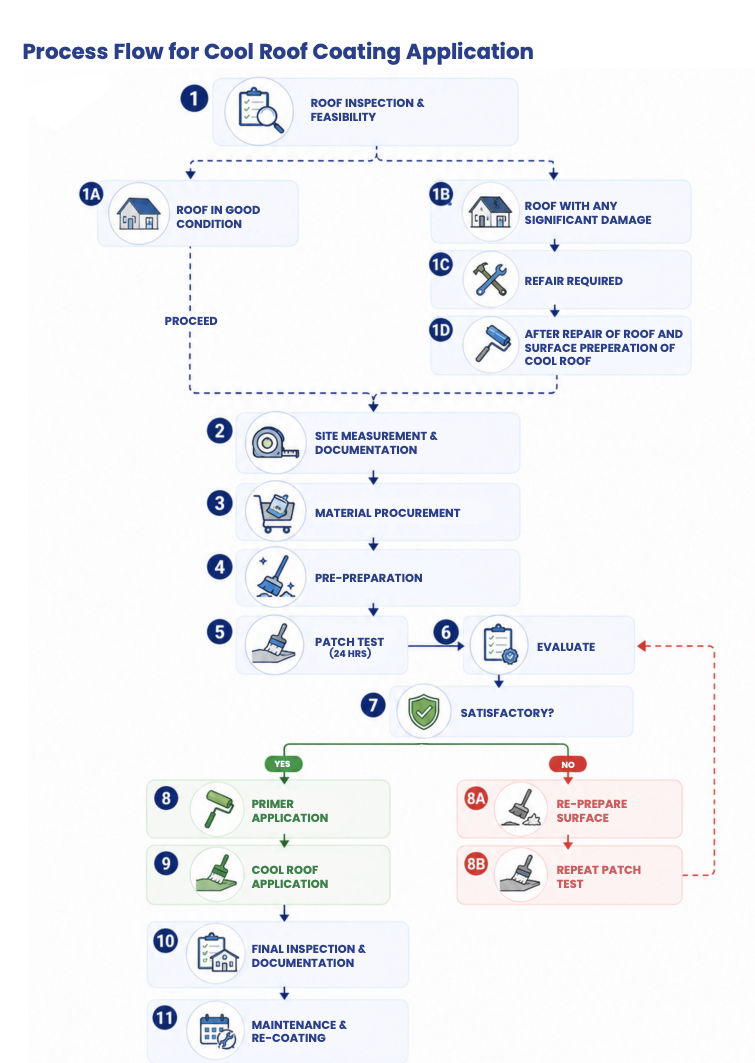
Paint with a solar reflective index of over 95 is recommended. These paints require no electricity or complex installation.
However, maintenance and cool roof check-ups are key to assessing dust buildup, algae, fungal growth, cracks, and coating deterioration, the SOP points out. During monsoon and rains, proper drainage must be ensured with outlets cleared to prevent water stagnation. A full re-coating, based on product life and exposure conditions, is typically done every five to seven years to restore optimal thermal performance, it adds.
When Citizen Matters visited the school, teachers reported that the roof across the school was cleaned weekly.
Beyond just a cool roof
While maths teacher Usha reported visible change during her classes, a few students said that they did not feel as much of a difference. Meanwhile, the temperatures are increasing, with the average number of annual heatwave days rising in cities like Chennai. The cool paint initiative should not be treated as a silver bullet, and passive cooling should be treated as the first step in reducing energy costs and shaping the design, say experts.
“This initiative requires a lot of maintenance and a significant amount of water, and another issue is that one roof’s reflection is another roof’s or building’s glare,” says Vivek Gilani, environmental engineer and founder of cBalance. “It may be fine for community buildings, but when this idea is applied indiscriminately to places like informal settlements, which have a heterogeneous building typology, problems emerge,” he highlights, also flagging the possibility of chemicals and the need to study the cool paint’s long-term effects.
Other initiatives such as rooftop edible gardens (REGs) could provide a nature-based, community-driven solution to urban heat stress, while lowering indoor temperatures by 1-2°C, roof surface temperatures by 8 -12°C, and ceiling temperatures by 2 -4°C during peak heat periods, find reports.
Read more: As cities heat up, traditional South Indian homes offer a blueprint to cool down
Instead of focusing on cool roof initiatives, principles from traditional architecture can be implemented, and glass and concrete for residential and government buildings, says G Sundarrajan of Poovulagin Nanbargal. Based on Chennai’s humid and hot weather, materials such as Madras terrace roofing and mud or clay can be utilised. In existing buildings, methods such as terracotta filler slabs for thermal insulation can be opted for.
Experts recommend:
- Implement passive cooling strategies.
- Tweak cool roof solutions based on location, building, and context.
- Implement principles from sustainable architecture such as materials like lime flooring.
“With El Niño and climate change across the world, days are getting hotter, and it is important we think of effective solutions,” signs off social science teacher Meena.