In the informal settlement of Seemapuri in Delhi, Rihanna sees her mother leave for work early every morning, come back around noon to make and serve food for the family, and then go back to work till 4 pm. “My mother is a waste segregator,” explains Rihanna, and this is her daily routine, come rain, hail or the gruelling sun of a Delhi summer. Many women in Seemapuri are engaged in waste work and have a similar routine.
Settlements such as Seemapuri often lack essentials such as water, electricity, and proper sewerage systems. Inside homes, the kitchen is typically the hottest part with minimal or zero ventilation. Some women say they try to cook early in the morning to avoid the unbearable afternoon heat, but some do not have any option but to cook during the hottest part of the day, as Rihanna’s mother does.
While the word ‘home’ often evokes a sense of comfort for many people, it is not necessarily a place of comfort for many Indian women. Consider a woman cooking in the kitchen three times a day during a scorching heat wave – can we truly call that comfort? Women face some of the highest exposure to heat stress in domestic spaces, such as kitchens and are deeply impacted by it. Many of them live in informal settlements such as bastis, chawls, or resettlement colonies, where the cycle of unpaid and often invisible domestic labour continues without recognition.
According to some media reports, Delhi has around 750 big and small slums housing approximately 3.5 lakh families and nearly 20 lakh people. Most homes in such settlements have congested rooms, with no ventilation and are constructed with tin sheets that absorb and trap heat, making indoor spaces extremely hot and humid. Combined with the lack of clean water and sanitation, this intensifies the impact of climate events such as prolonged heat waves. Women, in particular, shoulder the worst of this crisis as caregivers, workers, and homemakers who are not just exposed to the outdoor heat, but also to indoor heat while cooking and managing households.
Savitri, an elderly homemaker from Sunder Nagri, says, “Our kitchen is on the terrace, that’s why it is the hottest”. In most homes in Sunder Nagri, the kitchen is either a nook in the room itself or on the terrace. At least 4-5 people stay in one single room here. Where the kitchen is a part of the room itself, the entire space heats up as food gets cooked. To make matters worse, women have to turn off the fan too while making food, as the flames of the stove are disturbed otherwise. This makes the already unbearable heat even more suffocating.
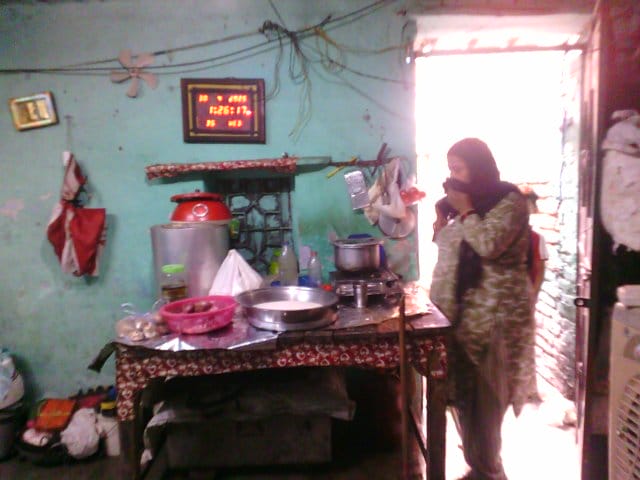
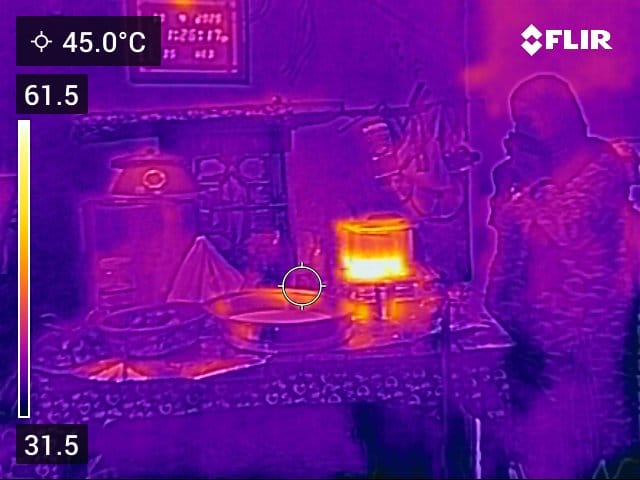
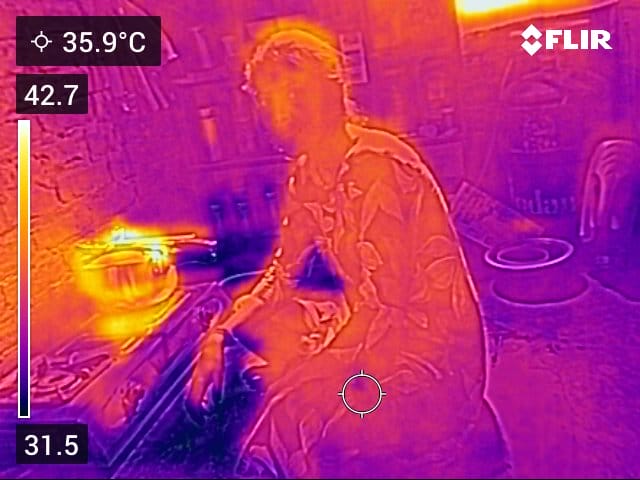
Photos that we clicked as part of a series called “Women in the Kitchen” aimed to document the harsh temperatures faced by women while cooking in these poorly ventilated spaces. It also highlighted the multiple sources of heat exposure they face: from the burning stoves inside their homes to the relentless rise in outdoor temperatures. Photos taken by a thermal camera show an average surface temperature range of 29°C to 36°C.
Read more: Shelters for the homeless in Bengaluru expose residents to climate risks
Health impact
For women who spend most of their time in cramped, ill-ventilated homes, and within those, often cooking in kitchens, the heat brings on moderate to severe health issues.
Extreme heat can lead to hormonal imbalances in women, causing irregular menstrual cycles and ovulation. It has a distinct impact on women, especially as their ability to thermoregulate is compromised during pregnancy and menopause, potentially reducing their capacity to adapt physiologically to a warming climate.
In an article (2023) published by Hindustan Times, experts explain that heat impacts can have a range of negative effects on women’s bodies, especially on their reproductive health. Due to prolonged heat waves, women not only feel fatigue, dehydration, and skin infections, but also menstrual irregularities, reduced fertility and complications in their pregnancy. A 2024 research paper examining how Indian cities are adapting to extreme heat finds that at current warming levels, 2 out of 1000 children die as infants in India, because of exposure of mothers to extreme heat during pregnancy.
Women we spoke to in Delhi’s settlements share many problems. “It gets extremely hot in the afternoons. I have to bathe three times a day, or else I get rashes on my skin,” says Jyoti, a resident of Madanpur Khadar. Mohini, a third-year college student and a resident of Bhajan Pura, has been experiencing frequent bouts of diarrhoea and itching. “Last week, I also had a fever and felt nauseous. I am not sure what is causing these symptoms, but I think it might be related to the heat,” she tells us.
Gender, caste, class: A triple whammy
As one studies the impact of heat on various vulnerable populations, it becomes increasingly clear that women bear a disproportionate share of the impact of heat as our summers become longer and more intense. Social norms have almost invariably pushed women to prepare food for their families, which forces them to stay in the kitchen regardless of weather conditions. For those working outside, they return from the scorching sun outdoors only to carry out their duties in overheated kitchens, with little respite.
An analysis published in Significance Magazine, a journal by the Royal Statistical Society, reveals a worrying increase in heat-related deaths among women in India since 2005. The increase in heat-related calamities underscores a broader pattern: the intersection of climate change and gender inequality.
We also see that these realities are most pronounced for women from the marginalised castes and low-income communities, due to their position in society. For many of them, this has been the reality for generations. They have been historically denied access to proper living conditions and essential resources, pushing them deeper into a vicious cycle of poverty, inequality, health risks and social and economic exclusion. This systematic deprivation, coupled with climate change and extreme weather impacts, has only made their mental and physical suffering worse.
Read more: Heat stories: The daily grind of outdoor workers under the scorching sun
The way forward
Addressing this crisis requires tackling its root causes, rather than relying on short-term relief-oriented approaches. Government institutions have yet to take steps to understand the full scope of the problem, as there is a pressing need for comprehensive heat mapping across sectors, regardless of settlement, occupation or gender. Heat has still not been classified as a National disaster.
While many states have developed Heat Action Plans, and Delhi has recently released its own, these plans often fail to address how heat impact intersects with living conditions, livelihood, caste, class, gender or literacy. In particular, they overlook that the indoors are also extremely heat-exposed, especially for those who spend long hours working in extremely hot kitchens.
Recognition of heatwave as a national disaster will create room for dedicated funding, which is essential not only to identify context-specific challenges but also to enable emergency response, preparedness, and long-term resilience strategies for the vulnerable and sensitive. Overcoming these challenges calls for targeted interventions. Otherwise, rising temperatures will continue to exacerbate existing health risks for women, pushing them further into the margins.
Nicely expressed the most ignored area of society! Kudos to Vaishali 👏