For nearly three decades, the world has gathered to talk about climate change at the annual Conference of the Parties (CoP). These efforts are well-meaning — they set shared goals, put climate on the world’s agenda, and create space for countries to work together. But turning these good intentions into actual progress? That’s where things get tricky.
Emissions keep rising, and the 1.5°C target is slipping further from reach. The challenge isn’t knowing what needs to be done — it’s understanding why it isn’t happening, how to make action easier, and how to hold leaders accountable for the commitments they’ve made. We need to explore what shifts — in priorities, systems, and mindsets — could turn shared goals into real progress. That’s where new storytellers can play a role: making these complex dynamics visible and sparking the conversations that help move us from intention to action.
At its heart, climate action isn’t just about the fine print of treaties; it’s about how people — across borders, cultures, and interests — find common ground. So how do we align short-term interests with the planet’s long-term needs? And what kinds of tools could spark the trust, accountability, cooperation, and imagination we need for long-term sustainability?
We believe that the Climate Challenge, a board game designed by the Dutch collective Perspectivity, offers some interesting possibilities. Over the last three years, we at Project Living Cities* have been using Climate Challenge to spark the kinds of conversations that international summits too often rush past. Project Living Cities has been taking this game to civil society gatherings, university classrooms and youth climate groups in Chennai and Bengaluru to introduce concepts around climate change, but also give participants a taste of the social life of problems like climate negotiations.
Read more: Inside the Assembly: How much do Tamil Nadu’s policymakers know about climate change?
Serious gaming – How does it work?
Serious games harness the immersive factor in play to make abstract systems tangible and visible. Several institutions across the world are recognising the potential of games to teach systems thinking, values and collaborative decision-making. In India, several groups like Fields of View and Swacardz have been successfully using games to engage with policies and civic issues.
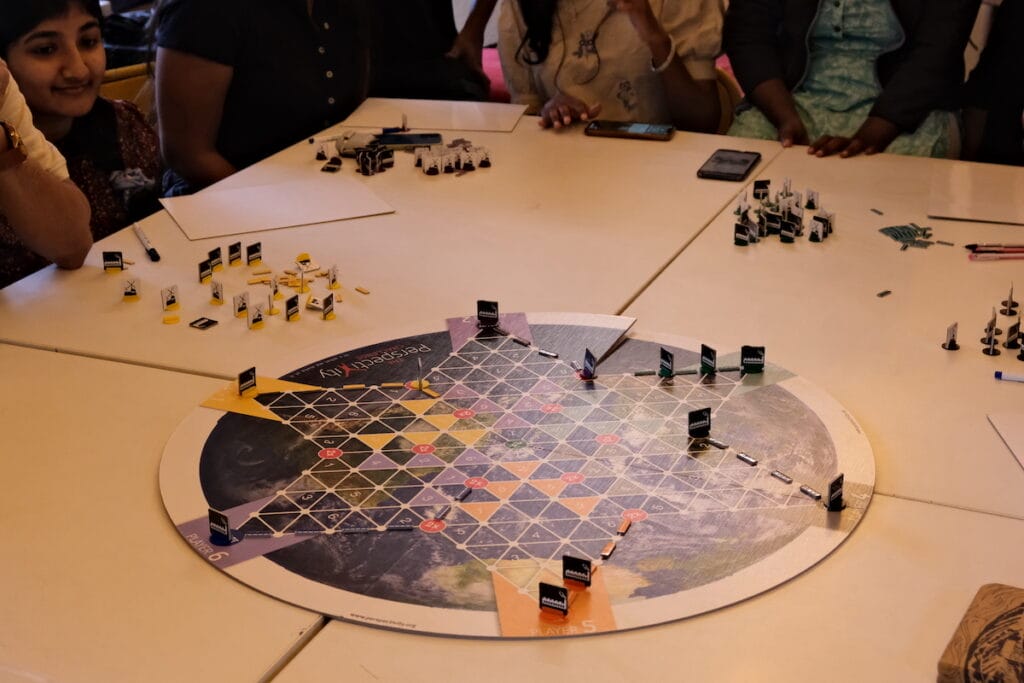
Climate Challenge allows participants from diverse backgrounds and age groups to engage with the issue of climate change and think critically about negotiation strategies prevalent on the global stage. The simple design and easily learnable rules of the game, however, make it easy for everyone to participate without making them feel intimidated about the subject.
Inside the game
In the game, players become heads of six fictional regions racing to build prosperous economies, much like Monopoly and other popular real estate games. But there is a catch: throughout the game, if the planet overshoots an emissions threshold, determined by the number of polluting entities, climatic events wipe out assets indiscriminately. Nobody knows exactly when it will hit, but the risk rises as emissions accumulate, an elegant way to represent tipping points or climate thresholds that Intergovernmental Panel on Climate Change (IPCC) reports warn us about.
Each round follows a three-step rhythm:
1. Decision time – Groups discuss strategies for expansion and build factories and roads in strategic points on the board
2. Central time – Teams negotiate their way through conflict and crises. Facilitators reveal how everyone’s choices interact on a shared carbon tracker.
3. Negotiation time (every third round) – Players gather to discuss crises and conflicts and come up with pacts and agreements for mutually beneficial outcomes.
Read more: MCAP: Initiated in 2022, how effective is plan to mitigate climate change in Mumbai?
What three years of facilitation taught us
In our time as facilitators of Climate Challenge, we have seen some strong patterns that are a stark reminder of why we need to rethink how the world engages in climate negotiations. We discuss some observations and examples from past iterations of the game:
Early boom, late bust
Teams often pursue aggressive growth in the first half, betting they can clean up later. But this results in a steep emission rise, and the board experiences at least one catastrophic meltdown that wipes out investments. In rather a cruel fate of irony, those who invest in clean-tech upgrades are subject to losses, forcing players towards a zero-sum approach later in the game. We have observed this pattern play out several times during our sessions in Chennai and Bengaluru.
The growth-first, sustainability-later approach is reflected in the way most countries have responded to the call for releasing Nationally Determined Contributions outlined in the Paris Agreement. Most heavy polluters tend to postpone deep cuts until after 2030, gambling on future negative-emission technologies. The rising climate impacts, meanwhile, are most disastrous for the least-polluting (often poorest) countries of the world.
Accountability needs scaffolding
Players often find that commitments made during negotiation time fall through in the face of growing economic interests. Teams are often bewildered when other teams pull out of agreements or engage in behaviour contrary to shared goals. In response, the entire board starts engaging in defensive, zero-sum play that results in diminished outcomes for everyone. In our latest session held in Chennai a few weeks ago, we witnessed a rapid breakdown in cooperation when one team decided to pull out of an agreement that they had previously agreed to. Interestingly, all the teams were largely collaborative and non-confrontational until that point.
Such cases are reminiscent of how global powers, especially developed countries, evade responsibility in climate negotiations. A prescient example is the failure of wealthy nations to deliver the promised US $100 billion in climate finance, which, in turn, has bred cynicism among countries in the Global South. This aspect reveals an important facet of global as well as national climate commitments: accountability needs to be built into commitment frameworks for them to have a lasting impact.
Collaborations and coalitions are key
Boards that recognise inequalities early and create an explicit burden-sharing formula usually finish with both higher profits and lower emissions. Teams and players that make efforts to build coalitions are also more resilient in the face of climate shocks, whereas boards where players are inward-looking tend to have more inequality and frequent climate shocks.
During one session in Bengaluru with participants from diverse backgrounds, teams decided to create a fund for compensating losses due to climate events, much like the Loss and Damage funds that were recently announced in the 27th Conference of the Parties by the United Nations Framework Convention on Climate Change (UNFCCC).
In another almost inspiring case, players suggested pooling all resources and distributing benefits equally among players. However, players ultimately decided not to go forward with it for various reasons. What was most evident in the conversation, however, was the powerful pull of cognitive biases. We noted people exhibiting status quo bias which is the tendency to keep things the way they are and loss aversion bias where people prefer avoiding losses over acquiring equivalent gains. These mental blind spots prevented people from making bold and proactive changes to their world.
To recap, these are some of our most important takeaways from facilitating the Climate Challenge:
- Equity is pragmatic, not charitable. Growth-first strategies ultimately backfire, while early sharing of technology and finance enlarges the collective pie.
- Vision beats fear. Tables that articulate a positive end-state (low inequality and low disaster risk) collaborate sooner and more deeply.
- Accountability needs scaffolding. Informal trust evaporates under pressure; transparency, third-party verification and punitive measures may be required.
So, can a board game fix the climate crisis?
Of course not. But what Climate Challenge can do is get you face-to-face with the social life of complex problems, such as climate negotiations. The game is a good reminder that when things come to an end, we are less concerned with who won than what kept us from winning together. If we can adopt this message, a sustainable and equitable future may still be within reach.
[*Project Living Cities is a collective helping shape conversations around the future of cities in India.]