Bengaluru boasts one of the world’s largest networks of decentralised sewage treatment plants (STPs). Yet, certificates of compliance are routinely issued without continuous monitoring, and much of the water treated on-site is never reused. In Part 1 of this series, we explored case studies of how three different apartment complexes navigate these issues.
Missing pipelines, no buyers, and low trust in recycled water: the reasons why treated water has nowhere to go are numerous. In this second part, we examine these hurdles and what it will take to convert wastewater into a vital resource.
Apartment residents often blame builder or operator failure as major reasons for poor functioning of STPs. However, Cheshta Rajora, Research Manager at WELL Labs lays out the other side of the problem — a systemic and structural gap. Apartments were made responsible for treatment without being given the technical means to do it well.
“These have been compliance-driven systems, and citizens also faced a lot of issues because they did not have the technical know-how of how to select proper design, right technologies, and efficient Operations and Management practices for the on-site systems. As a result, the output they were generating probably was not treated as per the fit-for-purpose standards,” she says.
A policy shift
A related policy shift came only recently. Until 2024, apartments were effectively required to reuse all treated water within their own premises — an expectation Cheshta said doesn’t hold up once volumes exceed non-potable demand on site. “The apartments, realistically, could not reuse 100 per cent of the treated water onsite because the output generated is fit for limited non-potable uses such as toilet flushing and landscaping,” she adds.
The 2024 policy change allows apartments to use 50 percent of treated water on site and release the remaining 50 percent outside the fence, for use elsewhere depending on the quality generated.
Where the excess water could go and why it mostly doesn’t
Water-intensive industries like data centres, and even construction, could make use of treated water. But Madhusudhan D, a researcher at Srishti Manipal Institute of Art, Design and Technology, points out that the city faces a major infrastructure gap: “For a fixed market, there needs to be a fixed infrastructure, fixed pipelines etc., so that the supply can go smoothly.” With expertise spanning engineering, psychology, behavioural science and sustainability studies, his research focuses on behavioural and decision-making patterns in the city’s water management.
He argues that the government could facilitate a system connecting apartments with surplus treated wastewater to nearby users through fixed pipelines — rather than requiring individual apartments to bear the entire infrastructure cost. He suggests a public-private cost-sharing model, with BWSSB developing a framework for local treated-water supply as a potential solution. This, he says, would shift wastewater treatment from a compliance requirement to a functioning part of Bengaluru’s urban water system.
A BWSSB official who requested anonymity, notes that apartments are already meeting Central Pollution Control Board (CPCB) requirements. But, reaching industrial-standard quality would require upgrading STPs with an additional ₹10 to ₹20 lakhs in capital costs, followed by operational expenses. Apartments are not yet ready for this, though he agrees that incentives and public-private partnership models should be explored.
Also, cooling towers in data centres require a higher quality of water than what most apartment STPs produce, the official explains. “This (building a supply infrastructure) depends on the end users and end end user acceptance. Proper SOP and the guideline need to be formed”. The SOP should define the water quality requirements of different industries, he said.
Missing ‘last-mile’
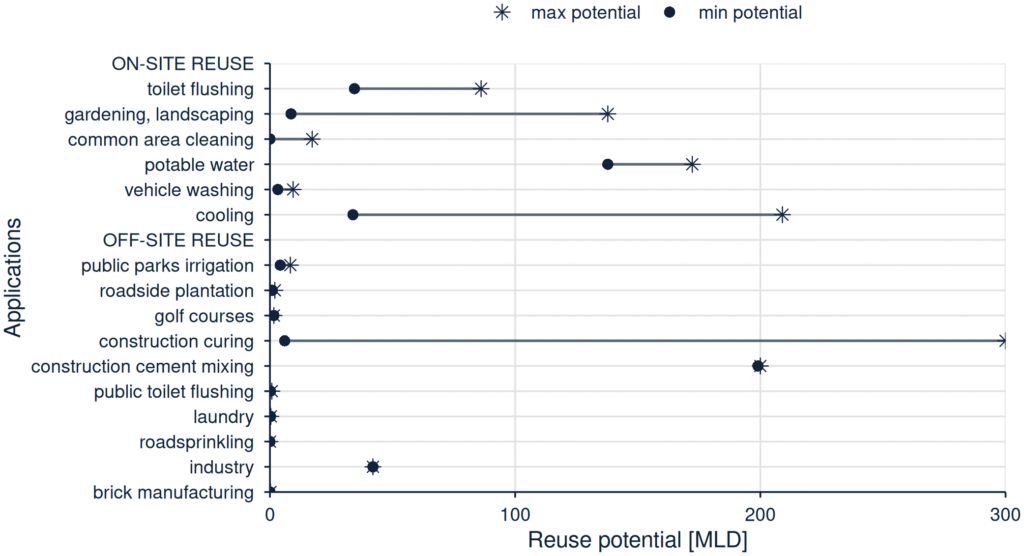
Cheshta’s account, from WELL Labs’ own research, matches this diagnosis closely. “Our current study shows that the sources of treated water and the potential sinks where it could be reused are in close proximity across the city but there is currently no clear mechanism to match them with each other,” she says. Sinks are end-uses like in industrial activities, cooling towers, construction, dust suppression and potentially even lake rejuvenation.
What’s missing, she adds, is “the last mile”: dedicated pipelines and micro-grids, regulated tanker fleets, an online platform to discover supply and demand, without which surplus treated water has no infrastructure to be transferred to an end user, no matter how spatially proximal they may be.
The demand side of this gap is growing. Bengaluru’s current wastewater volume is around 2,580 MLD. Cheshta’s estimate is that treated water could realistically meet 20–30 percent of the city’s demand in the next 10 years — “if we start treating it as a resource recovered rather than just waste.”
A coalition for better reuse
To try and close that loop, WELL Labs has been convening a water reuse coalition with various set of stakeholders, civil society organisations, STP vendors, builder groups, industry associations, research institutions and government entities. At a workshop held in January this year, attended by BWSSB officials among others, the group outlined a city-wide reuse plan built around three task forces: one on capacity-building and community acceptance (covering STP operator training, a decision-support tool for RWAs, and a compendium of best practices); one on technology (setting water-quality monitoring and treatment-reuse standards); and one on governance and finance (covering standards, policies and incentives for reuse).
This coalition aims to solve existing barriers in scaling reuse in the city.
T-Zed homes is an apartment that treats sewage to tertiary level and reuses it for domestic purposes, achieving close to 100 percent reuse within the complex itself. Cheshta says this could scale, but with a caveat: “It only works for really high numbers of apartments in a building,”
The economics depend on volume. She adds that this kind of on-site reuse is likely to matter most in peri-urban areas, where piped supply from BWSSB reaches new apartments quite late. They are relying solely on groundwater, which is already a very exploited source. “Whenever high-rise buildings come up, our research shows they’re going to come up more in peri-urban areas, where the central sewer network might get delayed.”
Read more: For home-buyers in Bengaluru, a checklist to assess water security
Behaviour is as much a barrier as infrastructure
Apartments should also ensure better usage of treated water, Madhusudhan says. On car washing, for instance: “When you give an option [between treated water and fresh water], they automatically choose fresh water. Apartments should replace all the taps where they have this cleaning of cars, where you don’t get anything but treated water there.”
This resistance isn’t necessarily just ignorance. If treated water smells bad or looks different, residents are unlikely to trust or use it, regardless of what regulations say, a point Cheshta reiterates. Low trust in recycled water persists even when it may meet compliance standards. Experts point to the same fix: visible, real-time water-quality monitoring, ideally through public dashboards and third-party verification, so that trust shifts. Madhusudhan frames this as an institutional responsibility: “If the government tells people that this treated water is safe, they also need to support that statement with reports. I feel like at the base of everything is institutional trust.”
Read more: CPCB norms ignored: Community voices rise against STP near Chennai’s Madambakkam Lake
Treated water as infrastructure, not waste
Madhusudhan argues Bengaluru cannot manage its water sources in silos. BWSSB, he says, should move from simply supplying more freshwater to managing Cauvery water, groundwater, rainwater, lakes, tanks and treated wastewater as one interconnected system: “BWSSB needs to completely re-haul its motive of water supply to Bangalore… towards a more sustainable urban infrastructure. Look at how Bangalore can utilise its lakes, tanks, rainwater and treated water together at one.” Treated wastewater, he argues, should not be considered merely a by-product apartments need to dispose of — it should become part of the city’s overall water-supply strategy, alongside groundwater and Cauvery water.
He also questions whether a one-time compliance certificate means much in practice: “If there’s a compliance certificate based on a paper, is it really worth it? Does it really manifest into reality?” Continuous monitoring, he insists, is essential: “Wastewater treatment is not one-time approval. It’s a continuous process, and it should have a regulatory check periodically” — a check that could ensure STPs function at full capacity and that water is used efficiently, rather than a formality signed off once at commissioning.
A Jakkur resident who did not want to be named, believes residents would comply more willingly with treated-water rules if they could monetise the output properly: “It definitely makes sense to enable a marketplace for selling treated water with all the right regulations in place.” They said that if staggered pricing were fixed for treated water of different quality grades, residents might even be willing to spend more to improve STP quality, in order to monetise it better. The BWSSB official said that the decision should be made at a policy level and that the builders won’t invest in such costly things unless there is a policy. “This is a policy decision that the government will make,” he says.
The way forward
- Government agencies must build a marketplace for treated water to seamlessly connect apartments and industries. This can include a searchable digital platform listing STP capacity, water quality and pricing, of the kind WELL Labs is developing.
- Build infrastructure — pipelines or tanker facilities — for moving treated water the “last-mile” between apartments and end-users such as parks, construction sites and industry.
- Issuance of compliance certificates should follow strict and continuous monitoring and direct audits, rather than a one-time sign-off at commissioning.
- Continuous monitoring of treated water quality should be ensured, ideally through public, real-time dashboards, to build the trust needed for wider reuse.
- Awareness and trust-building should be prioritised to ensure better usage of treated water within apartments
- Excess STP water should also be monitored to prevent it from entering stormwater drains and lakes unchecked, given its effect on flood retention capacity.
- Treated water should be integrated into the city’s water planning alongside Cauvery water and groundwater, rather than treated as waste.