In a 400-unit apartment complex in Jakkur, about one-third of treated water is being dumped into a nearby stormwater drain. While National Building Code (NBC) guidelines mandate that a building must have a Sewage Treatment Plant (STP) with a capacity of 210 to 290 Kilolitres per day (KLD), this apartment actually has an STP with around 300 KLD capacity. A resident of the complex, who requested anonymity, said that despite conducting audits, regularly monitoring water quality, and installing aerators, the apartment still struggles to reuse 100 per cent of its treated water.
This is not an isolated case. In a city that has faced severe water shortage in recent years, treated water can be an important resource for non-potable use. Apartments in Bengaluru operate under a ‘Zero Liquid Discharge’ (ZLD) norm — buildings with more than 120 units, or generating more than 80 kilolitres per day (KLD) of sewage, must treat and reuse it on site. As a result, Bengaluru has the world’s highest number of decentralised STPs. However, many residential complexes face major hurdles following the rules, so treated water is literally going down the drain.
This is Part 1 of a two-part series. In Part 2 we explore why Bengaluru struggles to reuse the treated wastewater generated by apartment STPs, and what infrastructure, policy and market mechanisms could help put that water to use.
Treated but not reused
This scale of shortfall is larger than individual complaints suggest and the mandate itself dates back to a pollution crisis a decade ago. Cheshta Rajora, Research Manager at WELL Labs, explained, “Around 2015, there was rampant lake pollution in the city, and Bellandur and Varthur lakes were repeatedly frothing and catching fire. This was all over the national news.” That drew widespread attention, and the Central Pollution Control Board directed State and local agencies to act. “As a result of that trickle-down effect, the ZLD mandate came from the Department of Forest, Ecology and Environment and the Bangalore Water Supply and Sewerage Board (BWSSB) in 2016.”
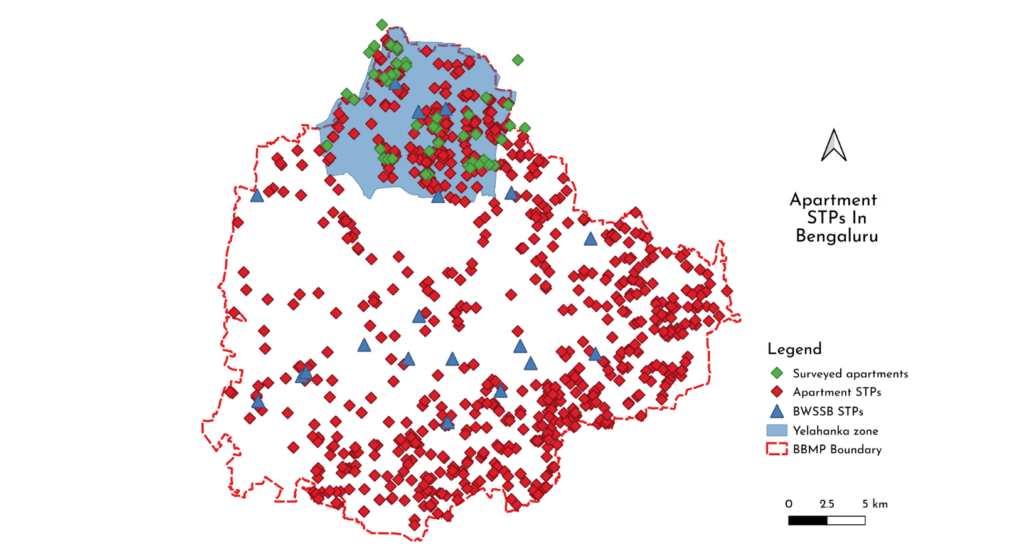
Today, WELL Labs estimates there are at least 4,000 registered apartment STPs in the city, of which around 2,500 are operational. Apart from this, the city has a total of 34 centralised STPs with a total capacity of 1,348 MLD. Of the ~2,250 million litres of wastewater generated daily in the city, 77% is treated, but only 14 per cent is reused. The rest flows into stormwater drains, mixes with untreated runoff water, and worse, ends up in lakes.
Compliance certificate, but not compliant operation
It’s no different in a 750-unit apartment in Yelahanka. The problems involving the STP began when residents moved in in 2018. The project had already been delayed by about two and a half years, and only two of the five blocks had received occupancy certificates. A resident, who did not want to be identified, alleged that the STP was already malfunctioning — foul smells, discoloured water and illegal discharge of untreated sewage were common.
Testing recorded coliform bacteria, BOD and COD levels above permissible limits, and pollution control authorities reportedly found the STP inadequate for the number of residents.
The apartment occupants complained repeatedly to the Karnataka State Pollution Control Board (KSPCB) and later to the Central Pollution Control Board. According to the resident, the builder eventually rectified the STP after sustained pressure. The residents also pushed board authorities to act, resulting in environmental compensation being imposed on the builder — a demand the builder has since challenged in the Karnataka High Court, where the matter remains pending.
The resident raised concerns that the builder allegedly operated the STP without obtaining the Consent for Operation (CFO), which is the mandatory clearance required to run it. This seems more like a regulatory failure rather than just a lapse on the builder’s part.
Once rectified, the STP’s functioning improved to about 80–85 per cent effectiveness since 2022. However, residents still question its 550 KLD capacity. Treated water is now used for flushing, gardening and basement cleaning. But, what happens to the excess remains unresolved, as the apartment management does not maintain a logbook accessible to residents, to record how surplus water is handled. There had also been an earlier instance, around 2020–21, when wastewater from the premises was found being discharged into a stormwater drain.
Weak monitoring and implementation
So, do STPs in Bengaluru function primarily as a compliance mechanism rather than properly monitored wastewater management systems? Rules exist, but consent requirements and monitoring are not consistently enforced, and there is no effective tracking of what happens to excess treated water once it leaves the plant.
While implementation is non-existent, government agencies are quick to pass the buck. A BWSSB official said that the Pollution Control Board is the monitoring authority for STPs. “BWSSB now has 34 centralised STPs and there is no problem,” he said. “There are 3,500 private STPs in apartments, supposed to be monitored by the Pollution Control Board. But they have very limited manpower. These private STPs don’t have an online monitoring system. A real-time monitoring system requires a good investment — ₹5 to ₹6 lakhs. So these are the challenges.”
Read more: Challenges in Bengaluru’s sewage treatment plants: Awareness gaps and inaccurate technologies
When monitoring itself is the weak link
Dr Prema Mistry, a resident of an apartment in Budigere Cross, alleged that excessive tanker-water dependence, weak STP maintenance and inadequate regulatory monitoring have contributed to recurring problems with the project’s sewage treatment system.
Prema said the apartment relied heavily on tanker water after she moved in in 2016, despite groundwater being available. After a borewell scan in 2018 indicated groundwater was accessible, she began questioning the continued purchase of tanker water, and alleges that excessive water procurement may also have affected the STP’s functioning — she claims the builder was possibly earning a commission on tanker water, and that the excess tanker water being fed into the STP caused it to function poorly.
She alleged that inadequately treated wastewater was previously discharged outside the premises, and later diverted through a pipeline towards an industrial area. She has since raised complaints with multiple government agencies and called for mandatory online monitoring of STPs to track water consumption and treatment quality.
The apartment’s rainwater harvesting system remains underused. More recently, she observed foul-smelling treated water, and said the STP has been sent for another audit — raising further concerns about maintenance, operator changes and regulatory oversight.
The resident from the Jakkur apartment echoed this, insisting that continuous monitoring by the Pollution Control Board should be mandated: “The government has to mandate and do site inspections and audits.”
Read more: Bengaluru’s Saul Kere: From biodiversity haven to construction zone
What happens when treated water is simply let out
Even where apartments are complying and their STPs are functioning, about 50% treated water routinely ends up in stormwater drains and lakes. But according to Cheshta, this comes at a cost. “If you are treating the water and letting it out, it is basically getting mixed with untreated runoff that is already there in these stormwater channels — that is a lot of money going down the drain,” she said.
“Once it gets mixed with that untreated runoff and ends up in lakes, it also brings down the capacity of those natural systems to hold the runoff that comes during rains” — a concern with direct implications for flood retention in a city where lakes already absorb monsoon overflow. She added that, in principle, lakes could instead be turned into ecological assets for treated water if managed well — though how practical that is at city scale, she said, remains an open question.
While a huge quantity of treated water ends up in drains, many water-intensive industries located near apartment complexes could actually make use of this excess water. But due to policy and infrastructure gaps, Bengaluru is losing out on this opportunity. In Part 2 of this series we delve deeper into these systemic gaps.